
How eye color works
There is no blue or green pigment in a human eye. Every eye color comes from one brown pigment, melanin, and from the way the iris scatters light. This page explains where brown, blue, green, hazel and grey eyes come from, what heterochromia and the limbal ring are, why pupils come in different shapes, what makes red eye in flash photos, and how the Eye Editor finds the eyes in a photo and gives them a new color.
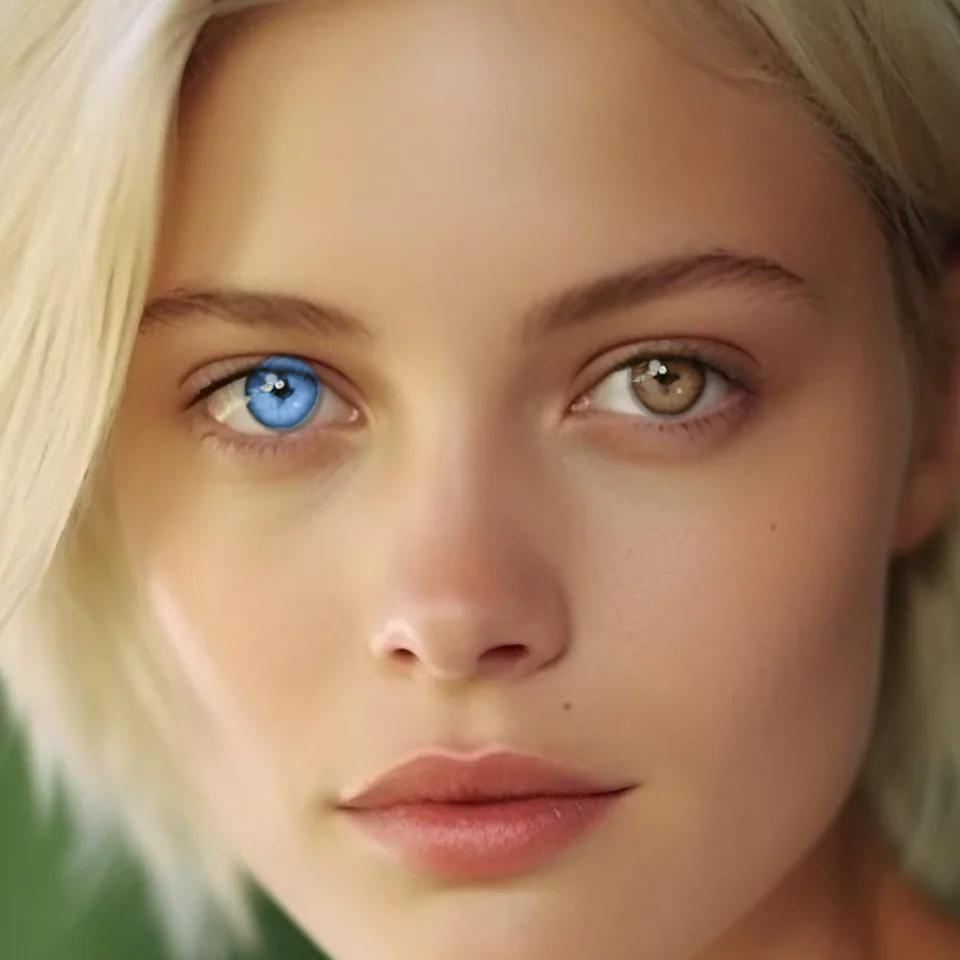
One pigment, many colors
The iris has two layers. At the back lies a thin sheet of cells that is dark brown in almost everyone, whatever the color of their eyes. In front of it lies the stroma, a loose web of fibres and cells, and the amount of melanin in the stroma decides the color you see. A lot of melanin absorbs most of the light that enters: the eye is brown, and with even more, almost black. Little melanin lets the light into the stroma, where it is scattered by the fibres and tiny particles. Short, blue wavelengths are scattered most, as in the sky, and the dark layer behind swallows the rest, so the eye looks blue. Blue eyes are therefore a structural color, like the blue of a jay's feathers, not a pigment.
Brown, blue, green, hazel and grey
Brown is by far the most common eye color in the world; blue is common mainly in northern Europe, and green is one of the rarest. Green eyes have a little melanin together with the blue scattering, and often a yellowish pigment as well: the yellow over the scattered blue looks green. Hazel eyes have more melanin, often unevenly spread, so they look brown in the middle and green or gold towards the rim, and seem to change with the light. Grey eyes have very little melanin but a denser stroma, which scatters all wavelengths more evenly, so the blue turns pale and grey. Eye color is inherited through several genes, not one, which is why two blue-eyed parents can occasionally have a child with green or brown eyes.
Heterochromia: two colors
Heterochromia means that the eyes, or parts of one eye, have different colors. In complete heterochromia one iris is a different color from the other; in sectoral heterochromia a slice of one iris differs; in central heterochromia a ring round the pupil has another color than the rest of the iris. In people it is rare and usually harmless, inherited or caused by a difference in how much melanin reached each eye before birth, though it can also follow an injury or an illness. It is far more common in animals: huskies and Australian shepherds often have one blue and one brown eye, and white cats one blue and one amber eye.
The limbal ring
Where the iris meets the white of the eye, many people have a darker ring, the limbal ring. It is most visible in young people and tends to fade with age, so a clear limbal ring reads as youth and health. In a study published in 2011, faces with a darker limbal ring were rated as more attractive than the same faces without it, which is one reason why some colored contact lenses add one. The Eye Editor's Limbal ring slider darkens the rim of the iris in the same way.
Pupils: round, slits and the rest
The pupil is the opening in the middle of the iris, and it is black because the light that goes in does not come back out. In people it is round and changes from about two millimetres in bright light to about eight in the dark. Other animals have other shapes. Cats, foxes and many snakes have vertical slits: a slit can close much further than a round pupil, and it suits animals that hunt close to the ground by night and day. Goats, sheep and horses have horizontal slits, which give a wide view of the horizon to watch for predators. Large pupils make a face look friendly and attentive, which is why cartoon and anime eyes draw them so big.
Red eye and catchlights
Red eye happens when a flash fires close to the lens in dim light: the pupils are wide open, the flash lights up the retina at the back of the eye, which is full of blood vessels, and the camera catches the red reflection. Many animals reflect green or yellow instead, from a mirror-like layer behind their retina that helps them see at night. A catchlight is the small reflection of a window or a lamp on the surface of the eye. Portrait photographers take care to have one, high on the iris, because eyes without a catchlight look dull; the Eye Editor's Sparkle slider adds one, and Fix red eyes turns red pupils dark again.
How the Eye Editor recolors an eye
To find the eyes, the Eye Editor looks for the face and for a pair of dark spots of the same size side by side in it, then fits a circle to each iris: the one with the strongest step from the darker iris to the lighter white on both sides, since the lids may cover it above and below. To recolor an iris it keeps the light of every pixel and changes only its color, so the strands, the darker rim and the lighter ring round the pupil stay; the pupil, which is too dark, and the catchlight and the white, which are too light, keep their own color. Larger eyes move the pixels near the middle outwards, smoothly less towards the skin, and new pupils take the iris from further in or out. Everything is drawn in your browser.
Frequently asked questions
Why are blue eyes blue if there is no blue pigment?
Because of scattered light. A blue iris has very little melanin in its front layer, so light enters it and is scattered by its fibres and tiny particles. Blue light is scattered more than red, and the dark layer at the back of the iris absorbs what is not scattered back, so the light that comes out looks blue, for the same reason the sky does.
Can eye color change over time?
Yes, in babies. Many babies, especially of European descent, are born with blue or grey eyes that turn green, hazel or brown in their first years, as melanin builds up in the iris. In adults the color is normally stable; a clear change in one or both eyes can be a sign of a medical condition and is worth showing to a doctor.
Are there people with violet or red eyes?
Not as a pigment. Eyes with very little melanin, as in some people with albinism, can look reddish or violet in some light, because the blood vessels behind the iris show through the scattered blue. Eyes described as violet are usually a very deep blue.
Does recoloring an eye in a photo look real?
It does when the new color follows the light of the iris. The Eye Editor keeps each pixel's brightness and changes its color, so the pattern of the iris, its rim, the pupil and the catchlight stay. A natural color at a strength below full, with a little Limbal ring and Sparkle, looks the most real; the looks such as Cat, Vampire or Ghost are meant to look like fantasy.
Related tools
Eye color changer
Change eye color in a photo online for free: blue, green, hazel, grey or any color, each eye its own, cat eyes, anime eyes, larger eyes and a glow. The eyes are found for you.
Morph one face into another
Morph one face into another in your browser. Two photos, matching points on the eyes, nose, mouth and chin, and a smooth morph you can play, stop halfway, record as a video or open as layers in the editor.
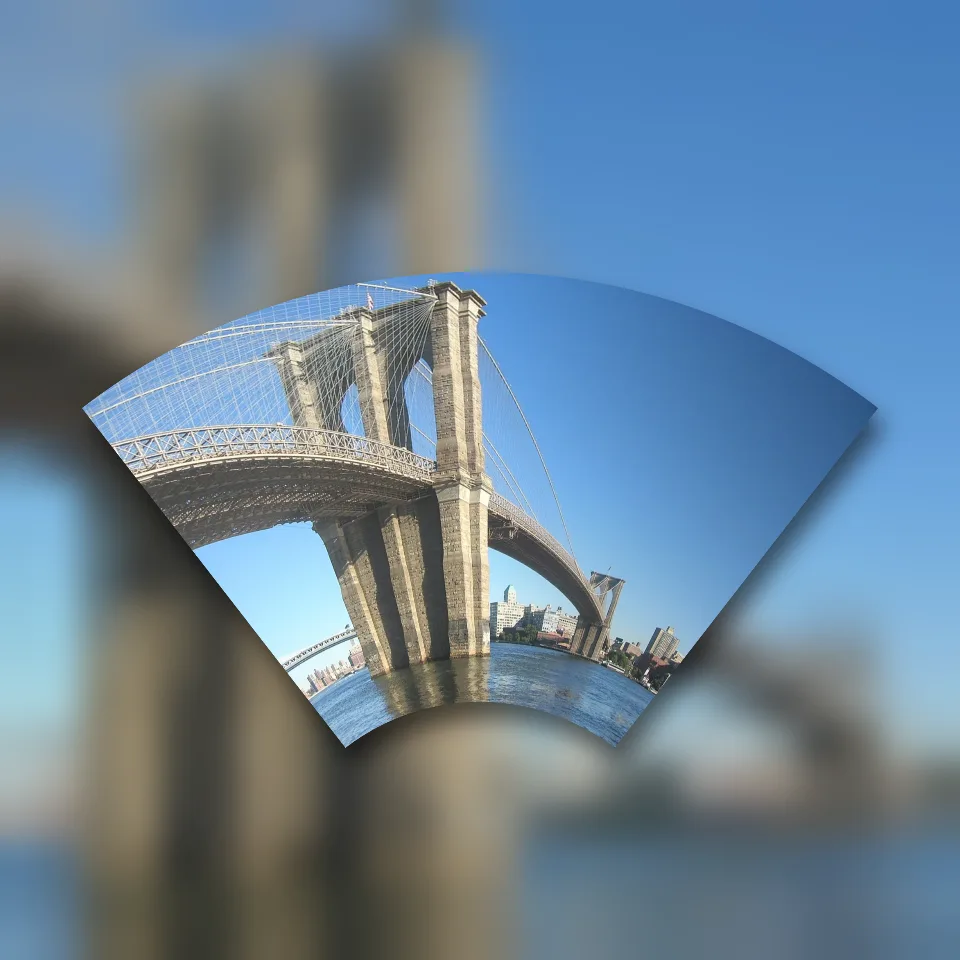
How bending a photo works
How an image is bent: a mesh of triangles, each stretched onto the bent shape. The maths of an arc, a wave, a cylinder and a page curl, how the light is added, and where image warping is used.
Ready to try it?
Open PictorX in your browser — no install, no credit card required to start.
Open the Eye Editor