
About Durak - rules, variants and strategy
Durak is the most popular card game in Russia and is played all over the countries of the former Soviet Union. Its name means "fool", and that is the point of the game: nobody wins, but the last player left holding cards is the durak. This page explains the rules, the two main variants, the customs around the game and how to play it well.
The game of the fool
Durak (дурак) is Russian for "fool". Unlike most card games, Durak has no single winner: every player tries to get rid of their cards, one after another they drop out safely, and the one player who cannot is the loser, the durak. The game is played in families, among friends, in courtyards and on long train journeys throughout Russia, Ukraine, Belarus and the other countries of the former Soviet Union, and it has travelled with Russian speakers around the world. By custom the durak often deals the next game.
The deck and the trump
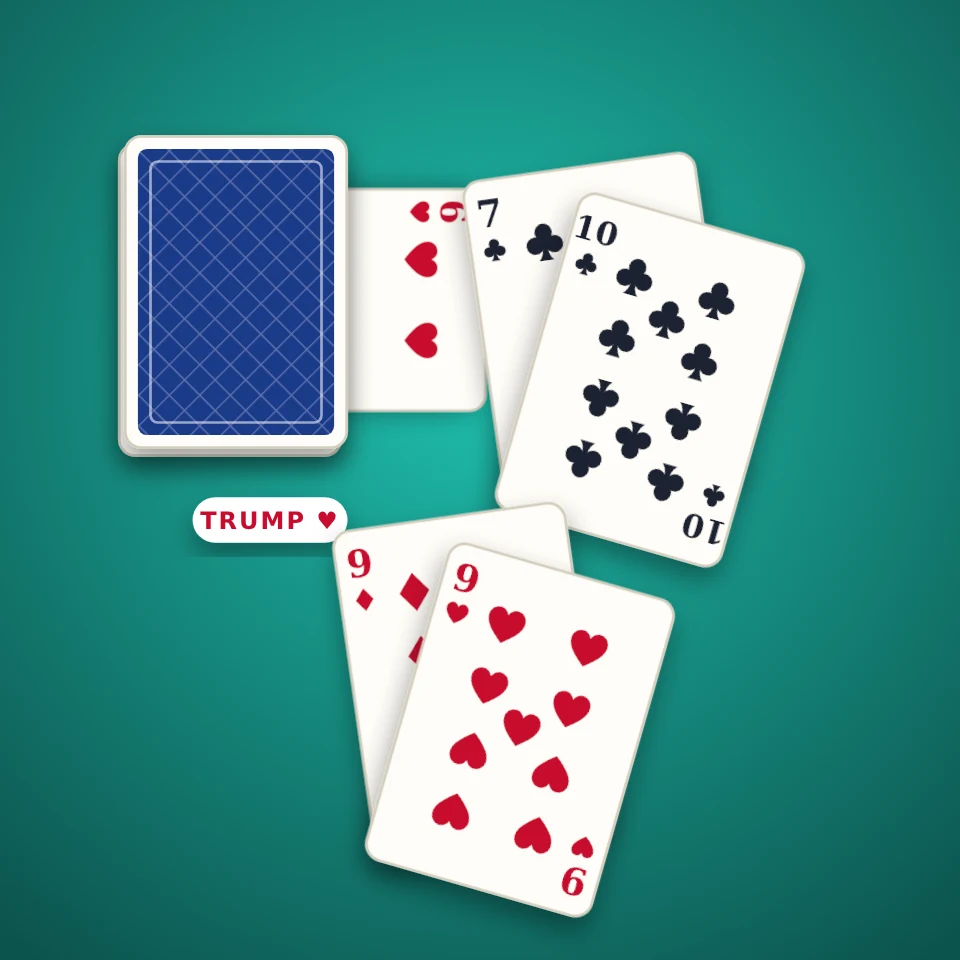
Durak uses a 36-card deck: the sixes, sevens, eights, nines, tens, jacks, queens, kings and aces of the four suits, with the ace high and the six low. It is usually played by two to six players. Each gets six cards; the next card is turned face up and placed crosswise under the rest of the deck, the stock. That card's suit is the trump suit for the whole game, and the card itself is the last one to be drawn. The player who holds the lowest trump makes the first attack.
Attacking and defending
The game is played in bouts between an attacker and the defender, the player on the attacker's left. The attacker lays a card face up. The defender must beat it with a higher card of the same suit, or with any trump if the attack card is not a trump; a trump can only be beaten by a higher trump. The beating card is laid across the attack card. The attacker, and in a game of three or more players the others as well, may then throw in more cards of any rank already on the table, and the defender has to beat each of them.
Taking the cards
A bout holds at most six attack cards, and never more than the defender has cards to answer with. If the defender beats everything and the attackers have nothing more to add, the cards on the table are put aside on the discard pile, and the defender becomes the next attacker. A defender who cannot, or does not want to, beat a card must take all the cards on the table into their hand. The attackers may still throw in matching cards before that, and the defender loses their turn to attack: the player after them attacks next.
Drawing back to six and the end of the game
After each bout, everyone with fewer than six cards draws from the stock until they have six again, the attacker first, then the other attackers, and the defender last. When the stock is used up, nobody draws any more, and players who play out their last card leave the game. The last player left with cards in hand is the durak. If the last two players run out of cards in the same bout, the game is usually counted as a draw.
Throw-in and transfer: the two main variants
Podkidnoy durak (подкидной, "throw-in") is the classic form described above, named after the throwing in of cards. Perevodnoy durak (переводной, "transfer") adds one move for the defender: as long as no card has been beaten, a defender who holds a card of the same rank as the attack can lay it beside the others and pass the whole attack on to the next player, who then has to defend against all of them. The attack can be passed on again in the same way, so a bout can travel around the table. The receiving player must hold enough cards to answer every attack card.
Other house rules
The rules vary from table to table, so it is worth agreeing on them before you start. In some groups the first bout of the game may have only five attack cards; in others only the defender's two neighbours may throw in, rather than everyone. Four or six players can play in teams of two, with partners sitting opposite each other. A well-known custom is the pogony, or "shoulder straps": a durak who loses while the last cards played against them are sixes has the sixes laid on their shoulders like a soldier's epaulettes.
Strategy
Trumps are your strongest cards, so save them: beat with the lowest card that does the job, and attack with low cards of plain suits. Holding several cards of one rank is useful in attack, because you can throw them in one after another. Early in the game, while the stock is full, taking a few low cards can be better than spending two trumps to beat them, since you will draw fresh cards anyway. Keep track of which trumps and aces have gone to the discard pile: towards the end, when the stock is empty, it pays to know which of your cards nobody can beat any more. And watch the number of cards your opponents hold, because throwing in when the defender is short of cards is the quickest way to make them take.
Frequently asked questions
Is there a winner in Durak?
Not in the usual sense. Everyone tries to get rid of their cards, and the players who manage it simply leave the game. The point is not to be the last one holding cards, the durak. In this game the computer keeps a count of how often you and the computer players were the durak.
Can a trump be beaten?
Yes, but only by a higher trump. A trump beats any card of the other three suits, whatever its rank, so the six of trumps beats a plain ace.
Can I throw in cards after the defender has decided to take?
Yes. In throw-in Durak the attackers may still add cards of ranks already on the table, as long as the total stays within six attack cards and within the number of cards the defender holds. The defender then takes them all.
What happens if nobody holds a trump at the start?
House rules differ: some groups deal again, others let the player with the highest card, or the player to the dealer's left, start. Here a player is chosen at random to make the first attack.
What is the difference between podkidnoy and perevodnoy Durak?
Podkidnoy (throw-in) Durak is the basic game, in which attackers throw in cards of matching ranks. Perevodnoy (transfer) Durak keeps all of that and lets the defender pass the attack on to the next player with a card of the same rank, before beating anything.
Related tools
Durak
Play Durak free in your browser against one, two or three computer players. Attack, beat cards with higher ones or trumps, throw in more of the same rank, and do not be the last one holding cards. Throw-in or transfer rules, Easy or Smart opponents.
About President - rules, ranks and strategy
How the climbing card game President is played: the ranks from 3 to 2, beating the pile with singles, pairs and triples, the titles and the card exchange, common variants, its relatives Daifugō, Tiến lên and Big Two, and how to play it well.
President
Play President free in your browser against two, three or four computer players. Beat the pile with higher singles, pairs or triples, pass when you cannot, and go out first to become President. Card exchange, standings over 5 or 10 hands.
About Crazy Eights - rules, variants and strategy
How Crazy Eights is played, how the eights and the stock work, how a round is scored, which variants are common, how it relates to Mau-Mau, Switch and Uno, and how to play it well.
Crazy Eights
Play Crazy Eights free in your browser against one, two or three computer players. Match the suit or rank, play an eight to call a new suit, and be first to empty your hand. Easy or Smart opponents, scored to 100 points.
Ready to try it?
Open PictorX in your browser — no install, no credit card required to start.
Play Durak