
The story of the countdown
Counting up is how we measure time, but counting down is how we wait for it. Ships once watched a ball fall from a tower to set their clocks, a film director invented the launch countdown for suspense, and millions now count the last ten seconds of the year together.
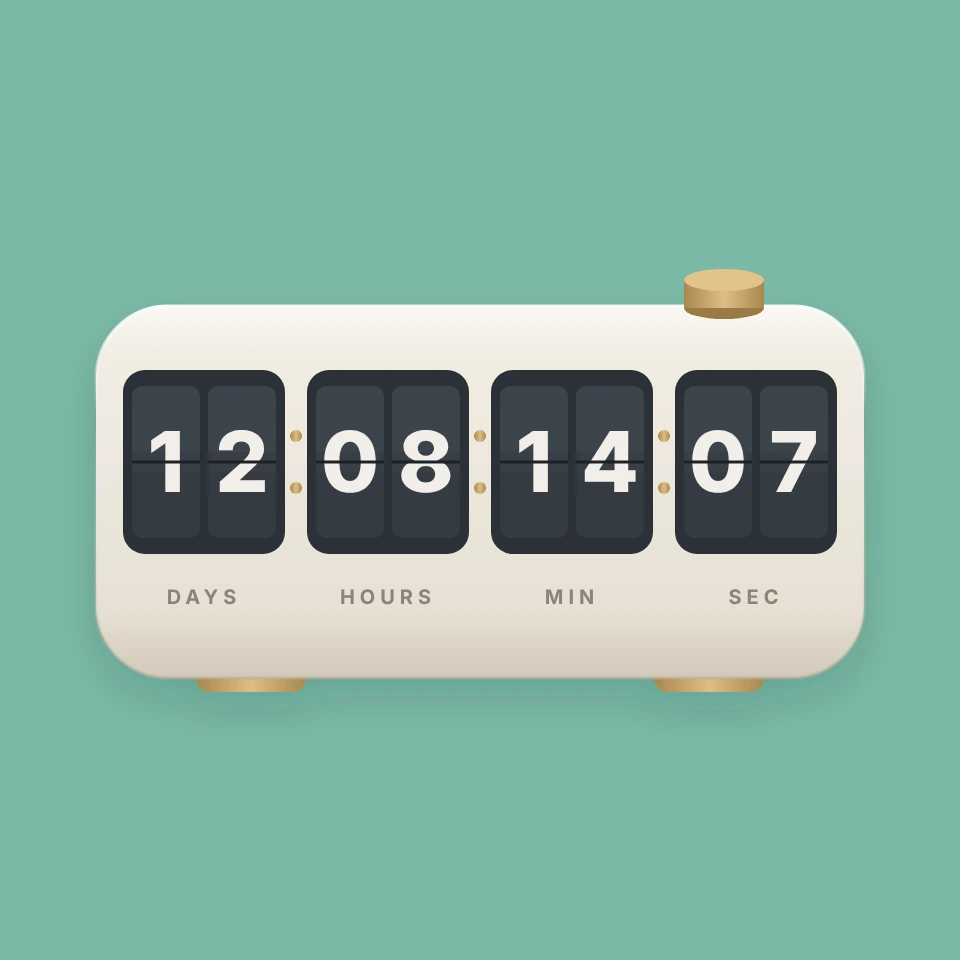
Time balls - the first public countdown
Long before digital clocks, sailors needed the exact time to work out their longitude at sea. From 1829 in Portsmouth and 1833 at the Royal Observatory in Greenwich, a large ball was raised up a mast and dropped at precisely 13:00. Ship crews in the harbour watched it climb and waited for the fall, which made the time ball one of the first public signals that turned a single moment into something many people waited for together.
Rocket launches and T-minus
The spoken ten, nine, eight before lift-off was not invented by engineers but by film director Fritz Lang. In his 1929 film Woman in the Moon he counted backwards to build suspense before a rocket launch, and real rocket teams adopted the idea. NASA turned it into T-minus time, where T is the moment of launch and planned holds pause the clock so that every check is finished before the final seconds.
The New Year's Eve ball drop
The time ball found a second life in New York. On the last night of 1907 a lit ball was lowered from the flagpole of One Times Square for the first time, and it reached the bottom exactly at midnight. Crowds began to count the final seconds out loud, radio and television carried the moment around the world, and today cities everywhere mark the New Year with their own drops, fireworks and giant countdown clocks.
Why counting down works
A countdown turns an abstract date into a visible distance. Watching the number shrink builds anticipation for a holiday or a wedding, gives a team a shared rhythm before a launch, and makes a deadline feel real enough to start on today. Showing progress from a start date adds a sense of how far you have already come, which is often just as motivating as how little time is left.
Frequently asked questions
Where does the countdown come from?
Public time signals such as the time balls of the 1830s let people watch for an exact moment. The spoken ten-to-zero count was popularised by the 1929 film Woman in the Moon and later by rocket launches and New Year celebrations.
What does T-minus mean?
T stands for the planned moment of launch. T-minus 10 minutes means ten minutes before that moment, and T-plus counts the time after it. Launch teams can hold the clock, so T-minus time can pause while real time keeps running.
Is the countdown correct for people in other time zones?
Yes. The target is stored as one exact moment in the time zone you chose, and every visitor's browser counts down to that same moment. A New Year preset in your own time zone, however, reaches zero at midnight where you are.
Related tools
Countdown timer
A free online countdown timer: count down live to an event, product launch or the New Year in any time zone, with flip or clean digits, share links, embed code and confetti.
Pomodoro timer
A free Pomodoro timer: 25 minutes of focus, 5-minute breaks and a long break after four sessions, with a progress ring, sound signals, notifications and daily stats.

To-do list
A free, minimalist to-do list: add tasks with Enter, tick them off, filter by status, tag and priority, sort by due date and keep several lists, all stored in your browser.
Calculator
A free online calculator with a basic and a scientific mode: trigonometry, logarithms, powers, roots, factorials, memory and history, with the correct order of operations.
Ready to try it?
Open PictorX in your browser — no install, no credit card required to start.
Open the countdown timer