
| Complexity |
|---|
Big-O Comparison
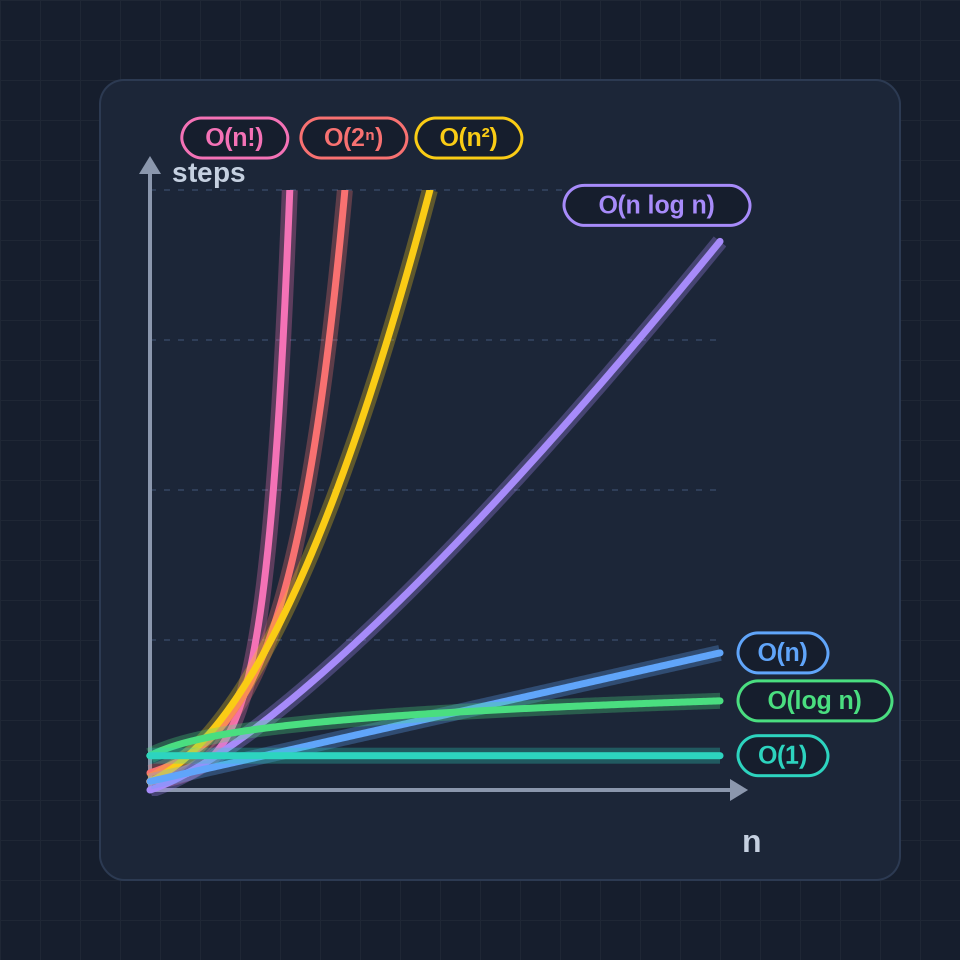
See why an algorithm's complexity class matters more than a fast computer. Switch nine classes from O(1) to O(n!) on and off, plot their step counts up to the n you choose on a linear or logarithmic axis, and read in the table how many steps each needs for your input size and how long that takes at a billion steps a second, from nanoseconds to longer than the age of the universe. Switch the complexity classes on or off with the chips above the chart, set how far the chart goes and whether its step axis is linear or logarithmic. Enter an input size n and a speed in steps per second to read each class's step count and running time in the table. Point at the chart to read the steps at any n; your settings are kept in this browser.
How it works
- Switch the complexity classes you want to compare on or off with the chips above the chart.
- Set how far the chart goes and choose a linear or a logarithmic step axis; point at the chart to read the steps at any n.
- Enter an input size n and a speed in steps per second, then read each class's step count and running time in the table and copy it.
What the table shows
For each class the table counts the steps at your n, with constant factors left out, and divides them by the speed. At n = 1,000 and a billion steps a second, O(n) takes 1 microsecond, O(n log n) 10 microseconds, O(n²) 1 millisecond and O(n³) 1 second, while O(2ⁿ) needs about 10²⁸⁴ years, far longer than the 13.8 billion years the universe has existed. Counts too big for a computer number are kept as logarithms and written as powers of ten.
Linear or logarithmic axis
On a linear axis the fast-growing classes leave the chart within a few steps of n, which shows how quickly they become hopeless: the height is set by the polynomial classes, and O(2ⁿ) and O(n!) shoot out of the top. A logarithmic axis gives each power of ten the same height, so every class fits: the polynomials become gently rising curves, O(2ⁿ) a straight line and O(n!) a line that keeps getting steeper.
Frequently asked questions
What does Big-O notation mean?
It describes how the running time or memory of an algorithm grows with the size n of its input, ignoring constant factors and smaller terms. An algorithm that takes 3n² + 5n + 2 steps is O(n²): double n and it takes about four times as long, whatever computer runs it.
Why are the logarithms base 2?
Because halving is what most O(log n) algorithms do: binary search halves the list at each step, so it needs about log₂ n comparisons. In Big-O the base does not matter, since log₂ n and log₁₀ n differ only by a constant factor of about 3.32.
Is an O(n log n) algorithm always faster than an O(n²) one?
Not for every n. Big-O hides the constant factors, so for small inputs a simple O(n²) method such as insertion sort can beat merge sort, and library sorts switch to insertion sort for short runs. As n grows, the class with the slower growth always wins in the end.
How big can n be?
Any whole number from 1 to 10¹⁵ for the table, and up to 1,000,000 for the chart. The step counts are worked out with logarithms, so even 1,000,000! steps, a number with about 5.6 million digits, is shown as a power of ten instead of overflowing.
Related tools
How Big-O notation works
What Big-O notation means, how to read O(1), O(log n), O(n), O(n log n), O(n²), O(2ⁿ) and O(n!), how to find the complexity of code, and why the class matters more than the hardware.
Big-O race: growth beats a head start
Watch the complexity classes race: teams of bouncing balls break through floors of 10, 100, 1000 points and grow on every floor by their class. Give the slow classes a head start and see O(2ⁿ) and O(n!) overtake them anyway.
Sort match
Race bubble, selection, insertion, merge, quick, heap, radix and counting sort on the same list. Every comparison, swap or move counts, and the sort with the least work wins.

Quicksort
Watch quicksort step by step. Choose the pivot rule, see each partition move smaller values before the pivot, and count comparisons, swaps, and partitions.
Binary search
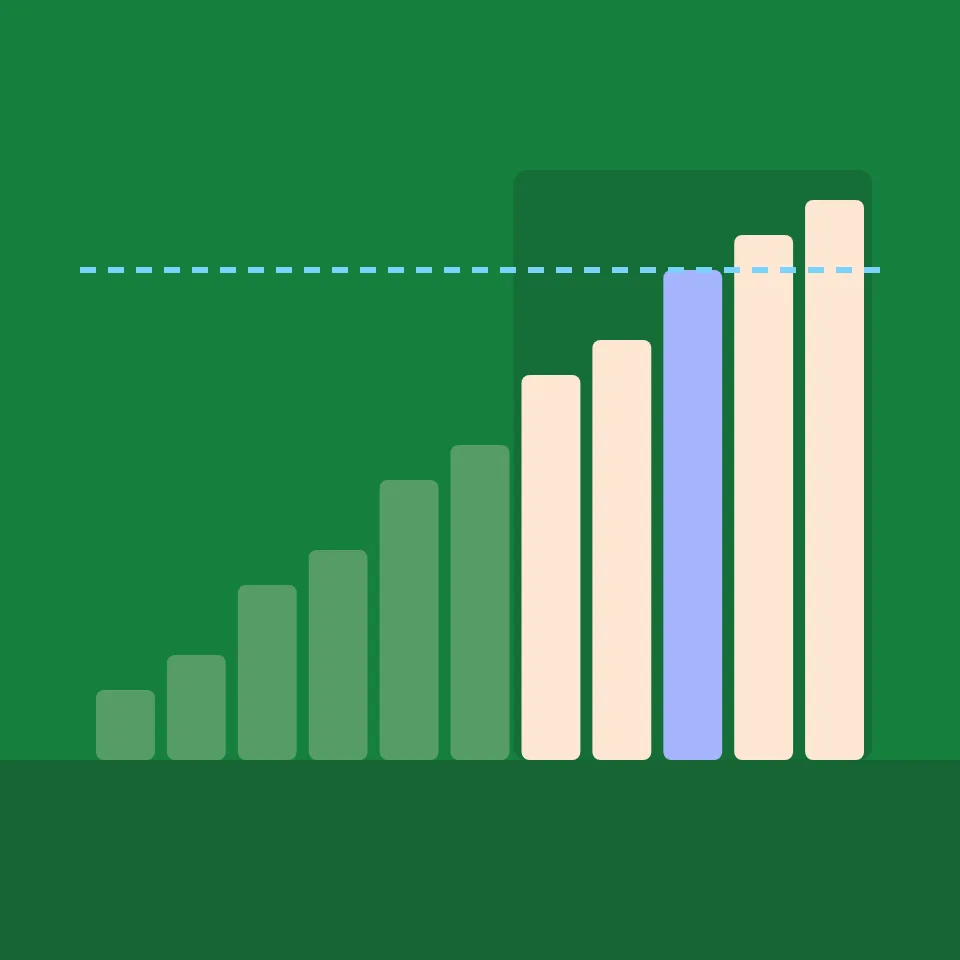
Watch binary search step by step. Choose a value, see each comparison with the middle value rule out half of the sorted list, and compare the count with linear search.
Recursion visualizer
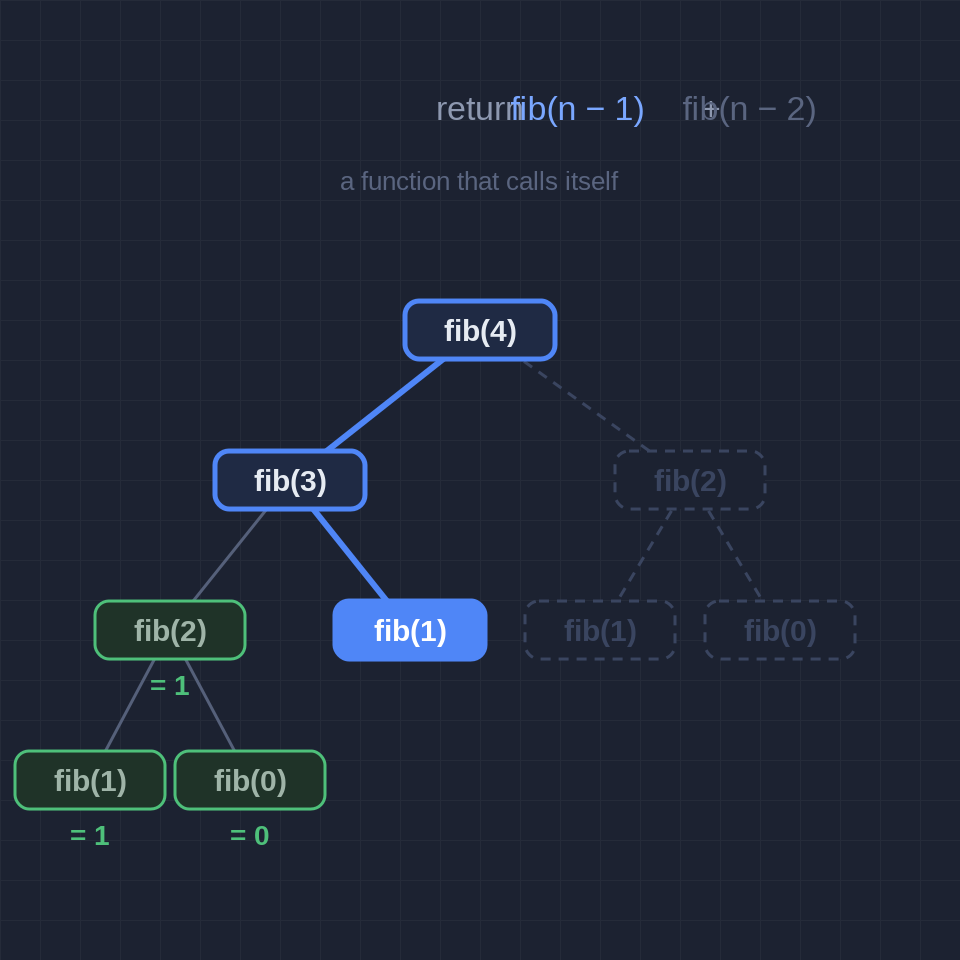
See recursion work one call at a time: the code with the current line, the call stack growing and shrinking, and the call tree with every return value, for factorial, Fibonacci, Hanoi, permutations, Ackermann and more.
Ready to try it?
Open PictorX in your browser — no install, no credit card required to start.
Go to Editor