
Pascal's triangle explained
Pascal's triangle is built from a single rule that a child can follow, yet it holds the answers to questions from algebra, probability and number theory. Its numbers count the ways to choose things, expand powers of sums, and hide the Fibonacci numbers and a fractal. It is one of the most studied number patterns in history, discovered independently in India, Persia, China and Europe.
The rule
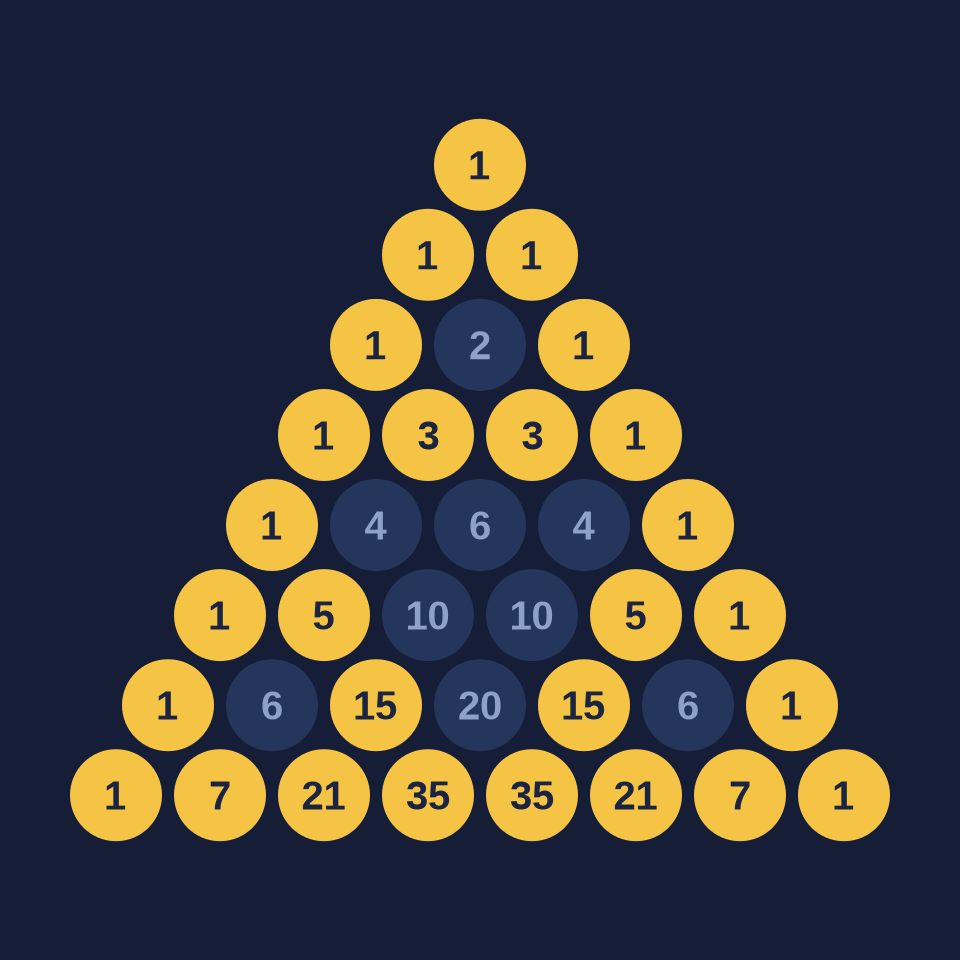
Write a 1 at the top. Each new row starts and ends with 1, and every number in between is the sum of the two numbers diagonally above it. The first rows read 1; 1 1; 1 2 1; 1 3 3 1; 1 4 6 4 1. Rows and places are counted from 0, so the 6 in the middle of row 4 is the number at row 4, place 2, written C(4, 2) or "4 choose 2".
Counting choices
C(n, k) is the number of ways to choose k things out of n, ignoring order, and equals n! / (k! (n − k)!). There are C(4, 2) = 6 ways to pick two of four friends, and C(49, 6) = 13,983,816 ways to pick 6 lottery numbers out of 49. The sum rule follows from counting: a choice of k from n either includes the last item, leaving k − 1 to choose from the other n − 1, or it does not, leaving k to choose from n − 1. That is why C(n, k) = C(n − 1, k − 1) + C(n − 1, k).
The binomial theorem
Multiply out (a + b)ⁿ and the coefficients are row n of the triangle: (a + b)² = a² + 2ab + b², (a + b)³ = a³ + 3a²b + 3ab² + b³. Each term picks a from some of the n brackets and b from the rest, and C(n, k) counts the ways to choose which k brackets give b. Setting a = b = 1 shows that row n adds up to 2ⁿ. The same numbers give the chances of k heads in n coin tosses, C(n, k) / 2ⁿ, and the bell shape of a Galton board.
Diagonals and sums
The outer diagonals are all 1s, the next ones count 1, 2, 3, 4, and the third diagonals hold the triangular numbers 1, 3, 6, 10, 15, the dots in a triangle. The fourth give the tetrahedral numbers 1, 4, 10, 20, the balls in a pyramid. Adding down any diagonal from the edge gives the number just past its end, one step to the side: the hockey stick identity. Adding along the shallow diagonals, which rise one row for every step to the right, gives the Fibonacci numbers 1, 1, 2, 3, 5, 8, 13.
Odd numbers and the Sierpiński triangle
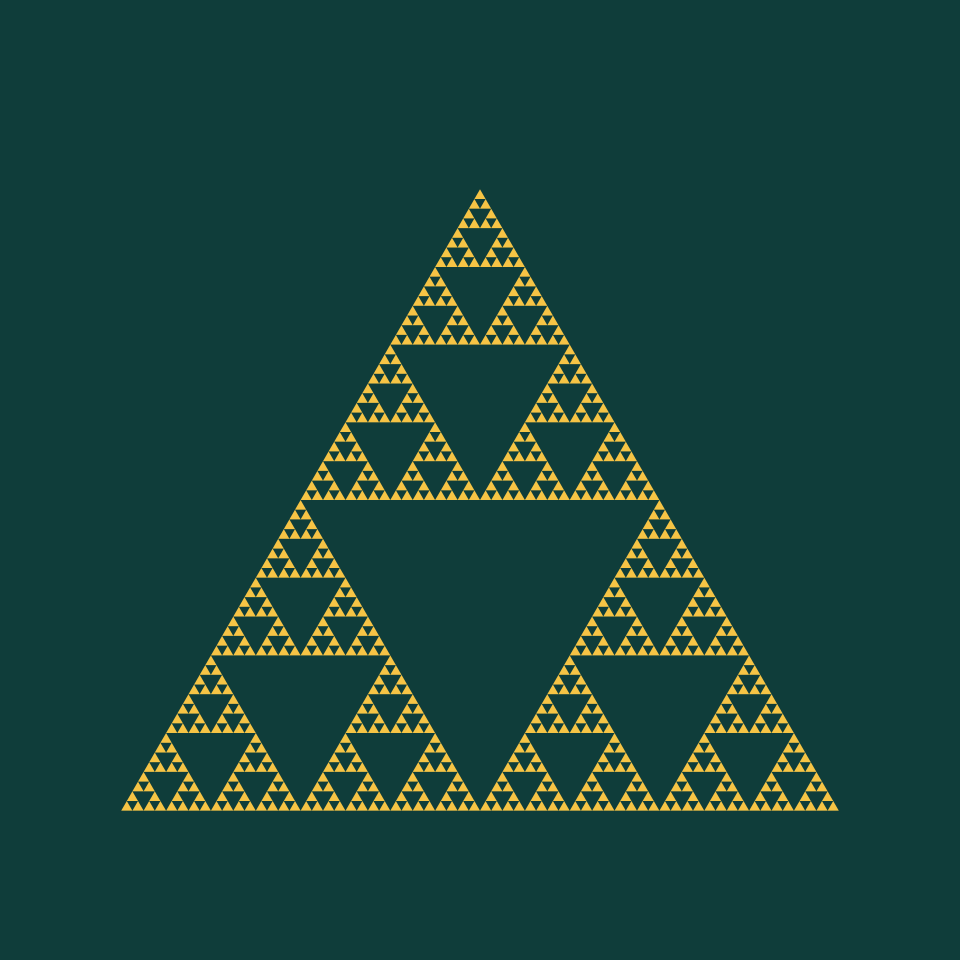
Colour the odd numbers and the Sierpiński triangle appears, sharper with every row added. Odd plus odd is even, so the pattern of odd numbers follows its own simple rule, and rows 2ᵏ to 2ᵏ⁺¹ − 1 repeat the triangle above them twice with a block of even numbers between. In 1878 Édouard Lucas proved that C(n, k) is odd exactly when every binary digit 1 of k is also a 1 of n, and in 1899 James Glaisher noticed the consequence that row n has 2ᵐ odd numbers, where m is the number of 1s in n written in binary. Remainders by 3, 5 or 7 make their own fractal triangles.
A triangle of many names
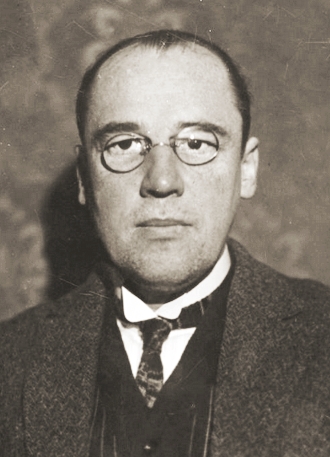
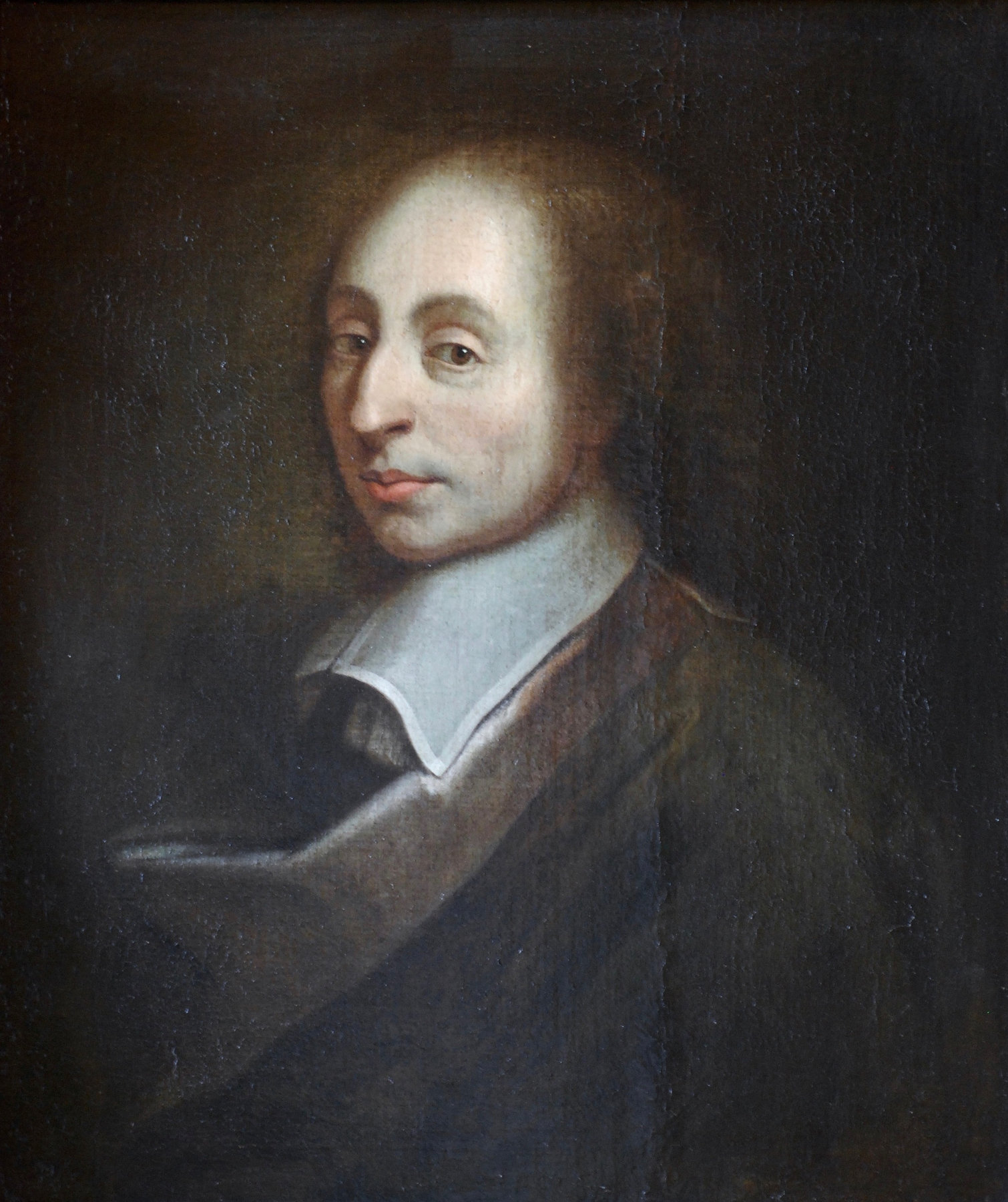
The triangle was known long before Pascal. In India, Pingala's work on poetic metres from around 200 BC contains the idea, and Halayudha described the triangle in the 10th century. In Persia, Al-Karaji and Omar Khayyam used it in the 11th century; in Iran it is called Khayyam's triangle. In China, Jia Xian described it in the 11th century and Yang Hui published it in 1261, and there it is called Yang Hui's triangle. Blaise Pascal's treatise of 1654 collected its properties and used them in the first mathematical study of chance, which is why most of the world now uses his name.
Explore it
Open the Pascal's triangle explorer to build the triangle up to 64 rows. Click any number to see C(n, k), the formula with factorials and the two numbers it is the sum of, and switch patterns to show (a + b)ⁿ with the row sums, the hockey stick, the Fibonacci diagonals, remainders from 2 to 9 and the counting, triangular and tetrahedral numbers. Every number is computed exactly, even the 18-digit numbers in the middle of row 63.
Frequently asked questions
Why does the triangle start counting at row 0?
Because row n then matches (a + b)ⁿ and the choices out of n items. The single 1 at the top is row 0: there is exactly one way to choose nothing from nothing, and (a + b)⁰ = 1.
Is the triangle symmetric?
Yes. C(n, k) = C(n, n − k), because choosing which k items to take is the same as choosing which n − k items to leave behind.
What are the powers of 11 in Pascal's triangle?
Read the first rows as numbers: 1, 11, 121, 1331, 14641 are 11⁰ to 11⁴. From row 5 on, the numbers have more than one digit and carry over: row 5, 1 5 10 10 5 1, gives 161,051 = 11⁵ once the tens are carried.
What is Pascal's triangle used for?
For counting combinations, working out probabilities such as the chance of k heads in n coin tosses, expanding powers of sums in algebra, and as a source of patterns in number theory. The binomial coefficients also appear in statistics, in the binomial distribution, and in computer graphics, in the Bézier curves used to draw smooth shapes.
Related tools
Pascal's triangle explorer
Explore Pascal's triangle up to 64 rows. Click any number for C(n, k), see (a + b)ⁿ and the powers of 2, the hockey stick, the Fibonacci diagonals, the Sierpiński pattern of remainders and the triangular numbers.
Sierpiński triangle builder
Build the Sierpiński triangle by removing middles, by the chaos game or from Pascal's triangle mod 2. Try other corners, jumps and rules, and see area, triangles and the fractal dimension 1.585.
The Fibonacci sequence
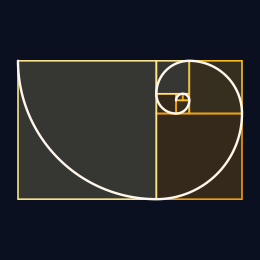
Each Fibonacci number is the sum of the two before it. Watch the squares spiral, the ratios settle on the golden ratio, and Binet's formula rebuild the same numbers.
Galton board
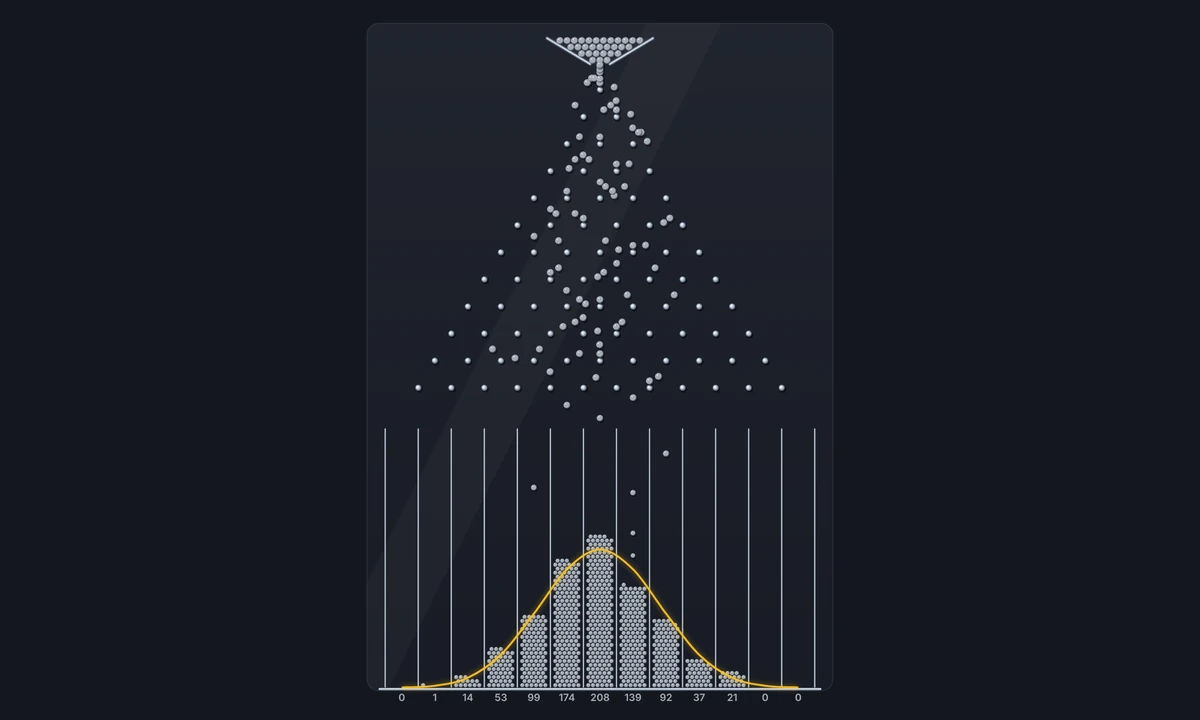
Drop balls through rows of pegs and watch a bell curve fill the bins. Change the rows, the bias, and the number of balls, and compare mean and spread with theory.
The Collatz Conjecture
Explore the Collatz 3n+1 problem in your browser. Walk hailstone sequences, grow a geometric Collatz tree, and zoom the continuous Collatz fractal.
Ready to try it?
Open PictorX in your browser — no install, no credit card required to start.
Open the Pascal's triangle explorer