
Natural selection explained
Natural selection is the simplest powerful idea in biology. Living things vary, much of the variation is inherited, and more are born than can survive. The variants that happen to survive and reproduce best leave more offspring, so over the generations the population comes to fit its surroundings, without anyone planning it. This page explains the parts of the idea, the classic examples that show it at work, and the misunderstandings it often meets.
Darwin and Wallace
Charles Darwin worked out the idea of natural selection in the years after his voyage on HMS Beagle (1831–1836), but held back from publishing it. In 1858 Alfred Russel Wallace, collecting animals in the Malay Archipelago, sent him an essay with the same idea. Their papers were read together at the Linnean Society in London on 1 July 1858, and Darwin's On the Origin of Species appeared in November 1859. Both had been struck by Thomas Malthus's point that populations grow faster than their food supply.
Variation
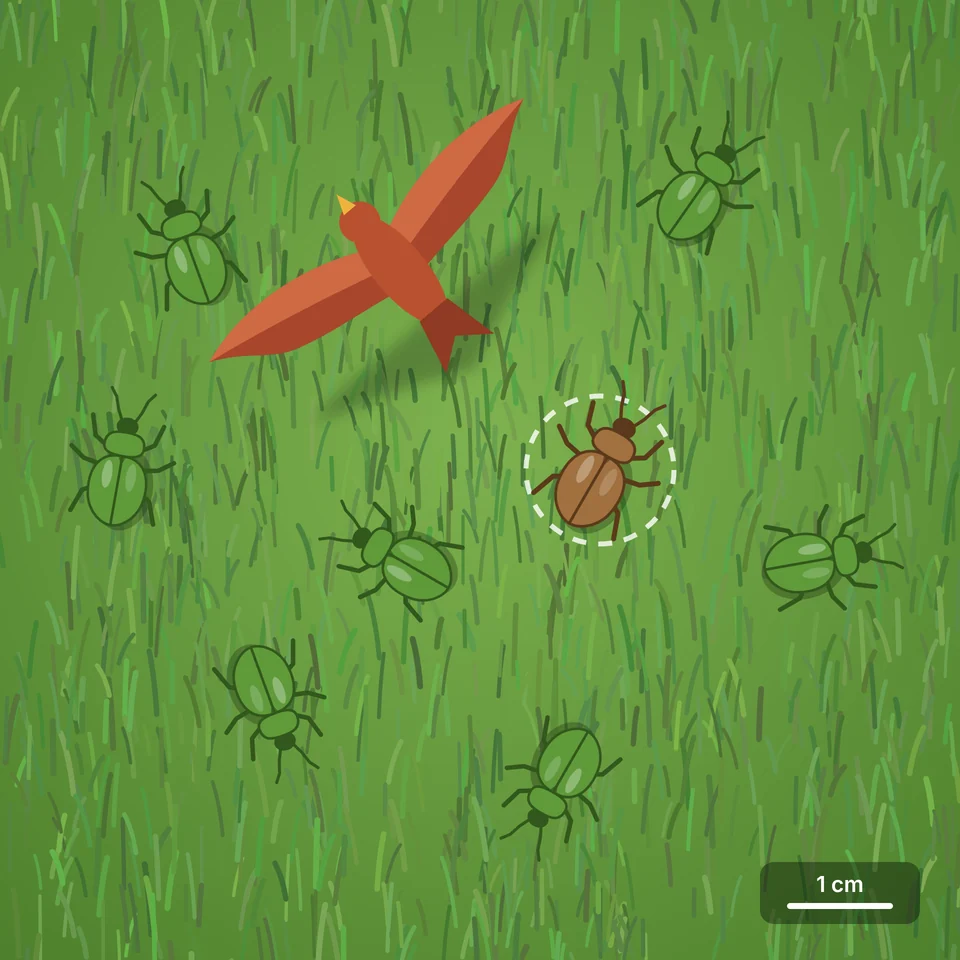
No two individuals of a species are alike. The beetles of one population differ in colour, size, speed and countless other traits. Without such differences there would be nothing to choose between. In the simulator every beetle has its own lightness, hue, size and speed, and the chart shows how varied the colours of each generation are.
Heredity
Selection only changes a population if offspring resemble their parents. Darwin did not know how inheritance worked; Gregor Mendel's experiments with peas, published in 1866 and rediscovered in 1900, showed that traits are passed on in units, now called genes. In the simulator each young beetle takes each of its four genes from one parent or the other, so traits are inherited without being blended away.
Selection and fitness
More young are born than the habitat can feed, and not all of them survive to breed. Fitness is the biologist's word for how many offspring an individual leaves compared with others. It is not strength or health in general but success in a particular place: a pale beetle is fit on sand and unfit on soot. Survival of the fittest, Herbert Spencer's phrase that Darwin later adopted, means survival of those best fitted to the conditions.
Mutation
Mutations are changes in DNA, mostly copying errors, and they create new variants. Most have little effect, some are harmful and a few are useful in a given place. They happen at random, not because they would be useful. In the simulator the mutation rate is the chance that a gene of a young beetle shifts a little; without mutation, a population can only use the variation it already has.
Genetic drift
Not all change is adaptive. In every generation some individuals leave more young than others by luck alone, and in small populations those accidents add up: variants can vanish or take over without any advantage. Sewall Wright and Ronald Fisher worked out the mathematics in the 1920s and 1930s, and Motoo Kimura's neutral theory of 1968 argued that much of the change in DNA is drift. Switch off the predators in a small population to watch it.
The peppered moth
The peppered moth, Biston betularia, rests by day on tree trunks. Before the Industrial Revolution nearly all were pale with dark speckles, hard to see on lichen. Coal smoke killed the lichen and blackened the bark around the industrial cities of England. A dark form, first recorded near Manchester in 1848, made up about 98 percent of the moths there by 1895. Bernard Kettlewell's experiments in the 1950s showed that birds took more of the moths that did not match their background, and Michael Majerus's large study from 2001 to 2007 confirmed it. After the clean air laws of the 1950s the bark grew lighter and the dark form became rare again. In the real moth the colour is set by one gene with a dark, dominant form, and in 2016 the mutation was traced to a piece of jumping DNA in the gene cortex.
Beach mice and rock pocket mice
Oldfield mice that colonised the white sand dunes of Florida's coasts have become much paler than their brown inland relatives, and experiments with clay models showed that owls and other predators attack the models that do not match the ground far more often. In the deserts of Arizona and New Mexico, rock pocket mice living on dark lava flows are dark, while those on the surrounding pale rock are light. In 2003 Michael Nachman and colleagues found that the dark fur of one lava population comes from a few mutations in a single gene, Mc1r; another lava population turned dark through different mutations, the same adaptation evolving twice.
Adaptation
An adaptation is a trait that spread because it helped its carriers survive and reproduce where they live: camouflage, a thick coat in the cold, a beak that fits a food. Adaptations are always relative to a place and a time. When the habitat changes, yesterday's adaptation can become a burden, as the pale peppered moths found on black bark. The simulator's habitat change lets you watch a population adapt, and adapt back.
Common misconceptions
Individuals do not evolve; populations do. Animals do not change because they need to: the variants come first, and the surroundings decide which of them leave more young. Evolution has no goal and does not always lead to more complex or better creatures, only to ones better fitted to present conditions. Selection cannot make what never arises, so a population may die out before the right variant appears. And calling evolution only a theory misreads the word: in science a theory is a well-tested explanation, and evolution by natural selection is one of the best tested in biology.
Frequently asked questions
What is the difference between natural selection and evolution?
Evolution is any change in the inherited traits of a population over the generations. Natural selection is one of its causes, the one that produces adaptations. Others are genetic drift, mutation and gene flow, the movement of genes between populations.
How fast can natural selection work?
Sometimes within a few generations. The dark peppered moth went from rare to 98 percent in about fifty years. Peter and Rosemary Grant measured the beaks of Darwin's finches on the island of Daphne Major growing deeper within a single drought year, 1977. Bacteria become resistant to antibiotics in days.
Is natural selection random?
Partly. Mutations arise by chance, and drift is chance. But selection itself is not random: which variants survive depends on how well they fit their surroundings, again and again in every generation. That steady sorting is what builds adaptations.
What is sexual selection?
A kind of selection Darwin described in 1871, in which traits spread because they help to win mates rather than to survive: a peacock's tail, a deer's antlers, a bird's song. It can favour traits that are costly for survival.
Related tools
Natural selection simulator
Watch evolution by natural selection: birds catch the beetles that stand out, food is limited, and the young inherit colour, size and speed with mutations. Replay the peppered moth and the beach mice, change the habitat during a run and see genetic drift.
Predator–Prey
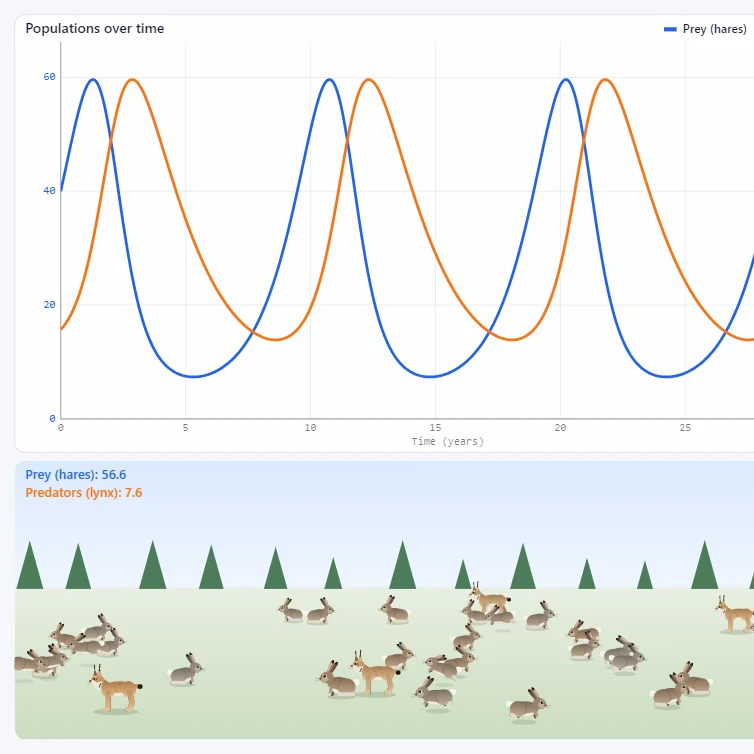
Watch hares and lynx rise and fall in the Lotka-Volterra model. Set the rates, see the predator peaks lag behind the prey peaks and follow the closed orbit in the phase plane.
DNA double helix
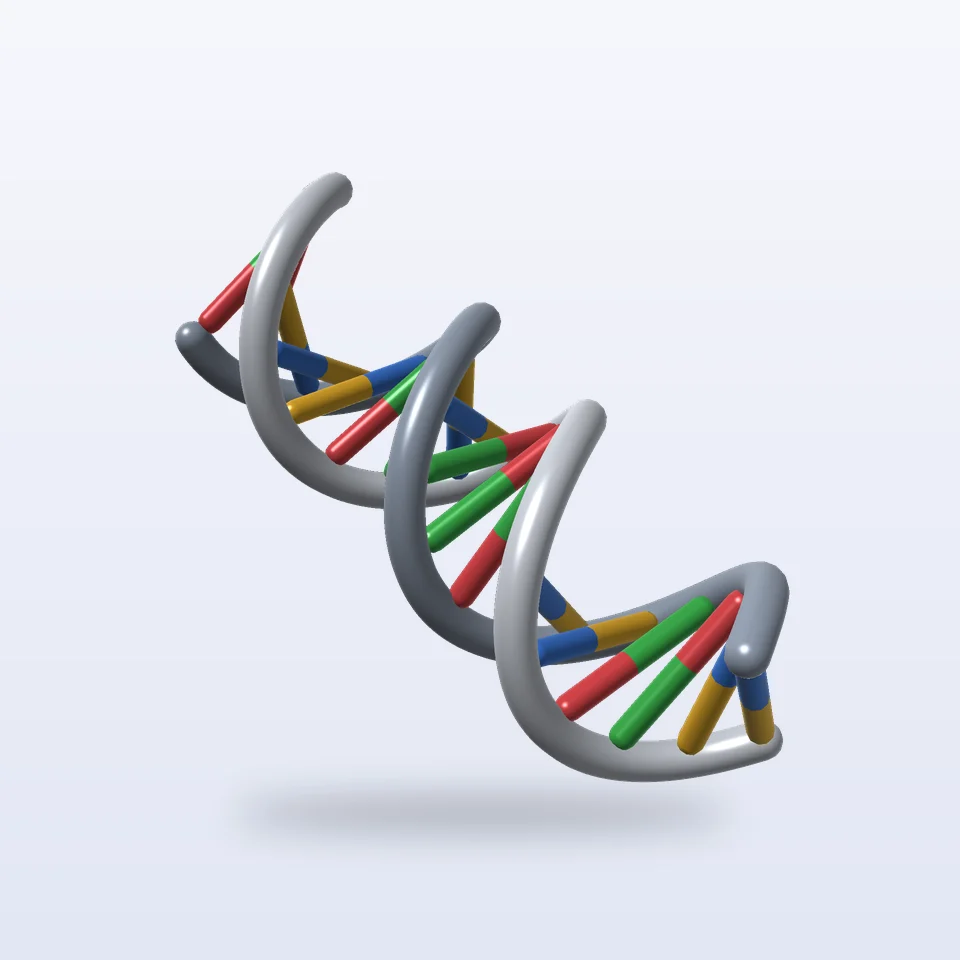
Type a DNA sequence and turn it as a double helix in 3D: the complementary strand fills in by base pairing, A with T and G with C. Compare B-, A- and Z-DNA, unzip the helix like a replication fork, and read the GC content, length and melting temperature.
Conway's Game of Life
Play Conway's Game of Life in your browser. Watch a glider gun, spaceships, and the R-pentomino, draw your own cells, and try Life-like rules such as HighLife.
Ready to try it?
Open PictorX in your browser — no install, no credit card required to start.
Open the Natural Selection Simulator