
How falling-block games work
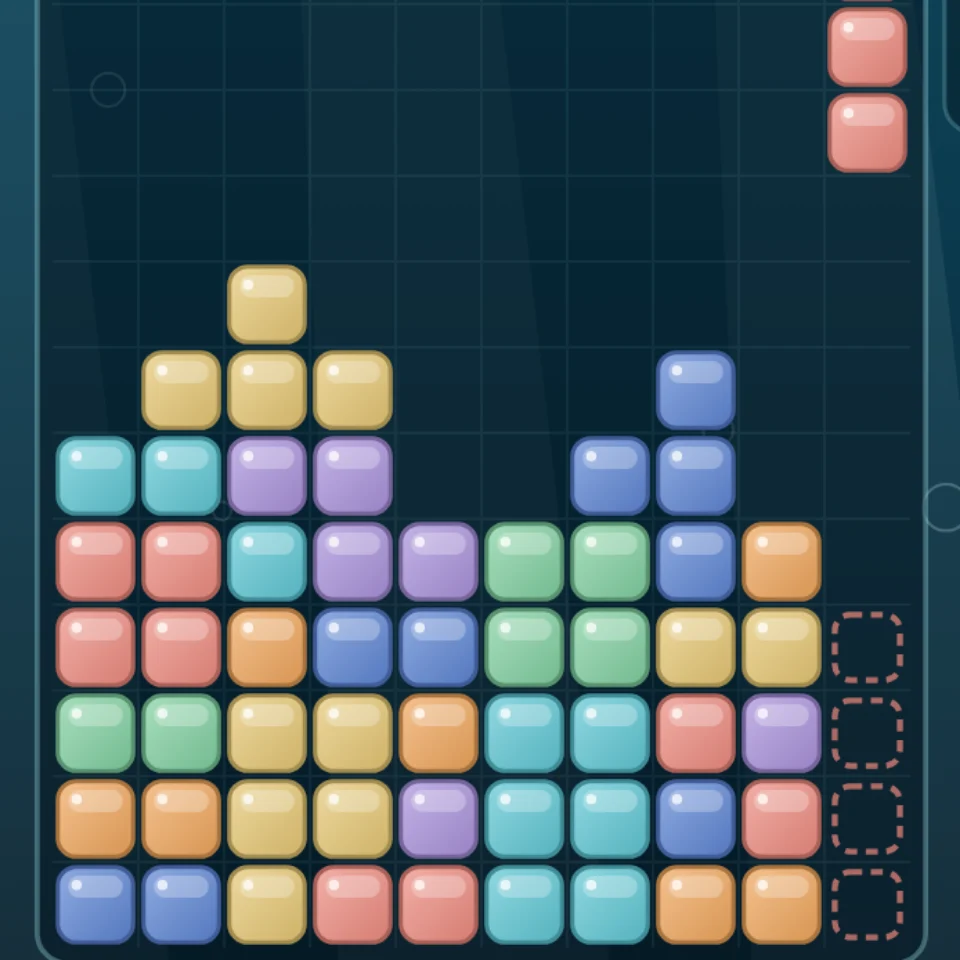
Coral Stack is a falling-block game: pieces made of four blocks drop into a narrow well, and you fit them together into full rows that disappear. It takes a minute to learn and a long time to master, because every piece is a small decision about where the next ones will fit.
Seven shapes of four blocks
Join four squares edge to edge and there are exactly seven shapes you can make, if a shape and its mirror image count as two: mathematicians call them the tetrominoes, part of the larger family of polyominoes. One is a straight bar, one a square, one a T, two are zigzags and two are L shapes. Every one of them fits in a well ten squares wide in several ways, which is what makes the puzzle work.
A fair deal: the bag of seven
If pieces were drawn completely at random, you could wait a very long time for the straight bar you need. Coral Stack deals them like cards from a bag: the seven shapes are shuffled, dealt one by one, and when the bag is empty a new one is shuffled. Each shape comes once in every seven pieces, the longest possible wait for any shape is twelve pieces, and you can plan with the three shown under Next.
Turning in tight places
A piece turns around a fixed point in its box. When the turned piece would overlap a wall or the stack, the game tries up to four other positions nearby, in a fixed order, and keeps the first that fits. These wall kicks let a piece turn while pressed against a side, and let skilled players slide pieces into overhangs. Each shape has its own list of positions to try; the long bar has a list of its own because it is four squares long.
Speed and score
At level 1 a piece sinks one row per second. Each level makes that faster, following a curve that reaches about a tenth of a second per row at level 9 and keeps going. Points reward risk: one row is worth 100 times the level, but four rows at once are worth 800, twice as much as four single rows. Clearing rows with every piece builds a combo that adds a growing bonus.
Tips to stack better
Keep the surface of the stack flat, so most pieces have somewhere to go. Leave one column at the side open and save it for the straight bar, to clear four rows at once. Avoid holes under overhangs: a hole only clears once every row above it is gone. Use Hold for the piece that does not fit now but will later, and glance at Next to plan two pieces ahead. When the stack gets high, clear rows first and score later.
Frequently asked questions
Why does the long bar never come when I need it?
In Coral Stack it does, eventually: every seven pieces include one bar, so the longest wait is twelve pieces. If you keep a column open for it, it pays to build the rest of the stack up evenly while you wait.
When is the game over?
When a new piece cannot appear because the stack is in the way at the top, or when a piece settles entirely above the top of the well. Clearing rows lowers the stack, so the game can go on as long as you keep up.
Does a higher starting level score more?
Yes. Every clear is multiplied by the level, so starting at level 5 makes each row worth five times as much from the start. The pieces fall faster too, so it is a trade between speed and points.
Related tools
Coral Stack
Play Coral Stack, a free falling-block game in your browser: turn and slide sea-glass pieces to fill whole rows, with a landing guide, hold, a preview of the next three pieces, levels and touch controls.
Wood Block Sudoku Puzzle
Play Wood Block Sudoku free in your browser. Drag wooden pieces onto a 9x9 board and clear rows, columns and 3x3 boxes. Combos, streaks, a holder slot and no time limit.
2048
Play 2048 free in your browser. Slide the tiles with the arrow keys or a swipe, merge equal numbers and reach 2048. Board sizes from 3 x 3 to 6 x 6, undo and best score.
Quarry Blast
Play Quarry Blast, a free maze action game in your browser: place charges, break crates, set off chain reactions, collect tools and find the hidden hatch on every level. Keyboard and touch controls.
Thread Link
Play Thread Link, a free numberlink puzzle: draw a thread between each pair of matching numbers, without crossings, until every square is used. Seven board sizes, endless numbered puzzles, hints and undo.
Breakout
Play Breakout free online: break the bricks to reveal a picture or your own photo, with levels, power-ups and mouse, touch or keyboard controls.
Ready to try it?
Open PictorX in your browser — no install, no credit card required to start.
Play Coral Stack