
Complex numbers explained
Complex numbers began as a trick for solving cubic equations and became one of the most useful ideas in mathematics, physics and engineering. This page explains what i is, how a complex number becomes a point of the plane, why multiplication turns and stretches, how De Moivre's formula gives powers and roots, and why e^(iπ) + 1 = 0.
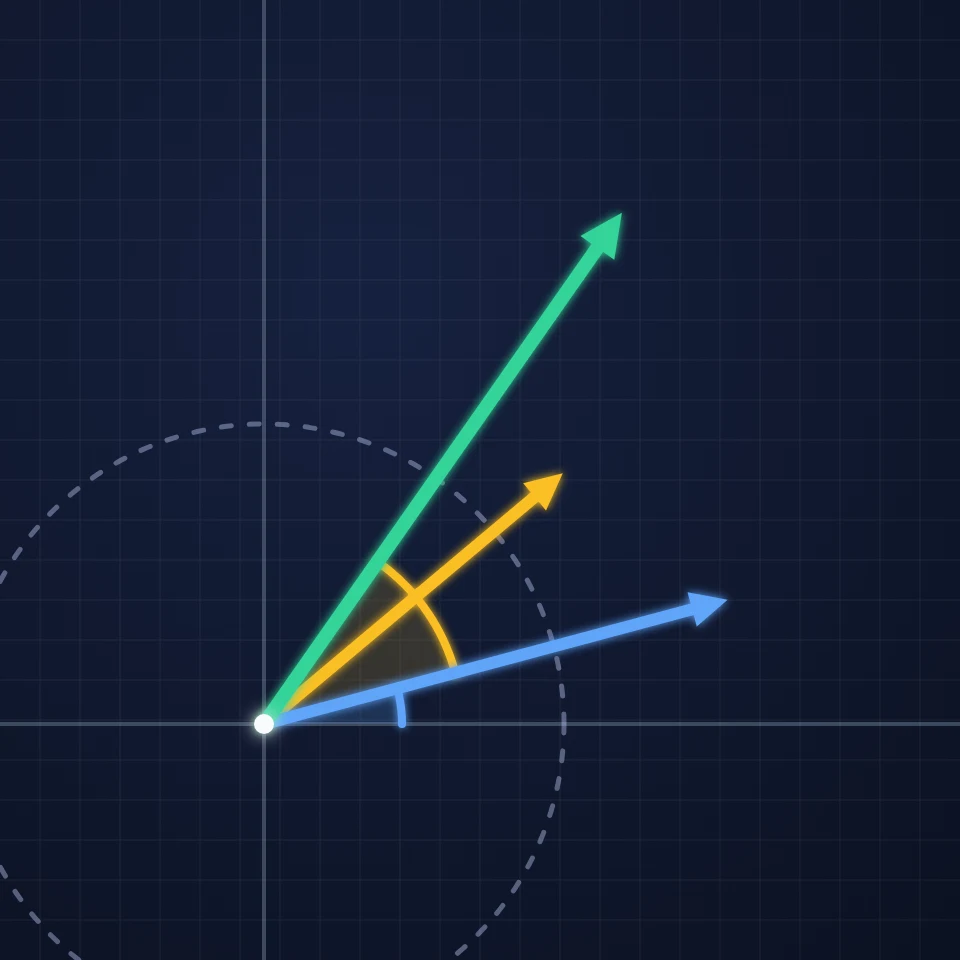
From cubic equations to i
In 1545 Gerolamo Cardano published a formula for cubic equations that sometimes required the square root of a negative number even when all three roots were real. Rafael Bombelli showed in 1572 that calculating with such roots by the ordinary rules, with √−1 · √−1 = −1, led to the right real answers: for x³ = 15x + 4 the formula gives ∛(2 + 11i) + ∛(2 − 11i) = (2 + i) + (2 − i) = 4. Descartes called these numbers imaginary, Euler wrote i for √−1, and Gauss made the name complex number standard.
Points of the plane
Caspar Wessel in 1797 and Jean-Robert Argand in 1806 saw that a + bi can be drawn as the point (a, b), or as the arrow from 0 to it. The real numbers fill the horizontal axis and the multiples of i the vertical one. The modulus |z| = √(a² + b²) is the distance from 0, by Pythagoras, and the argument is the angle from the positive real axis, defined up to whole turns; the principal argument lies between −180° and 180°. Two complex numbers are equal only when both their real and their imaginary parts are equal.
Addition is adding arrows
To add complex numbers, add the real parts and the imaginary parts: (a + bi) + (c + di) = (a + c) + (b + d)i. In the plane this is vector addition, the diagonal of the parallelogram on the two arrows, and the difference z − w is the arrow from w to z, so |z − w| is the distance between the two points. The triangle inequality |z + w| ≤ |z| + |w| says that one side of a triangle is never longer than the other two together.
Multiplication turns and stretches
Multiply out (a + bi)(c + di) and replace i² by −1: (ac − bd) + (ad + bc)i. In polar form the rule is simpler: the moduli multiply and the arguments add. So multiplication by w = r·e^(iφ) maps the whole plane by a rotation through φ and a scaling by r, which is why the triangles 0, 1, z and 0, w, zw are similar. Multiplying by i rotates by 90°, and doing it twice rotates by 180°: i² = −1 is not a rule imposed from outside but what a quarter turn done twice must be.
Conjugates and division
The conjugate of z = a + bi is z̄ = a − bi, its mirror image in the real axis. A number times its conjugate is real, z·z̄ = a² + b² = |z|², which turns division into multiplication: z / w = z·w̄ / |w|². For example (3 + i) / (1 + i) = (3 + i)(1 − i) / 2 = (4 − 2i) / 2 = 2 − i. In polar form, dividing divides the moduli and subtracts the arguments; 1/z lies on the reflected ray at the distance 1/|z|, the inverse of z in the unit circle reflected in the real axis.
Powers and roots by De Moivre
Abraham de Moivre's formula (cos θ + i sin θ)ⁿ = cos nθ + i sin nθ follows from adding the argument n times. Powers of a number with modulus greater than 1 spiral outwards, those with modulus less than 1 spiral inwards, and those on the unit circle go round it. Reversed, the formula solves zⁿ = w: there are n roots, with the real n-th root of |w| as their modulus and the arguments (arg w + 360°·k)/n. They are the corners of a regular n-gon; for w = 1 they are the roots of unity, the powers of ω = e^(2πi/n), and their sum is 0.
Euler's formula
Leonhard Euler showed in 1748 that e^(iθ) = cos θ + i sin θ, by comparing the power series 1 + x + x²/2! + … of the exponential with those of the cosine and the sine. In the plane, e^(iθ) is the point at angle θ on the unit circle, its shadows on the axes are cos θ and sin θ, and every complex number is r·e^(iθ). The same limit that defines e, (1 + x/n)ⁿ, gives e^(iθ) when x = iθ: n small turns of about θ/n each, every one stretching very slightly. With θ = π the formula becomes Euler's identity e^(iπ) + 1 = 0.
Polynomials, quadratics and how the app works
Over the complex numbers every polynomial of degree n has exactly n roots, counted with multiplicity: the fundamental theorem of algebra, proved by Gauss in 1799. When the coefficients are real, complex roots come in conjugate pairs; the quadratic az² + bz + c = 0 has the roots (−b ± √(b² − 4ac)) / 2a, a pair p ± qi mirrored in the real axis when the discriminant is negative. In the app every number is a pair of double-precision reals; products and whole powers are computed exactly by the rules above, so (1 + i)⁸ is exactly 16, roots come from the polar form, and simple values are recognised and written exactly, such as √2, i√3/2 or π/4.
Frequently asked questions
Are complex numbers real?
They are as real as negative numbers or fractions: a consistent system with clear rules and many uses. Electrical engineers describe alternating currents with complex numbers called phasors, quantum mechanics writes its wave functions with them, and they make signal processing, control theory and the study of fluid flow simpler. The name imaginary is historical and does not mean they are less legitimate.
Can complex numbers be ordered?
No. There is no way to say which of two complex numbers is larger that also works with addition and multiplication the way it does for real numbers: if i were positive, i² = −1 would be positive too, and if i were negative, (−i)² = −1 would be positive. What can be compared are their moduli, the distances from 0.
What is the difference between a + bi, r·e^(iθ) and r∠θ?
They are three ways of writing the same number. Rectangular form a + bi gives the coordinates and is best for adding; the exponential form r·e^(iθ) and the engineers' angle notation r∠θ give the modulus and the argument and are best for multiplying, dividing, powers and roots. The app shows them all: the tiles give the rectangular form with the polar form beneath, and the labels use the form you choose.
Why do the n-th roots of unity add up to zero?
Because turning the whole set by 360°/n, which is what multiplying by ω does, gives the same set. Their sum S therefore satisfies ωS = S, and since ω ≠ 1 for n ≥ 2, S must be 0. Geometrically they are the corners of a regular polygon centred at the origin, whose centre of mass is the origin.
Related tools
Complex numbers you can drag, multiply and turn
Drag complex numbers on the Argand plane and watch the arithmetic: addition as a parallelogram, multiplication as a turn and a stretch, division, the conjugate and 1/z, rectangular and polar form, powers by De Moivre's formula, n-th roots and roots of unity, Euler's formula e^(iθ) = cos θ + i sin θ and the complex roots of a quadratic.
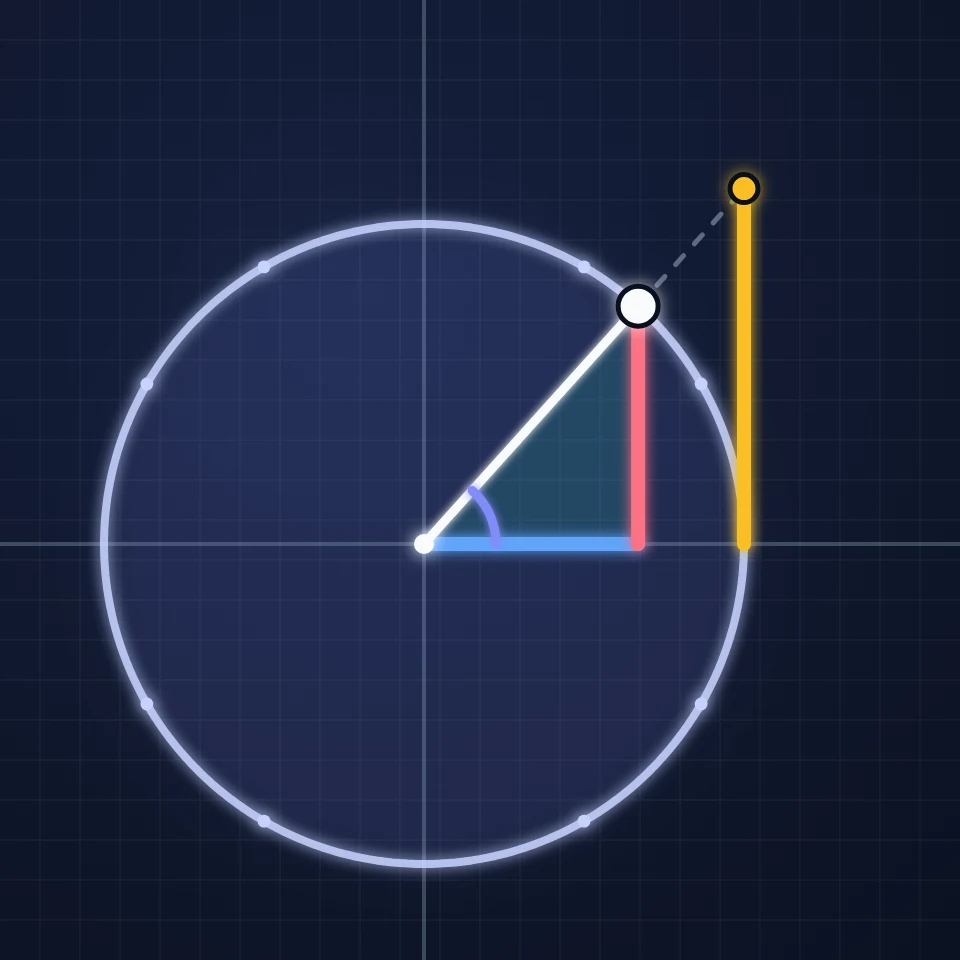
The unit circle and trigonometry explained
How the unit circle defines sine, cosine and tangent for every angle: the six functions as segments, radians and arc length, exact values of the special angles, quadrant signs and reference angles, the graphs and their transformations, the key identities and the inverse functions with their ranges.
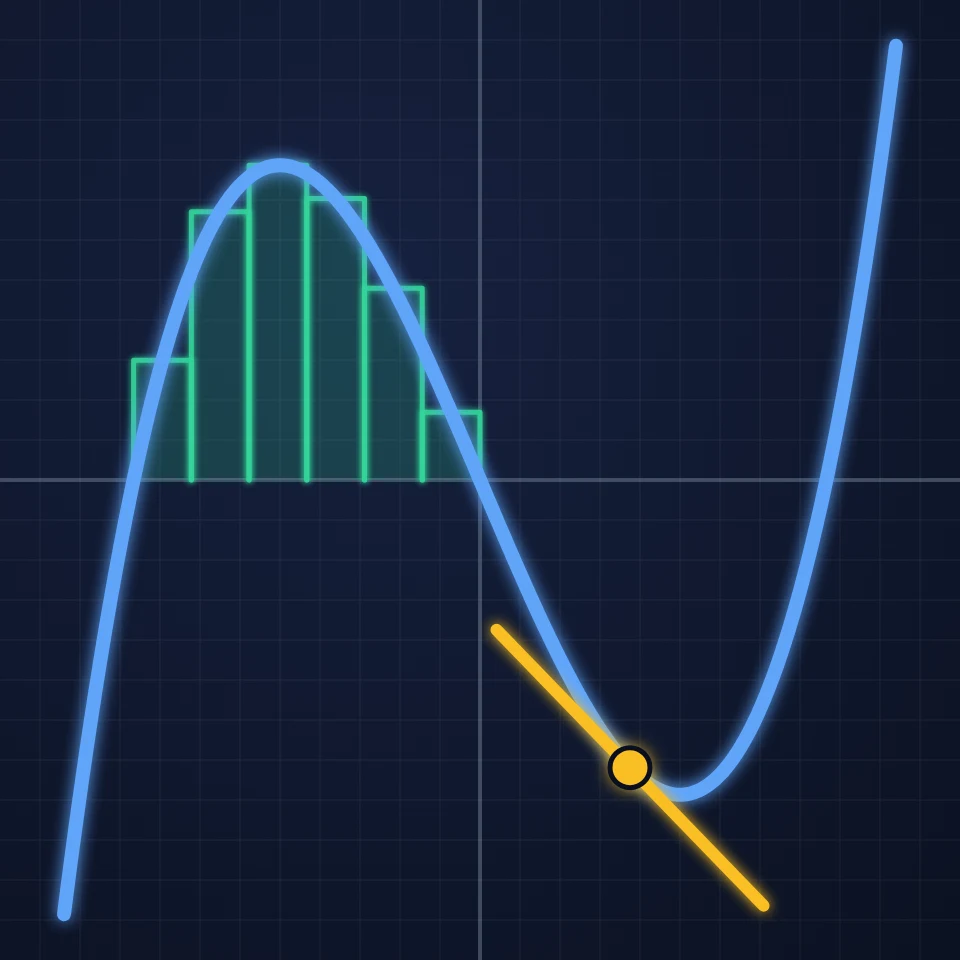
Derivatives and integrals explained
How calculus measures change and area: the derivative as the limit of secant slopes, the rules of differentiation, corners and vertical tangents, extrema and concavity, Riemann sums and why their errors fall like 1/n, 1/n² or 1/n⁴, adaptive quadrature and the Fundamental Theorem that links the two.
Fourier Epicycles
Draw any shape and watch rotating circles trace it: Fourier epicycles online. Pick a heart, star or butterfly, type a word, choose how many circles turn and save a PNG or SVG.
Ready to try it?
Open PictorX in your browser — no install, no credit card required to start.
Open the complex numbers app