
About Chess Puzzles - Mates, Tactics and How to Solve Them
Chess puzzles are positions with one clear way to win, taken from real games or composed by hand. Solving them is the quickest way to get better at chess, because they train you to spot the patterns that decide games. This page explains the kinds of puzzles, the tactics they teach and how to solve them.
A short history
Chess problems are almost as old as the game. Arabic manuscripts from the ninth century already collect mansubat, positions to be won. In the nineteenth century composers turned the problem into an art form, with the classic task "White to play and mate in two". Today most puzzles come from real games: computers find the positions where one line wins, and puzzle sites let millions of players try them.
Mate in N
A mate in N asks you to force checkmate in N moves of your own, against any defence. In a mate in 1 you look for a single move, so you can check every candidate. From mate in 2 on you must see the opponent's replies too, and the first move is often a quiet one or a sacrifice that only works because of what follows.
Winning material
Not every puzzle ends in mate. A win in 2 or 3 gains material or a decisive advantage with a tactic: a fork attacks two pieces at once, a pin holds a piece in front of a more valuable one, a skewer forces the more valuable piece to move and wins the one behind it, and a discovered attack moves one piece to unmask another. At the end you are clearly ahead, even if the game goes on.
How difficulty is measured
Lichess rates puzzles like players. Every attempt is a game between the player and the puzzle: if you solve it, you gain points and the puzzle loses some; if you fail, the puzzle gains. After thousands of attempts its rating shows how hard it really is. On PictorX, puzzles rated up to 1250 are easy, up to 1750 medium, and above that hard.
How to solve a puzzle
Look at the opponent's last move first: what did it allow or overlook? Then go through the forcing moves: checks, captures and threats. For each, picture the best reply, not the one you hope for. If a mate seems impossible, look for a sacrifice that opens up the king. Only play a move once you can see the whole line.
Frequently asked questions
Are chess puzzles good for improving?
Yes. Most games between club players are decided by tactics, and puzzles train exactly those. A few puzzles every day help more than many puzzles once in a while, and solving them slowly and correctly helps more than guessing fast.
What is the difference between a chess puzzle and a chess problem?
A puzzle usually comes from a real game and asks for the best practical line, such as winning material. A composed problem is made up by a composer, often in an unlikely position, and has an exact task, such as mate in exactly three moves, with a single solution.
Can a puzzle have more than one solution?
Sometimes. The puzzles here have one main line, chosen because the alternatives are clearly worse. In a mate puzzle, any move that checkmates at once is also accepted.
Where do the puzzles on PictorX come from?
From the Lichess puzzle database, which Lichess has released into the public domain. Each puzzle was found by a computer in a game played on lichess.org and tried by thousands of players before it got its rating.
Related tools
Chess Puzzles
Solve 5000 free chess puzzles in your browser: mate in 1 to mate in 5, and win in 2 or 3 moves. Pick easy, medium or hard, White or Black to play, with hints and the full solution.
About Chess - History, Rules and How the Computer Plays
How do you play chess? Where the game came from, how each piece moves, check, checkmate and draws, and how a computer picks moves with minimax and alpha-beta.
Chess
Play chess in your browser with all the rules: castling, en passant, promotion, check and checkmate. Play the computer from Easy to Expert, a friend on the same screen, or watch the computer play itself.
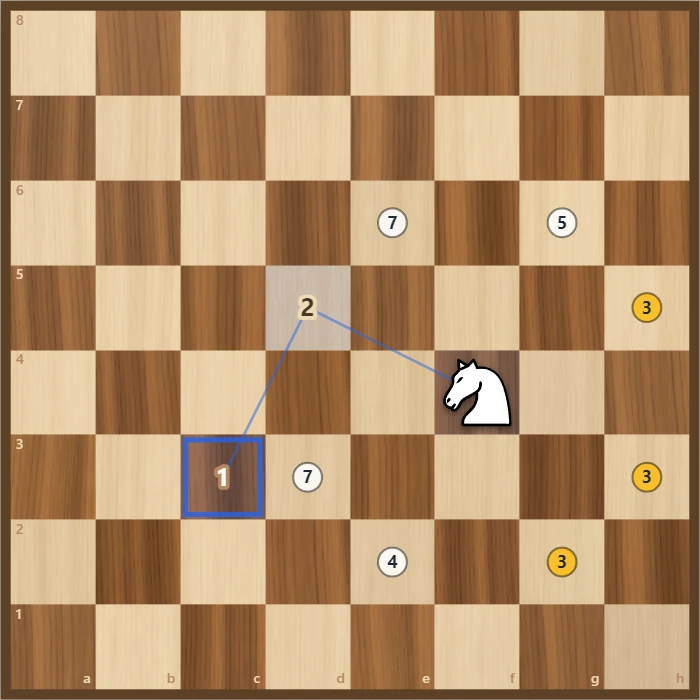
The knight's tour
What is a knight's tour? From a 9th-century Indian poem to Euler, the graph behind it, Warnsdorff's rule, backtracking and why odd boards have no closed tour.
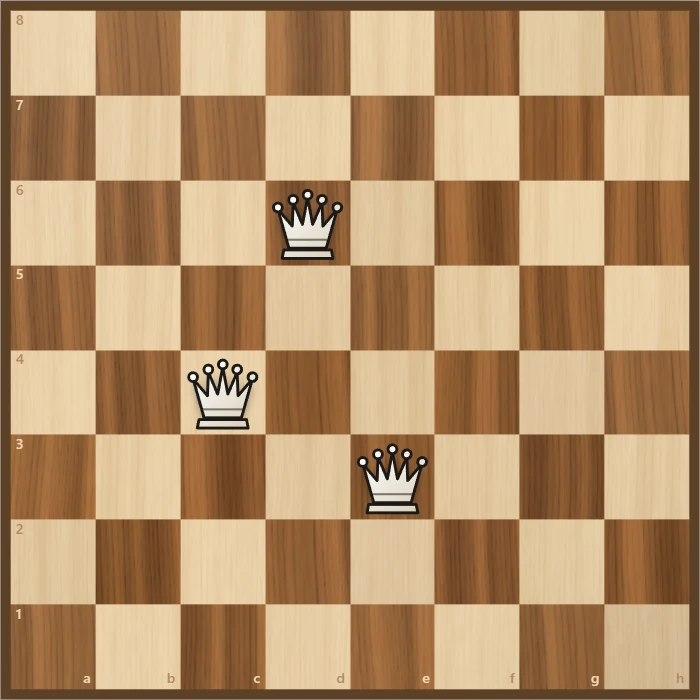
The eight queens puzzle
What is the eight queens puzzle? Max Bezzel's 1848 chess puzzle and Gauss, the 92 solutions in 12 families, symmetry, backtracking and the n-queens problem.
Ready to try it?
Open PictorX in your browser — no install, no credit card required to start.
Solve chess puzzles