
Cell division explained
All living things are made of cells, and every cell comes from another cell by division. A bacterium simply splits in two; the cells of plants, animals and fungi go through mitosis, a precise sequence in which copied chromosomes are lined up and pulled apart, and to make eggs, sperm and spores they use meiosis, which halves the number of chromosomes and shuffles the genes. This page explains both, the cell cycle around them, and what happens when they go wrong.
Every cell from a cell
In 1855 Rudolf Virchow summed up a new idea: every cell comes from a cell, omnis cellula e cellula. Walther Flemming, staining the cells of salamander larvae in the 1870s, saw thread-like structures in the nucleus split lengthwise and move apart; he called the process mitosis, from the Greek word for thread, and described it in his book Zellsubstanz, Kern und Zelltheilung of 1882. Wilhelm Waldeyer named the threads chromosomes, coloured bodies, in 1888. Oscar Hertwig watched the nuclei of egg and sperm fuse in 1876, and Edouard van Beneden found in 1883 that the egg and sperm of the roundworm Ascaris carry half the chromosomes of its body cells, the first clue to meiosis.
The cell cycle
A cell's life between divisions is the cell cycle. In G1 the cell grows and does its work; cells that stop dividing, like most nerve cells, rest in a state called G0. In the S phase, for synthesis, every chromosome is copied. In G2 the cell checks the copies and grows a little more, and then comes M, mitosis and cytokinesis. A typical human cell in culture takes about 24 hours for one round, of which mitosis is about one. The cycle is driven by proteins called cyclins and cyclin-dependent kinases; Leland Hartwell, Tim Hunt and Paul Nurse shared the 2001 Nobel Prize in Physiology or Medicine for discovering them.
Chromosomes and chromatids
A chromosome is one long DNA molecule wound around proteins. Spread out in the nucleus it is chromatin, too fine to see in a light microscope; before division it coils up thousands of times into a compact rod. After the S phase each chromosome consists of two identical sister chromatids held together by a protein ring called cohesin and joined most tightly at the centromere, where the kinetochore, the attachment point for the spindle, is built. Human body cells have 46 chromosomes in 23 pairs: one chromosome of each pair, the homologue, comes from the mother and one from the father. A cell with two sets is diploid (2n), a cell with one set haploid (n).
The phases of mitosis
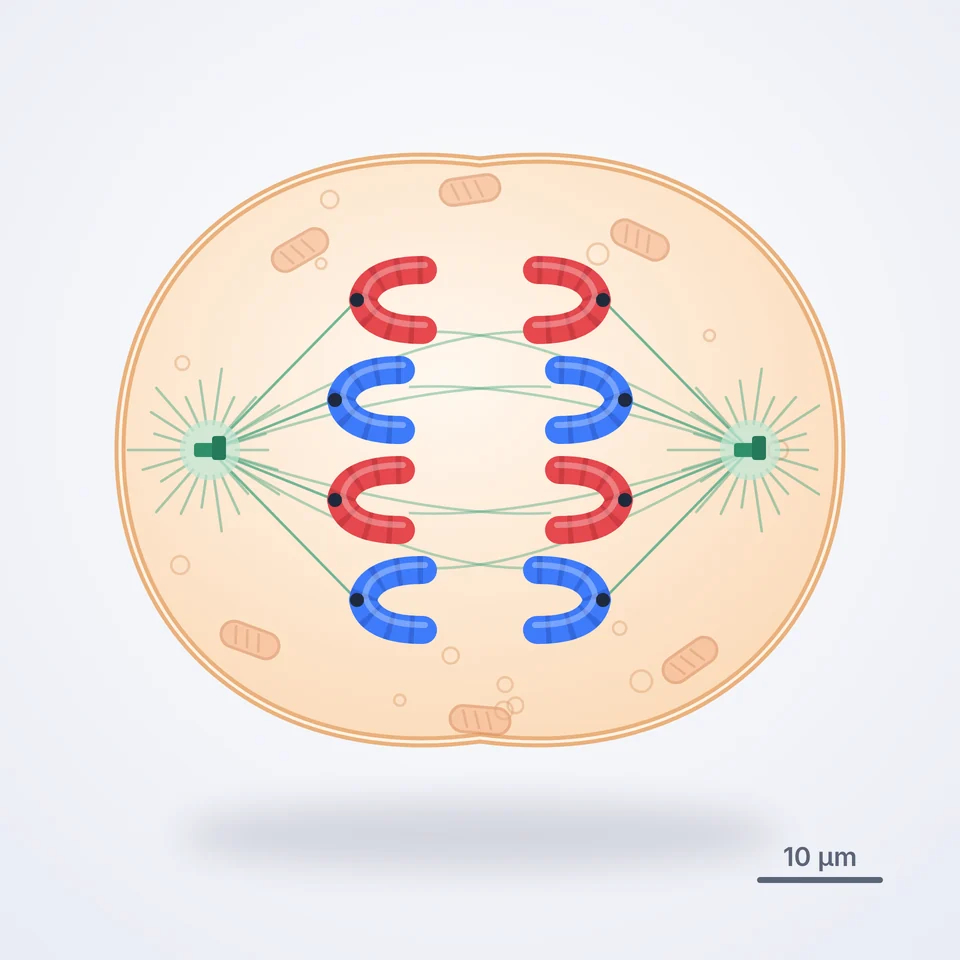
Prophase: the chromosomes condense and the centrosomes move apart, growing the spindle of microtubules between them. Prometaphase: the nuclear envelope breaks up and microtubules search the space until they catch a kinetochore; each sister ends up attached to the opposite pole. Metaphase: tugged from both sides, the chromosomes gather on the metaphase plate in the middle of the cell. Anaphase: an enzyme called separase cuts the cohesin, and the sisters are pulled apart as the kinetochore fibres shorten and the poles move away from each other. Telophase: the chromosomes arrive at the poles and unwind, and new nuclear envelopes form around each set.
The spindle checkpoint
A single chromosome without an attachment is enough to hold up anaphase. Unattached kinetochores send out a wait signal, and only when every chromosome is pulled from both sides does the cell trigger the separation. This spindle assembly checkpoint is why mitosis is so accurate: a human cell gets its 46 chromosomes right in all but a tiny fraction of divisions. Many cancer drugs, such as taxol, which freezes the microtubules, work by stopping cells in mitosis.
Cytokinesis
Dividing the nucleus is not yet dividing the cell. In animal cells a contractile ring of actin and myosin forms under the membrane at the cell's equator and tightens like a purse string, drawing in the cleavage furrow until the two cells pinch apart. Plant cells cannot pinch in because of their stiff wall. Instead, vesicles carrying wall material gather at the equator along a scaffold of microtubules, the phragmoplast, and fuse into a cell plate that grows outwards until it meets the old wall.
Meiosis
Meiosis makes the cells for sexual reproduction: eggs and sperm in animals, spores in plants and fungi. The DNA is copied once, and then the cell divides twice. Meiosis I separates the homologous chromosomes, halving the number of chromosomes per cell; meiosis II, which is much like mitosis, separates the sister chromatids. From one diploid cell come four haploid ones. In women only one of the four becomes an egg, and meiosis starts before birth and pauses for years; in men it goes on throughout life and takes about three and a half weeks.
Crossing over and independent assortment
In prophase I the homologues find each other and zip together along their length, held by the synaptonemal complex; biologists name the steps leptotene, zygotene, pachytene, diplotene and diakinesis. While they are paired, the DNA of a maternal and a paternal chromatid is cut and rejoined crosswise, exchanging pieces. The crossings show as chiasmata when the homologues pull apart. Then, in metaphase I, each pair settles on the plate with either homologue facing either pole, independently of the others. With 23 pairs that gives 2 to the power 23, over 8 million, ways to sort the chromosomes, before counting the crossovers: this is why siblings differ.
When division goes wrong
If a pair fails to separate, which is called nondisjunction, one cell gets an extra chromosome and the other is missing one. Most such embryos do not survive, but some do: trisomy 21 (Down syndrome), trisomy 18 and 13, and differences in the number of sex chromosomes such as Klinefelter syndrome (XXY) and Turner syndrome (a single X). The risk of nondisjunction in eggs rises with the mother's age, partly because the cohesin holding the chromosomes together weakens during the decades of waiting. In body cells, errors of mitosis and an uncontrolled cycle are hallmarks of cancer.
Seeing it for yourself
The tip of an onion root is the classic slide: the cells there divide all the time, and a squash stained with orcein or toluidine blue shows every phase at once. Counting how many cells are in each phase estimates how long the phases last, since a phase that takes longer is caught more often. In research, fluorescence microscopy shows the DNA, the microtubules and the centrosomes in different colours, and live imaging films the whole process.
Frequently asked questions
How long does mitosis take?
In a human cell in culture, about an hour, in a cycle of about 24 hours. Prophase and prometaphase take the longest, anaphase only a few minutes. The early embryos of frogs and flies divide much faster, every 10 to 30 minutes, by skipping the growth phases.
How many cells do mitosis and meiosis make?
Mitosis makes two daughter cells, each identical to the mother cell. Meiosis makes four haploid cells from one, although in human egg formation only one of them becomes the egg and the others, the small polar bodies, are lost.
Do bacteria divide by mitosis?
No. Bacteria and archaea have no nucleus and usually a single circular chromosome. They copy it and divide by binary fission, with a ring of a protein called FtsZ, a distant relative of tubulin, pinching the cell in two. Mitosis evolved in the ancestors of plants, animals and fungi.
What is the difference between a chromosome and a chromatid?
A chromatid is one of the two identical halves of a copied chromosome. Before the S phase a chromosome is a single DNA molecule; after it, the chromosome consists of two sister chromatids joined at the centromere, but it is still counted as one chromosome. Once the sisters separate in anaphase, each is a chromosome again.
Related tools
Cell division: mitosis and meiosis
Watch mitosis and meiosis phase by phase: interphase, prophase, metaphase, anaphase, telophase and cytokinesis, with real chromosomes, the spindle, crossing over and nondisjunction. Play, step or scrub through every phase and save the picture.
DNA double helix
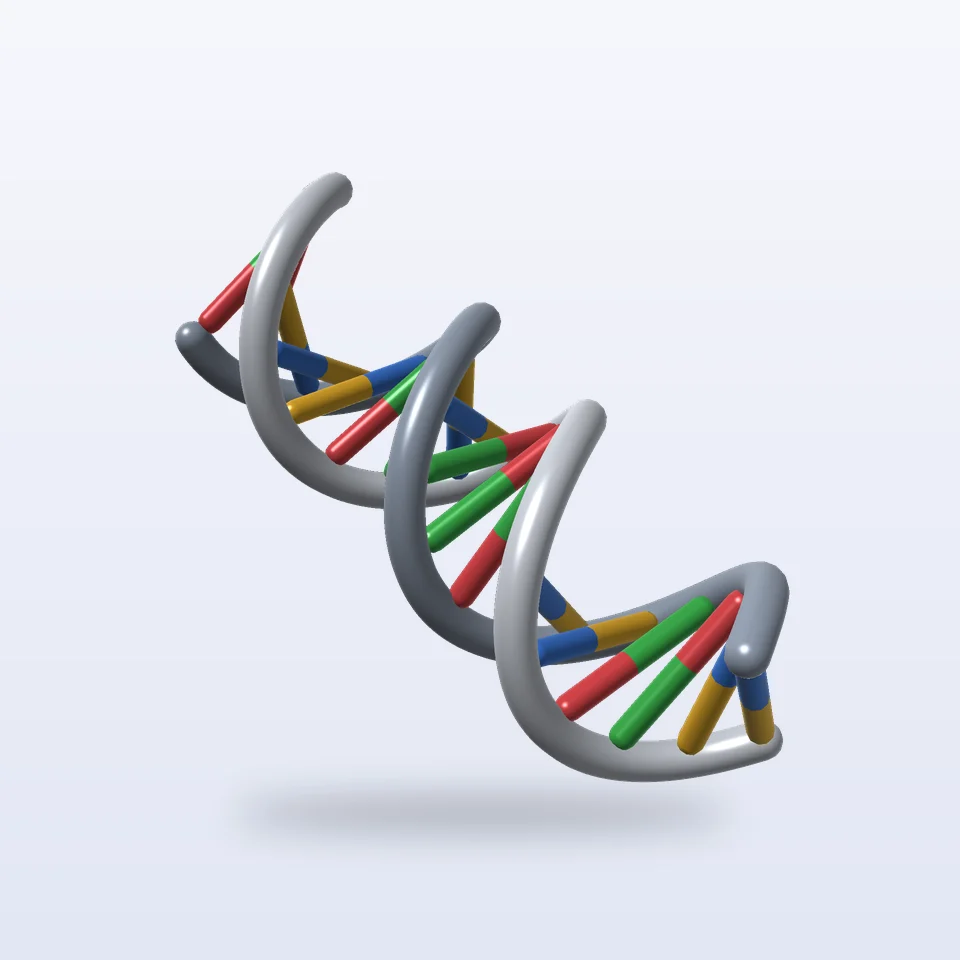
Type a DNA sequence and turn it as a double helix in 3D: the complementary strand fills in by base pairing, A with T and G with C. Compare B-, A- and Z-DNA, unzip the helix like a replication fork, and read the GC content, length and melting temperature.
Natural selection simulator
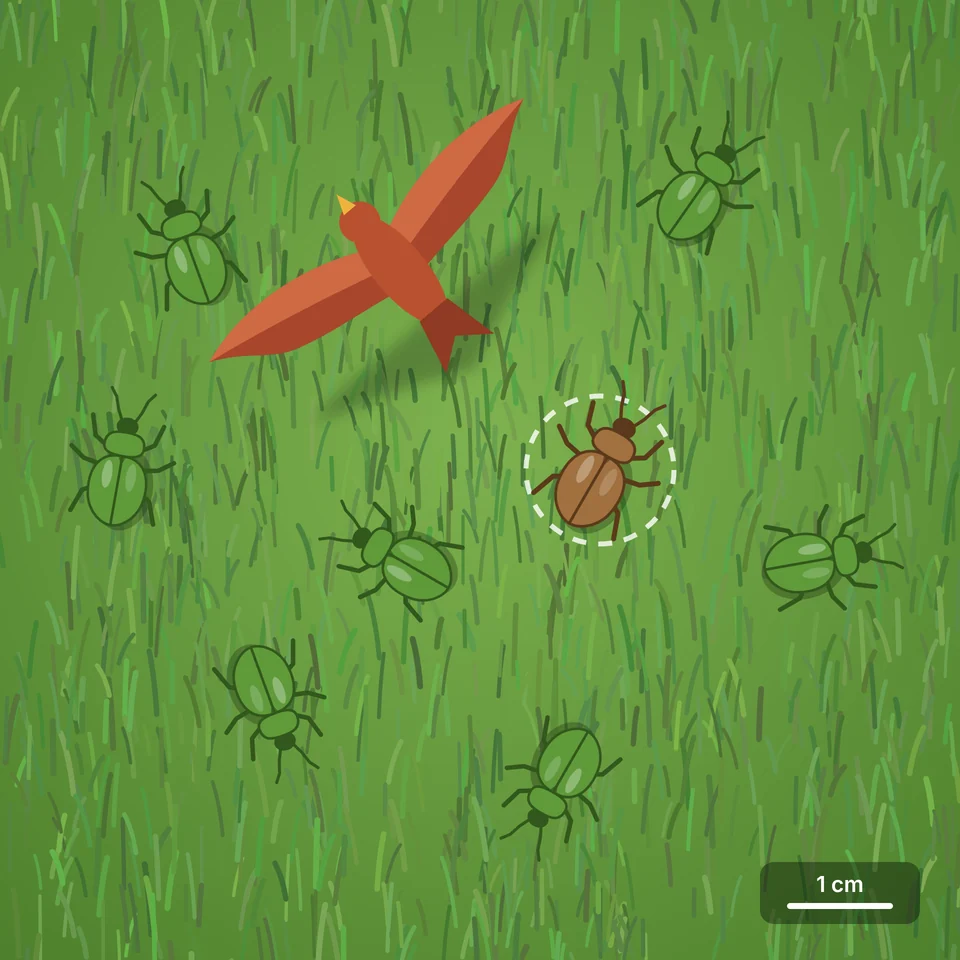
Watch evolution by natural selection: birds catch the beetles that stand out, food is limited, and the young inherit colour, size and speed with mutations. Replay the peppered moth and the beach mice, change the habitat during a run and see genetic drift.
Predator–Prey
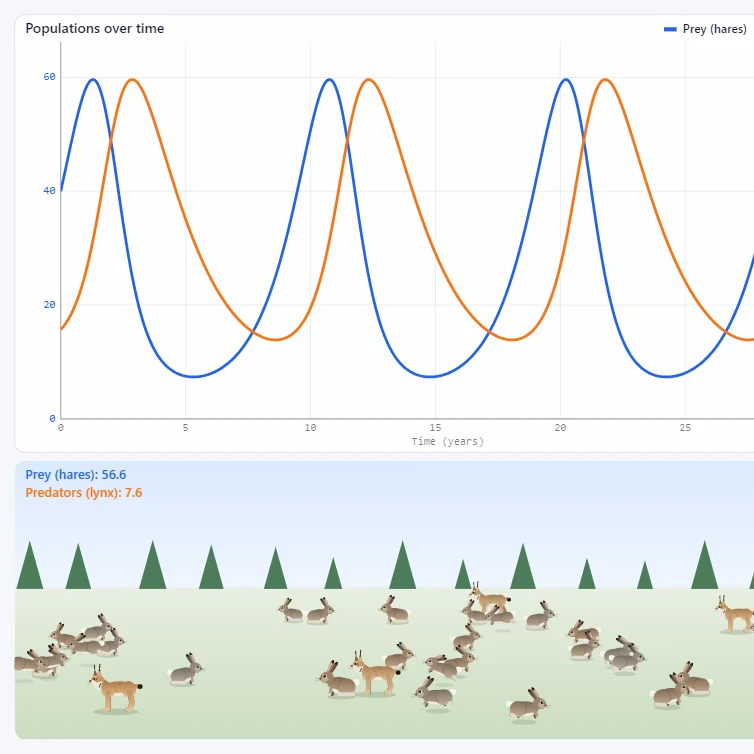
Watch hares and lynx rise and fall in the Lotka-Volterra model. Set the rates, see the predator peaks lag behind the prey peaks and follow the closed orbit in the phase plane.
Ready to try it?
Open PictorX in your browser — no install, no credit card required to start.
Open the cell division simulator