
| p | n − p | n − p is |
|---|
- n divisible by 3
- n = 3k + 1
- n = 3k + 2
Goldbach conjecture tester
Every even number greater than 2 seems to be the sum of two primes: 100 = 3 + 97 = 11 + 89 = 17 + 83 = 29 + 71 = 41 + 59 = 47 + 53. Goldbach guessed it in 1742 and nobody has proved it since. Type any even number up to 4 × 10^18 to watch the search for its first split, find the split closest to the middle, see all its splits drawn as arcs, and plot Goldbach's comet of how many splits each even number has. Enter an even number from 4 to 4 × 10^18. The table tries the primes p = 2, 3, 5 … in order until n − p is also prime, and shows why each one before it failed. The tiles show the split with the smallest p, the split closest to n/2 and how many splits Hardy and Littlewood's formula expects. Up to 10 million you also see every split, drawn as an arc from p to n − p: point at an arc, or click a split in the list, to highlight it. Hard cases jumps to numbers that need an unusually large p. Comet plots the number of splits of every even number up to a limit; click a dot to open that number.
How it works
- Enter an even number, or pick one of the hard cases that need an unusually large prime.
- Read the first split in the table of primes tried, the split closest to n/2 and the expected number of splits, and up to 10 million see every split as an arc.
- Switch to Comet to see how many splits every even number up to 200,000 has, and click a dot to open that number.
How the tester finds a split
To split n, try the primes p = 2, 3, 5, 7 and so on, and check whether n − p is prime. For 98 the first seven tries fail: 96, 95, 93, 91 = 7 × 13, 87, 85 and 81 all have small factors, so the first split is 19 + 79. Usually the search is over quickly, because a number near n is prime with a chance of about 1 in ln n. Even for numbers with 19 digits a few dozen tries are typical, but the record is 3,325,581,707,333,960,528, which needs p = 9,781, the 1,206th prime.
Goldbach's comet
Count the splits of every even number and plot them, and you get Goldbach's comet: a band of dots that rises and spreads out. 1,000,000 has 5,402 splits and 10,000,000 has 38,807, so the larger the number, the more ways it has and the harder a counterexample becomes to imagine. The comet has distinct bands because multiples of 3 have more splits: when n is divisible by 3, n − p is never divisible by 3 for a prime p above 3. Hardy and Littlewood turned this into a formula that predicts the counts to within about one percent.
Frequently asked questions
What is Goldbach's conjecture?
That every even number greater than 2 is the sum of two primes. Christian Goldbach suggested a version of it in a letter to Leonhard Euler in 1742, and Euler replied that he was sure it was true, although he could not prove it. It is still one of the oldest unsolved problems in mathematics.
Has it been checked by computer?
Yes, for every even number up to 4 × 10^18, by Tomás Oliveira e Silva, Siegfried Herzog and Silvio Pardi in 2013. Checking can never prove it for all numbers, but no exception has ever been found.
What is the weak Goldbach conjecture?
That every odd number greater than 5 is the sum of three primes. Unlike the even version, it has been proved: Ivan Vinogradov showed it for all large enough odd numbers in 1937, and Harald Helfgott closed the gap in 2013.
Why do some numbers have more splits than others?
Because of their prime factors. If n is divisible by 3, then for every prime p other than 3, n − p is not divisible by 3, so it has a better chance of being prime. Numbers divisible by 3, 5 and 7, like 210, have the most splits for their size.
How large a number can I test?
Any even number up to 4 × 10^18, the limit of the computer check. Primes are tested with a Miller–Rabin test that is exact in this range, and up to 10 million every split is found with a sieve. Everything runs in your browser.
Related tools
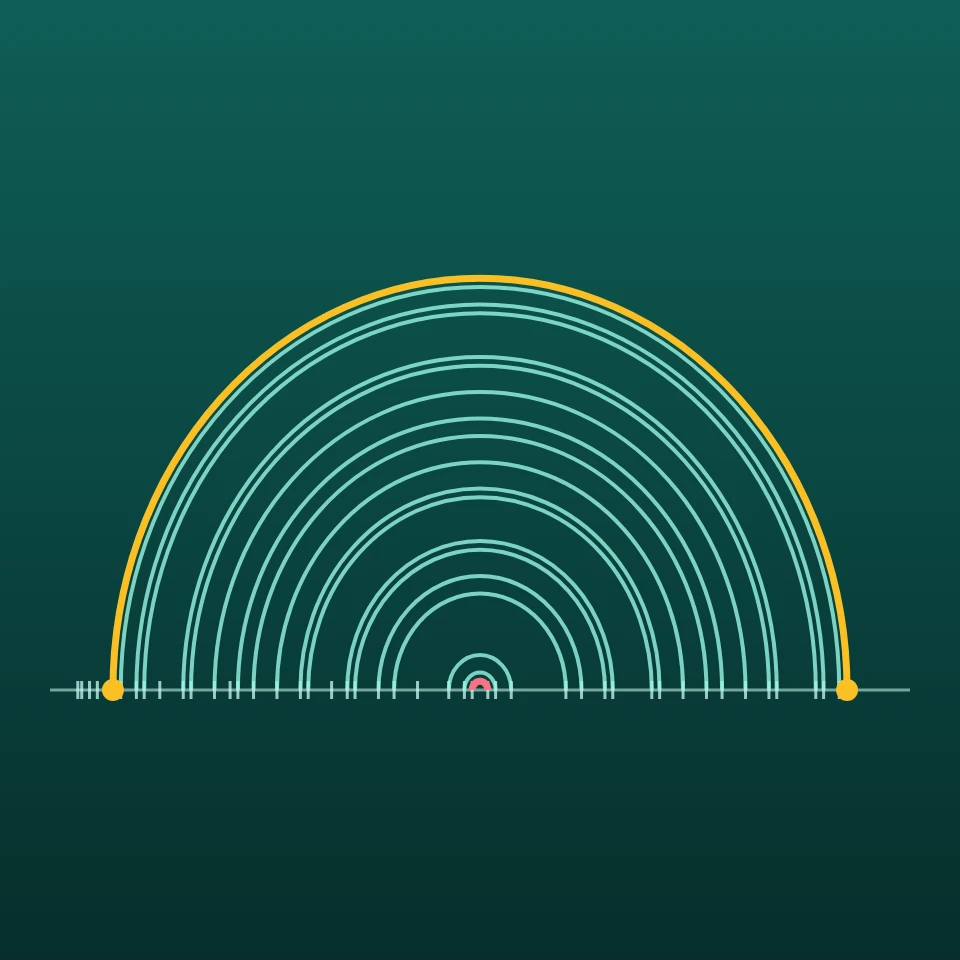
Goldbach's conjecture explained
What Goldbach's conjecture says, how it is checked up to 4 × 10^18, Goldbach's comet, Hardy and Littlewood's formula for the number of splits, and what has been proved: Vinogradov, Chen and Helfgott.
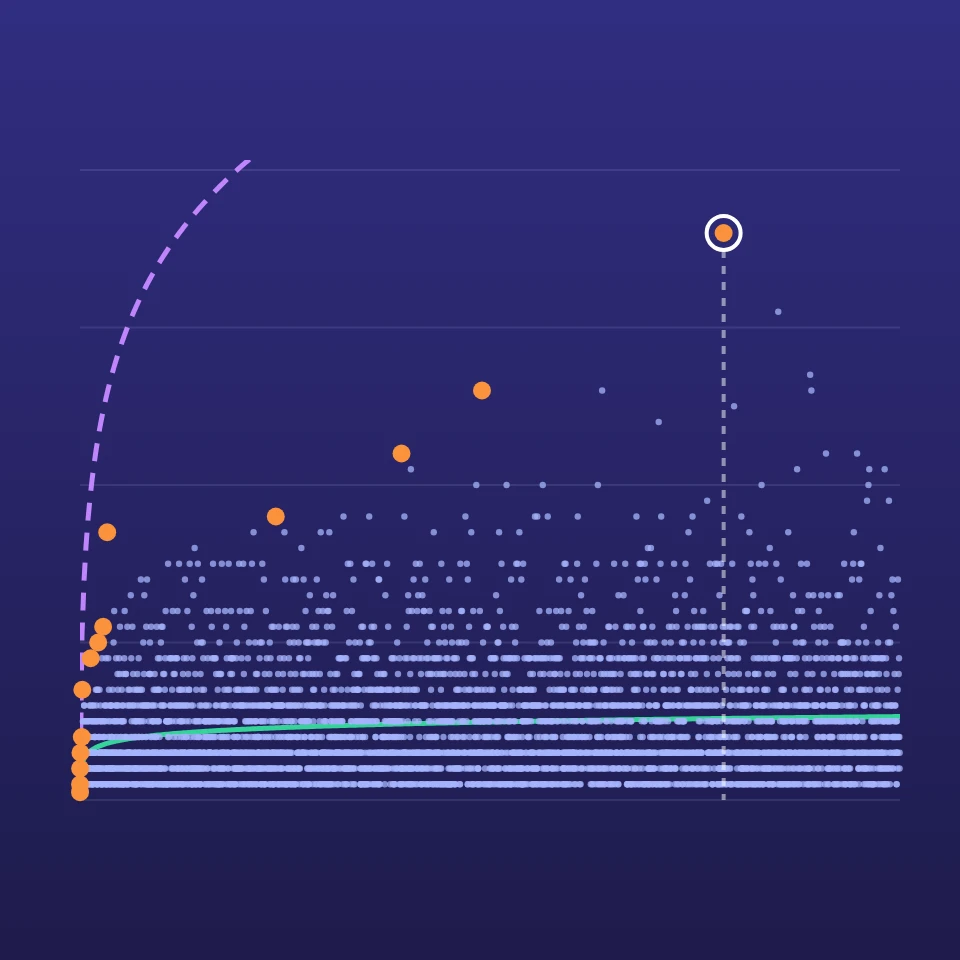
Prime gap explorer
Plot the gap between every pair of consecutive primes in any range up to 2 trillion. Compare it with ln p and Cramér's (ln p)², count twin primes, see how often each gap occurs and jump to the record gaps.
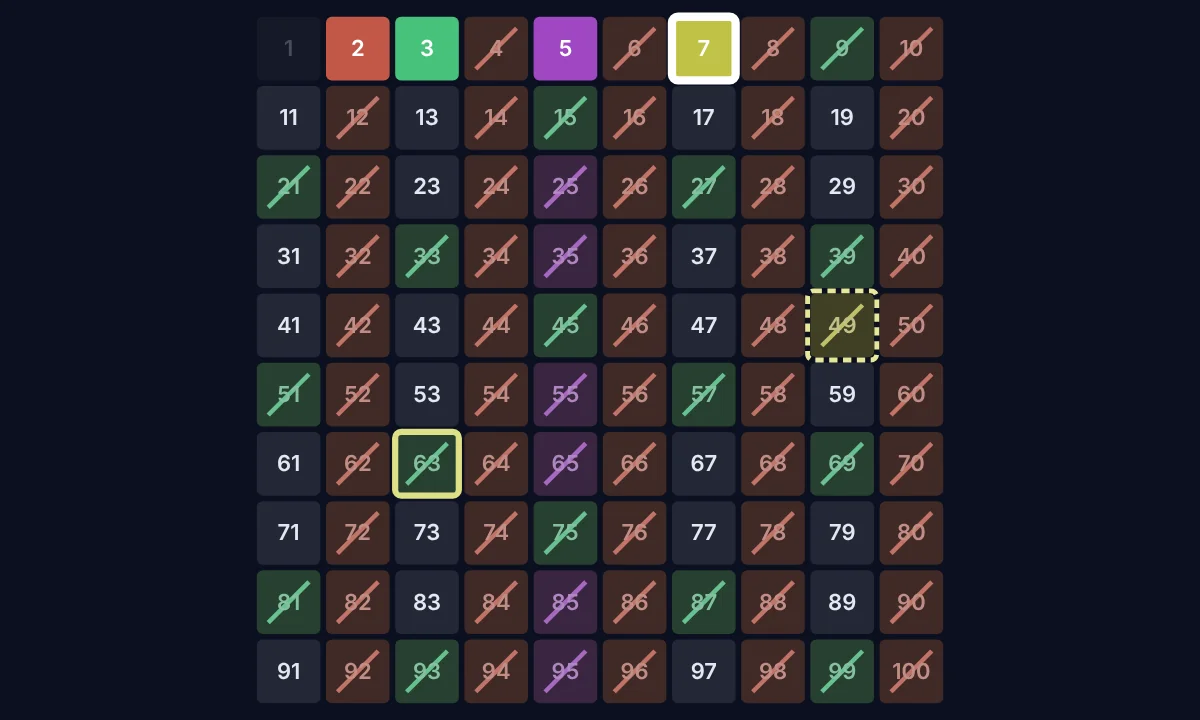
Sieve of Eratosthenes
Watch the Sieve of Eratosthenes find the prime numbers up to 100, 200, 500 or 1000. Each prime crosses out its multiples in its own colour, step by step.
Ulam spiral
Draw the Ulam spiral in your browser. Mark the primes, read the quadratic on each diagonal, and open Euler's unbroken run of 40 primes.
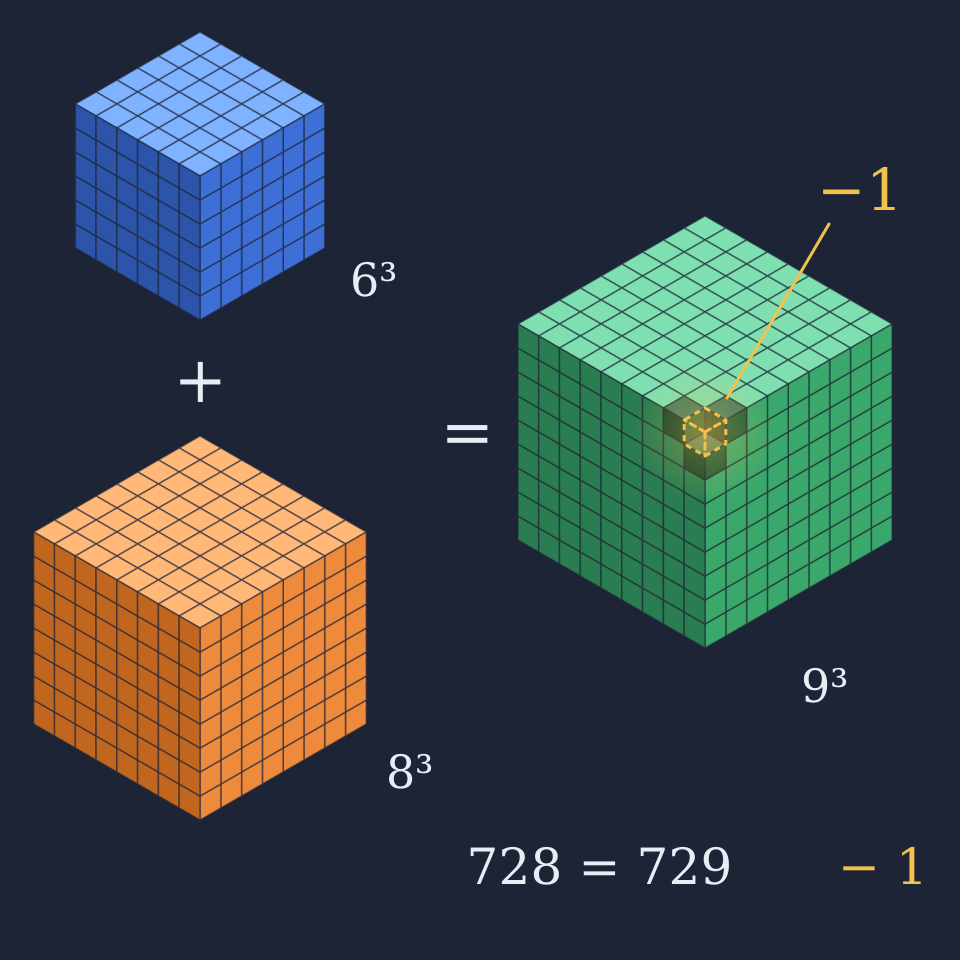
Fermat's Last Theorem
A free check of aⁿ + bⁿ = cⁿ for positive integers. See the Pythagorean triples for squares, and for every larger exponent the exact gap, including the near-miss from The Simpsons.
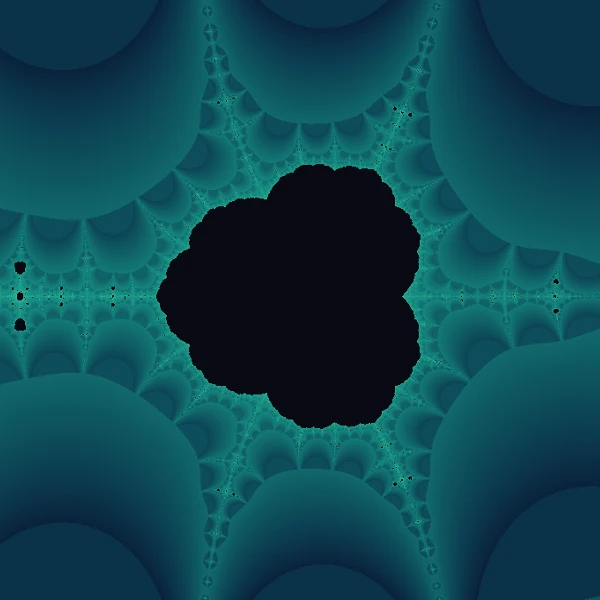
The Collatz Conjecture
Explore the Collatz 3n+1 problem in your browser. Walk hailstone sequences, grow a geometric Collatz tree, and zoom the continuous Collatz fractal.
Ready to try it?
Open PictorX in your browser — no install, no credit card required to start.
Go to Editor