
How to make fair teams
Picking teams sounds simple, until someone is chosen last again. Random teams are quick, fair and take the pressure off. This page explains how the team generator divides people and why it works.
Captains or chance
In many schoolyards two captains take turns picking players. It is quick, but the same children end up last, and the teams are often uneven because the captains pick their friends. Drawing teams at random removes both problems: nobody chooses, so nobody is chosen last, and over many rounds everyone plays with everyone.
Dealing names like cards
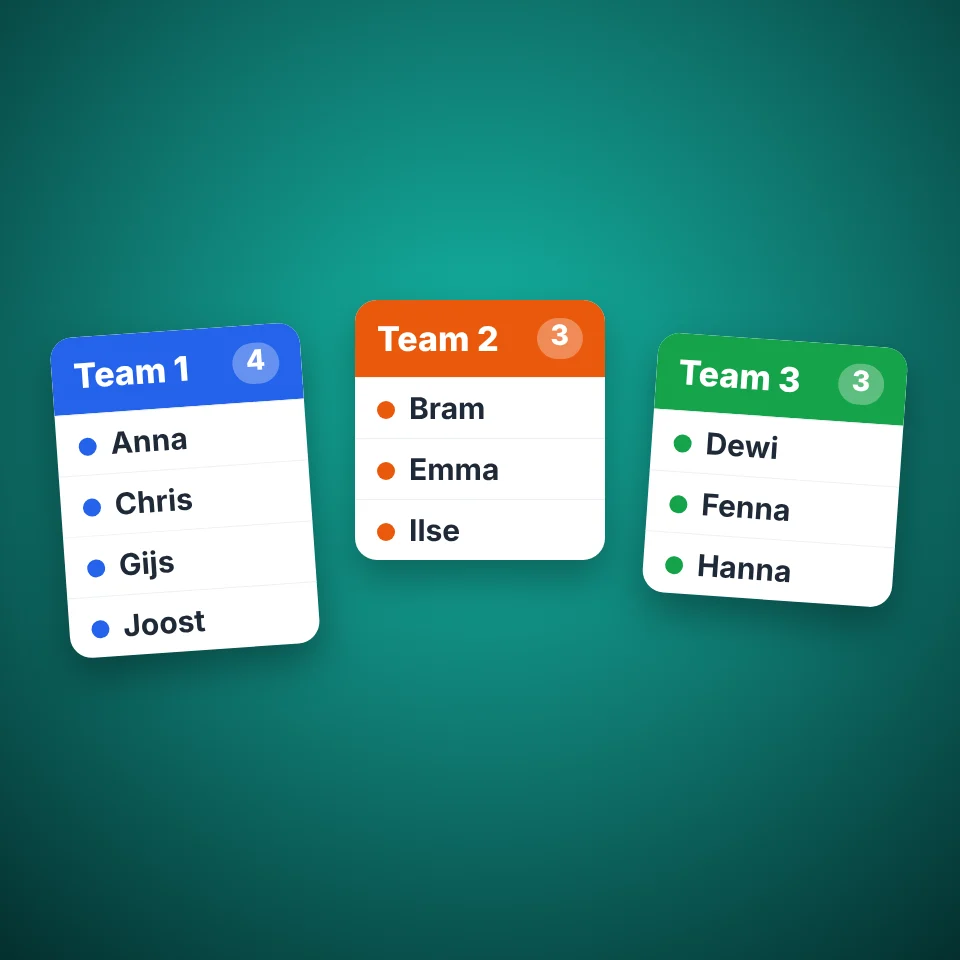
The team generator shuffles the names fairly and then deals them out one at a time, the way you deal cards to players around a table. That keeps team sizes within one of each other. Because every order of the names is equally likely, every possible split into teams of those sizes is equally likely too.
Random groups in class and at work
Teachers use random groups so that pupils work with classmates they would not choose themselves, and to avoid the same groups forming every time. At work, random breakout groups mix departments and get people talking who rarely meet. Mixing the groups each time is easy: one click makes a new split.
Frequently asked questions
Are random teams balanced in skill?
Not on purpose: chance does not know who is strong. Over many rounds things even out, and for one important match you can still move a player by hand after copying the teams.
How many ways are there to split people into teams?
Many. Twelve people can be split into two teams of six in 462 ways, and into three teams of four in 5,775 ways. The team generator picks one of them, each with the same chance.
Related tools
Team generator
Split a list of names into random, fair teams: choose the number of teams or the number of people per team, and get balanced teams in one click, to copy or save as a PDF.
Draw lots
Draw lots online: pick names from a hat for a raffle or an order, or let everyone draw someone else's name for Sinterklaas or Secret Santa, hidden until each person looks. Fair and free.
Random generator
Draw a random number from 1 to 10, 1 to 100 or any range, roll dice, draw playing cards, flip a coin or draw lots for a raffle or Secret Santa. Fair, free and with a history of your results.
Decision wheel
A free decision wheel: spin a wheel of your own options with weights and colors, get a fair random result, keep a spin history and save lists such as yes or no, dinner or numbers 1 to 10.
Ready to try it?
Open PictorX in your browser — no install, no credit card required to start.
Open the team generator