
The story and the numbers of bingo
Bingo looks like the simplest game there is: numbers are called and you mark them. Behind it are five centuries of lotteries, two main versions played on different sides of the Atlantic, and some neat probability.
From an Italian lottery
Bingo is usually traced back to Lo Giuoco del Lotto d'Italia, a national lottery of Italy that dates from around 1530. In the eighteenth century a version called le lotto was played in France, with cards of numbers and numbered tokens drawn from a bag, and lotto games spread across Europe as a pastime for families and clubs.
Beano becomes bingo
In the United States of the 1920s a lotto game called beano was played at fairs, with dried beans as markers. As the story goes, the New York toy salesman Edwin S. Lowe saw it in 1929, and a player who was so excited that she shouted bingo instead of beano gave it its name. Lowe sold the game as Bingo, and it soon became one of the best-known games in the country.
75-ball and 90-ball
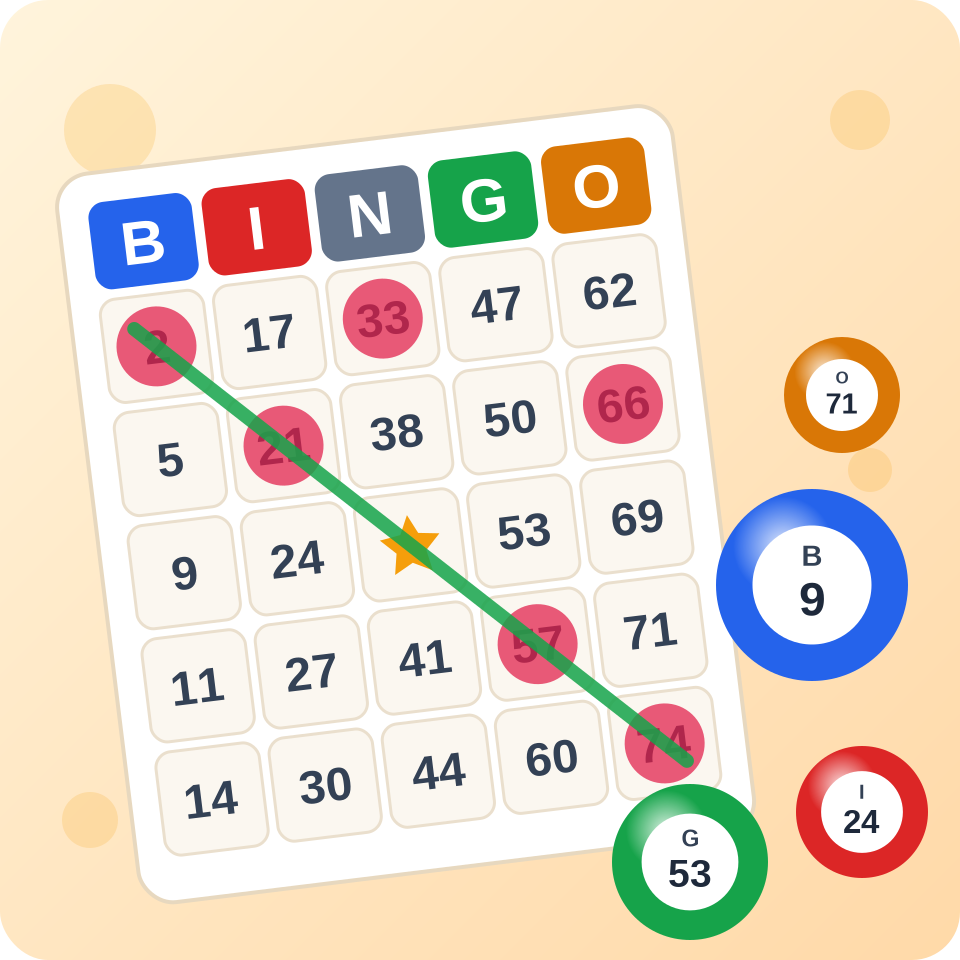
This game is 75-ball bingo, the version played in North America: a card of five columns under the letters B, I, N, G and O, with 1 to 15 under B, 16 to 30 under I and so on up to 75, and a free square in the middle. In Britain, Ireland and Australia 90-ball bingo is more common. Its tickets have three rows and nine columns, with fifteen numbers per ticket and five in each row, and there are prizes for one line, two lines and a full house.
How many balls does a game take?
Each column of a 75-ball card holds five of its fifteen numbers, so there are about 5.5 × 10²⁶ different cards if the order within a column counts, and still about 1.1 × 10¹⁷ when it doesn't. With a single card you need on average about 41 balls for a line, about 61 for the four corners and about 73 for a full house. More players means a shorter game: with three cards a line comes after about 33 balls on average, and in a hall with a hundred cards often within 20. Every ball has the same chance, so a number that has not come up for a while is no more likely next time.
Bingo calls
Callers in British bingo halls have a nickname for almost every number, often a rhyme or a picture of the digits: Kelly's eye for 1, legs eleven for 11, two little ducks for 22, clickety-click for 66, two fat ladies for 88 and top of the shop for 90. In 75-ball bingo the caller says the letter first, like B 7 or O 64, so players know at once which column to look in.
Frequently asked questions
Is bingo pure luck?
Yes. Every card has the same chance, and the balls are drawn at random. The only skill is to keep up: to mark every called number and call Bingo in time. More cards give you more chances to win, but also more numbers to watch.
What is the free square for?
The middle square of a 75-ball card has no number and counts as marked from the start. It makes the lines through the middle, and both diagonals, one number shorter, so games are a little quicker.
Why does each column have its own numbers?
So you can find a called number at once: B 7 can only be in the B column. It also spreads the numbers evenly over the card, so no card is much better than another.
Related tools
Bingo
Play 75-ball bingo online against the computer: one or two cards, a line, four corners or a full house, a caller at your speed and computers that call Bingo too.
Yahtzee
Play Yahtzee free in your browser. Roll five dice up to three times, hold the ones you want and fill 13 boxes. Play solo, with up to 4 players or against the computer.
Higher or Lower
Play Higher or Lower online: guess whether the next playing card is higher or lower, build the longest streak, and see the odds from the cards left in the deck. Aces high or low.
Random generator
Draw a random number from 1 to 10, 1 to 100 or any range, roll dice, draw playing cards, flip a coin or draw lots for a raffle or Secret Santa. Fair, free and with a history of your results.

Gambler's fallacy
Flip a fair coin 100 times a second and see what comes after every streak of 5 or 8 heads in a row. It is still 50/50: the coin has no memory.
Ready to try it?
Open PictorX in your browser — no install, no credit card required to start.
Play bingo