
Watch a matrix transform the plane
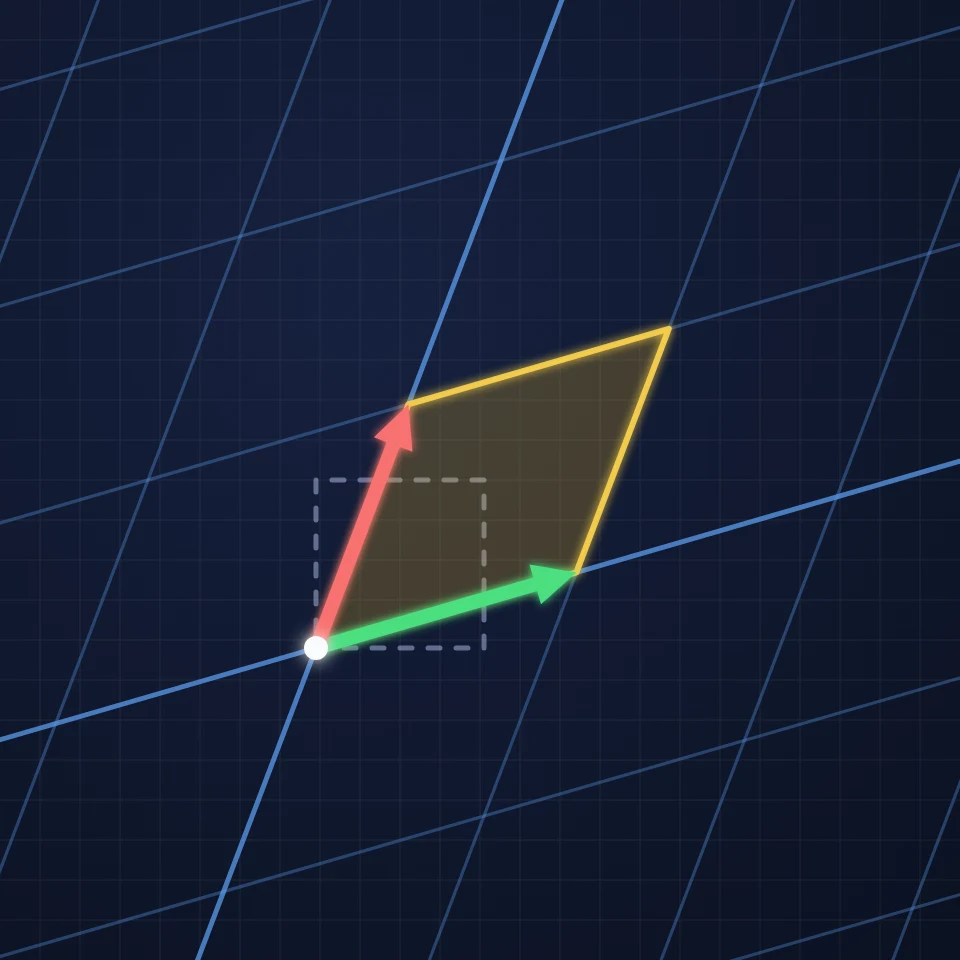
A 2×2 matrix is a machine that moves every point of the plane, and its two columns tell you everything: they are where the basis vectors î and ĵ land. Drag them, or type the entries, and watch the grid shear, turn, stretch or flip as the matrix grows out of the identity. The shaded parallelogram is the image of the unit square, so its area is the determinant; the dashed lines are the eigenvectors, the only directions that stay put; and the modes play the inverse, a composition of two matrices and the singular value decomposition. Type the four numbers of the matrix A under the picture (2, 3/4, √2/2 or cos 30 all work), or drag the tips of î and ĵ on the plane: the columns of A are where î = (1, 0) and ĵ = (0, 1) land, and every other point follows. Play animates from the identity to A. The faint grid is the plane before, the blue grid after; the shaded parallelogram spanned by î and ĵ has the area det A, orange when the orientation flips (the F is mirrored) and flat when det A = 0. The dashed lines are the eigenvectors, which only stretch; with complex eigenvalues no line stays put and the dots show a point spiralling under A, A², A³. Drag v to see Av. Pick a mode for the inverse round trip, the composition B·A next to A·B (the dashed outline), or the singular value decomposition played as turn, stretch, turn; the rotation-aware path turns a rotation instead of squashing it. Step and Back move a quarter of a stage, Reset goes back to the identity, and with Sound on a tone follows the determinant. Save the picture, record a video, or open it in the photo editor with the pencil: the grids, the shape, the basis vectors, the eigenvectors, v, the labels and the caption come as layers of their own.
Як це працює
- Type the four entries of A (2, 3/4, √2/2 or cos 30) or drag the tips of î and ĵ on the plane; with Snap on they land on halves.
- Press Play to grow the matrix out of the identity, on a straight path through the entries or a rotation-aware one, and read the matrix, determinant, trace, eigenvalues and area scale in the tiles.
- Pick a mode for the inverse round trip, the composition B·A next to A·B, or the singular value decomposition played as turn, stretch, turn; drag v to follow Av.
- Try the examples, from a rotation and a shear to a projection and a singular matrix, then save the picture, record a video or edit it in the photo editor.
Columns are where î and ĵ land
A linear transformation keeps the origin where it is and keeps lines straight, so the grid stays parallel and evenly spaced. That means it is decided by two vectors: where î = (1, 0) and ĵ = (0, 1) go. Write them as the columns of a matrix A = [a b; c d] and the image of any point follows by linearity: A(x, y) = x·(a, c) + y·(b, d) = (ax + by, cx + dy). That is all matrix-vector multiplication is.
The determinant is an area
The unit square spanned by î and ĵ lands on the parallelogram spanned by the columns, whose area is |ad − bc|. Every other region is made of little squares that scale the same way, so det A is the factor by which A changes all areas. Its sign records orientation: a negative determinant means the plane has been flipped over, and the letter F comes out mirrored. A zero determinant means the columns are parallel and the whole plane is squashed onto a line (or a point), which is why such a matrix has no inverse.
Eigenvectors stay on their line
Most vectors are knocked off their line by A, but an eigenvector only stretches: Av = λv. The eigenvalues are the roots of the characteristic polynomial λ² − (a + d)λ + (ad − bc), so their sum is the trace and their product the determinant. A symmetric matrix such as [2 1; 1 2] has two perpendicular eigen-lines, stretched by 3 and 1; a shear has only one; and when the discriminant (a + d)² − 4(ad − bc) is negative the eigenvalues are complex, no line stays put, and A acts as a rotation combined with a scaling in a suitable basis.
Inverse, composition and SVD
If det A ≠ 0, the inverse A⁻¹ = (1/(ad − bc))·[d −b; −c a] undoes A, and the round-trip mode plays A and then A⁻¹ back to the identity. Doing A and then B is the single matrix BA, read from right to left, and in general BA ≠ AB: a turn followed by a shear is not a shear followed by a turn. The singular value decomposition A = UΣVᵀ says that every matrix is a rotation, a stretch along the axes by the singular values σ₁ ≥ σ₂ ≥ 0, and another rotation (with a reflection when det A < 0); for the shear [1 1; 0 1] the singular values are the golden ratio 1.618 and its inverse 0.618.
Поширені запитання
What does a 2×2 matrix do to the plane?
It moves every point (x, y) to (ax + by, cx + dy). The origin stays put, straight lines stay straight, and parallel, evenly spaced grid lines stay parallel and evenly spaced, though they may be turned, stretched, sheared or flipped. The columns of the matrix are the images of the basis vectors: the first column is where î = (1, 0) goes and the second where ĵ = (0, 1) goes, which is why dragging their tips in the app edits the matrix.
Why is the determinant an area?
The unit square has area 1 and lands on the parallelogram spanned by the columns (a, c) and (b, d), whose area is |ad − bc|. Since a linear map scales every small square by the same factor, all areas are multiplied by |det A|. The sign tells the orientation: positive when î still turns counter-clockwise to ĵ, negative when the order has flipped, as in a reflection, where the F appears mirrored.
What happens when the determinant is zero?
The columns point along the same line, so every point of the plane lands on that line (or, for the zero matrix, on the origin). Different points land on the same place, so the map cannot be undone: a singular matrix has no inverse. Projection onto a line is the typical example; its eigenvalues are 1 along the line and 0 across it, and the app shows the grid collapsing as the animation ends.
How do you find the eigenvalues and eigenvectors of a 2×2 matrix?
Solve det(A − λI) = 0, which is λ² − (a + d)λ + (ad − bc) = 0, so λ = (tr ± √(tr² − 4 det)) / 2. For each real λ an eigenvector is (b, λ − a), or (λ − d, c) when that is zero. For [2 1; 1 2] the eigenvalues are 3 and 1 with the eigenvectors (1, 1) and (1, −1). On the app's straight animation path (1 − t)I + tA these lines never move: the vectors on them only grow or shrink.
Why is BA not equal to AB?
Because the order of transformations matters. BA means apply A first and then B (a matrix acts on the vector to its right). Turning by 90° and then shearing sends î to (1, 1) and ĵ to (−1, 0), so BA = [1 −1; 1 0]; shearing first and then turning gives AB = [0 −1; 1 1]. The composition mode plays A, then B, and draws the other order as a dashed outline; the two coincide only for special pairs, such as two rotations or two scalings along the same axes.
Can I use the picture?
Yes. Save gives a PNG at the size you choose, Record films the animation with its sound, and the pencil opens the picture in the PictorX photo editor with the background, the original grid, the transformed grid, the shape, the basis vectors, the eigenvectors, the vector v and the labels on layers of their own and the caption as editable text. In the editor itself it is under Apps ▸ Science ▸ Mathematics ▸ Linear Transformations. For exact arithmetic on bigger matrices, the Matrix Calculator handles up to 6 × 6 with fractions. Everything runs in your browser.
Linear Transformations: як записати відео?
Натисніть червону кнопку «Запис» на панелі відтворення: вона знімає те, що показує сцена. Натисніть її ще раз, щоб зупинити, і відео збережеться на вашому пристрої. Запис безкоштовний, потрібно лише увійти. Без підписки на відео в куті буде невеликий логотип PictorX. Кнопка поруч із «Запис» відкриває параметри відео: формат (як показано, квадрат, сторіз 9:16 або широкий 16:9), тривалість (доки ви не зупините, або 5, 10, 15 чи 30 секунд для соцмереж) і файл: MP4, WebM або анімований GIF. Для звуку виберіть власні звуки застосунку або одну з трьох музичних доріжок: спокійну, яскраву чи ритмічну.
Схожі інструменти
Linear transformations explained
How a 2×2 matrix moves the plane: why its columns are the images of the basis vectors, why the determinant is a signed area, what singular matrices, eigenvalues and complex eigenvalues mean geometrically, how inverses and products of matrices work, and how the polar and singular value decompositions split any matrix into rotations and stretches.
Матричний калькулятор
Безкоштовний онлайн-калькулятор матриць: додавайте, віднімайте, множте, транспонуйте й обертайте матриці розміром до 6x6, обчислюйте визначник, ранг і степені з точними дробами.

Complex numbers you can drag, multiply and turn
Drag complex numbers on the Argand plane and watch the arithmetic: addition as a parallelogram, multiplication as a turn and a stretch, division, the conjugate and 1/z, rectangular and polar form, powers by De Moivre's formula, n-th roots and roots of unity, Euler's formula e^(iθ) = cos θ + i sin θ and the complex roots of a quadratic.

The unit circle: sine, cosine and tangent you can turn
Drag an angle round the unit circle and see sin, cos and tan as segments, with exact values for 30°, 45°, 60° and every special angle, degrees and radians as multiples of π, the quadrant signs (ASTC), the reference angle, the sine and cosine graphs traced live and identities checked with real numbers.
Готові спробувати?
Відкрийте PictorX у браузері — без встановлення і без кредитної картки.
Перейти до редактора