
Complex numbers you can drag, multiply and turn
A complex number a + bi is a point in the plane, and its arithmetic is geometry. Drag z and w and the sum appears as the diagonal of a parallelogram; multiply them and the arrows' lengths multiply while their angles add, so multiplying by i is a quarter turn and i² = −1. Raise a number to a power and it spirals out, take its n-th roots and they sit on a regular polygon, and let θ turn to see e^(iθ) travel round the unit circle until e^(iπ) + 1 = 0. Drag the points z and w on the plane, or type them under the picture as 3 + 2i, 2∠45°, 2e^(iπ/4) or a small expression such as (1 + i)^3; with Snap on they land on whole numbers. Pick an operation: the sum is the diagonal of the parallelogram, the product turns z by the angle of w and stretches it by its length (the arcs show the arguments adding), the conjugate is a reflection in the real axis and 1/z an inversion in the unit circle. Powers spiral out from 1 (De Moivre), the n-th roots of z sit at the corners of a regular polygon, and Euler's formula sends e^(iθ) round the unit circle with cos θ and sin θ as its shadows. The quadratic shows the roots of az² + bz + c, a conjugate pair when the discriminant is negative. Play turns w (or z), glides along the powers, turns θ or sweeps the quadratic; Step and Back take one step and Reset goes back to the numbers in the fields. With Sound on, a tone follows the angle. Save the picture, record a video, or open it in the photo editor with the pencil: the grid, the unit circle, the vectors, the construction, the results, the points, the labels and the caption come as layers of their own.
Як це працює
- Drag z and w on the plane or type them as 3 + 2i, 2∠45° or 2e^(iπ/4); with Snap on they land on whole numbers.
- Pick an operation and read z, w, the result in rectangular form, its modulus and its argument in the tiles; write the labels as a + bi, r·e^(iθ) or r∠θ, in degrees or radians.
- Press Play to turn w round the origin, glide along the powers zⁿ, turn θ in Euler's formula or sweep a quadratic until its roots become a conjugate pair.
- Try the examples, from i² = −1 and the cube roots of 8 to Euler's identity, then save the picture, record a video or edit it in the photo editor.
The complex plane
Every complex number z = a + bi is a point of the plane, a units along the real axis and b units up the imaginary axis; drawn as an arrow from 0 it is also a vector. Its modulus |z| = √(a² + b²) is the arrow's length and its argument arg z is the angle from the positive real axis, so z = r(cos θ + i sin θ) in polar form. The picture is called an Argand diagram after Jean-Robert Argand, who published it in 1806; Caspar Wessel had described it in 1797.
Adding and multiplying
Complex numbers add like arrows: (3 + i) + (1 + 2i) = 4 + 3i, the diagonal of the parallelogram on z and w. Multiplication is where the plane shows its power. Expanding (a + bi)(c + di) with i² = −1 gives (ac − bd) + (ad + bc)i, and in polar form the moduli multiply and the arguments add. Multiplying by w turns every point by arg w and stretches it by |w|, so the triangle 0, 1, z is similar to the triangle 0, w, zw. Since i has modulus 1 and argument 90°, i·i is a half turn: −1.
Conjugates, division and 1/z
The conjugate z̄ = a − bi is the reflection of z in the real axis, and z·z̄ = a² + b² = |z|² is real. That is how to divide: multiply the top and the bottom by the conjugate of the denominator, so 1/z = z̄ / |z|². Geometrically 1/z has the modulus 1/|z| and the argument −arg z: an inversion in the unit circle followed by a reflection. Dividing by w therefore divides the moduli and subtracts the arguments.
Powers, roots and Euler's formula
De Moivre's formula (r(cos θ + i sin θ))ⁿ = rⁿ(cos nθ + i sin nθ) turns powers into turning: (1 + i)⁸ has the modulus (√2)⁸ = 16 and the argument 8 × 45° = 360°, so it is 16. Run backwards it gives the n-th roots: a number has exactly n of them, on a circle of radius ⁿ√r, 360°/n apart, the corners of a regular polygon. Euler's formula e^(iθ) = cos θ + i sin θ says the same in one line: e^(iθ) is the point at angle θ on the unit circle, and at θ = π it gives e^(iπ) + 1 = 0.
Поширені запитання
What is i, the imaginary unit?
i is a number whose square is −1. No real number has that property, so i lies off the real line, one unit up the imaginary axis. Cardano and Bombelli met square roots of negative numbers in the 16th century while solving cubic equations and found that calculating with them gave correct real answers; today i is as ordinary as a negative number. Multiplying by i turns a point a quarter turn counter-clockwise, which is why doing it twice gives −1.
How do you convert a + bi to polar form?
The modulus is r = √(a² + b²) and the argument θ is the angle of the point (a, b), found with atan2(b, a) so that it lands in the right quadrant. Then a + bi = r(cos θ + i sin θ) = r·e^(iθ), also written r∠θ or r cis θ. For 1 + i, r = √2 and θ = 45° (π/4); for −1 + i√3, r = 2 and θ = 120°. Back again: a = r cos θ and b = r sin θ.
Why does multiplying complex numbers rotate them?
Write both in polar form: r₁e^(iθ₁) · r₂e^(iθ₂) = r₁r₂e^(i(θ₁ + θ₂)). The lengths multiply and the angles add, so multiplying every point of the plane by w is a rotation by arg w combined with a scaling by |w|. The Multiplying a shape example applies it to a letter F and to the grid: the shape turns and grows but keeps its form, which is why multiplication by a complex number is a similarity.
How many n-th roots does a complex number have?
Exactly n, unless the number is 0. If z = r·e^(iθ), the roots are ⁿ√r·e^(i(θ + 2πk)/n) for k = 0, 1, …, n − 1: the same modulus, arguments 360°/n apart, so they form a regular n-gon centred at 0. The cube roots of 8 are 2 and −1 ± i√3; the n-th roots of 1, the roots of unity, are the corners of a regular polygon on the unit circle and always add up to 0.
Why is e^(iπ) + 1 = 0?
Euler's formula e^(iθ) = cos θ + i sin θ follows from the power series of eˣ, cos x and sin x, or from the limit (1 + iθ/n)ⁿ, n small turns and stretches that the app draws as a polygon. It places e^(iθ) on the unit circle at the angle θ in radians. Half a turn, θ = π, lands on −1, so e^(iπ) = −1 and e^(iπ) + 1 = 0, which links e, i, π, 1 and 0 in one equation.
Can I use the picture?
Yes. Save gives a PNG at the size you choose, Record films the turning, the spiral of powers or the moving roots with its sound, and the pencil opens the picture in the PictorX photo editor with the background grid, the unit circle, the vectors, the construction, the results, the points and the labels on layers of their own and the caption as editable text. In the editor itself it is under Apps ▸ Science ▸ Mathematics ▸ Complex Numbers. Everything runs in your browser.
Complex Numbers: як записати відео?
Натисніть червону кнопку «Запис» на панелі відтворення: вона знімає те, що показує сцена. Натисніть її ще раз, щоб зупинити, і відео збережеться на вашому пристрої. Запис безкоштовний, потрібно лише увійти. Без підписки на відео в куті буде невеликий логотип PictorX. Кнопка поруч із «Запис» відкриває параметри відео: формат (як показано, квадрат, сторіз 9:16 або широкий 16:9), тривалість (доки ви не зупините, або 5, 10, 15 чи 30 секунд для соцмереж) і файл: MP4, WebM або анімований GIF. Для звуку виберіть власні звуки застосунку або одну з трьох музичних доріжок: спокійну, яскраву чи ритмічну.
Схожі інструменти
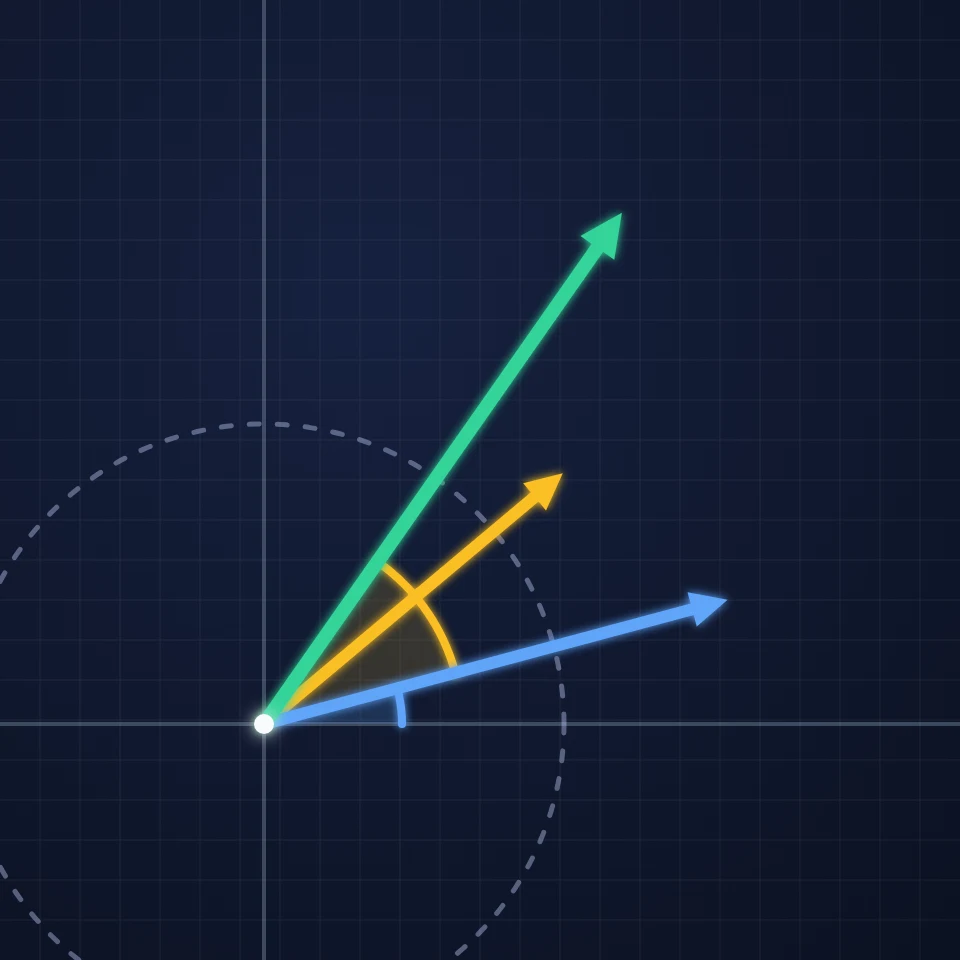
Complex numbers explained
What complex numbers are and why they work: the imaginary unit i, the complex plane, modulus and argument, addition as vectors, multiplication as rotation and scaling, conjugates and division, De Moivre's formula, n-th roots and roots of unity, Euler's formula and the fundamental theorem of algebra.
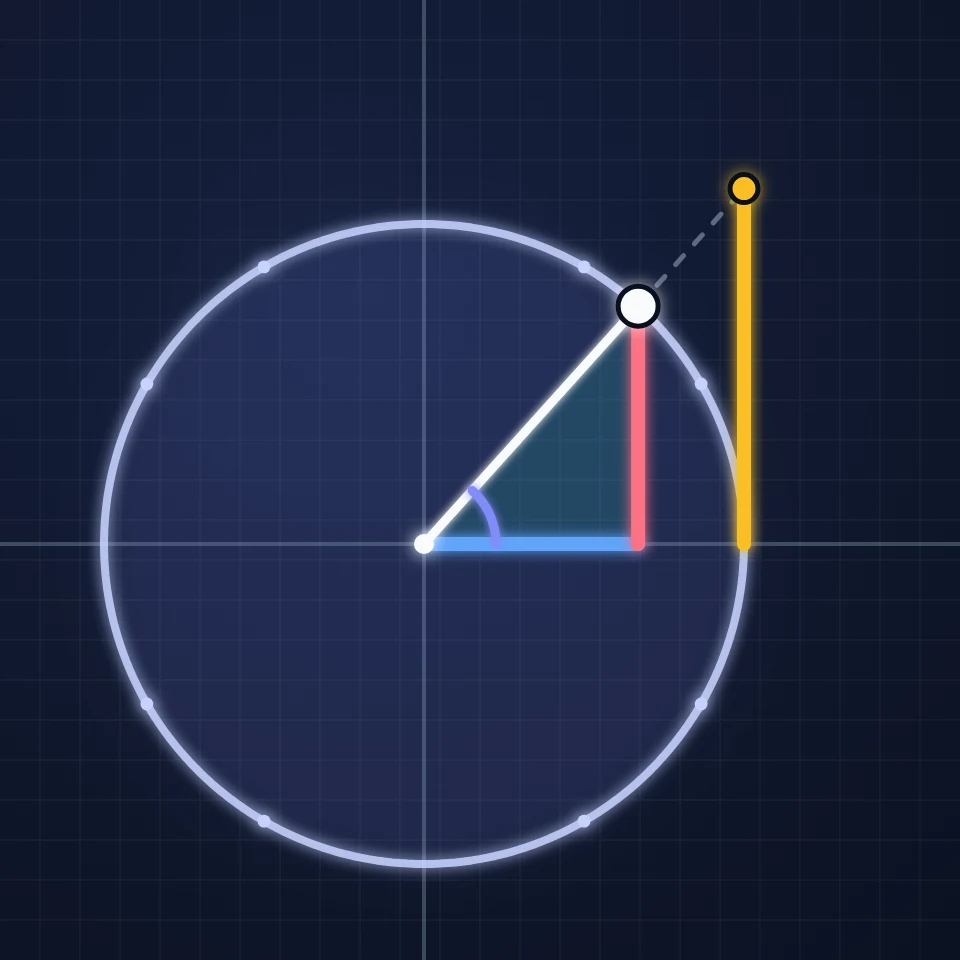
The unit circle: sine, cosine and tangent you can turn
Drag an angle round the unit circle and see sin, cos and tan as segments, with exact values for 30°, 45°, 60° and every special angle, degrees and radians as multiples of π, the quadrant signs (ASTC), the reference angle, the sine and cosine graphs traced live and identities checked with real numbers.
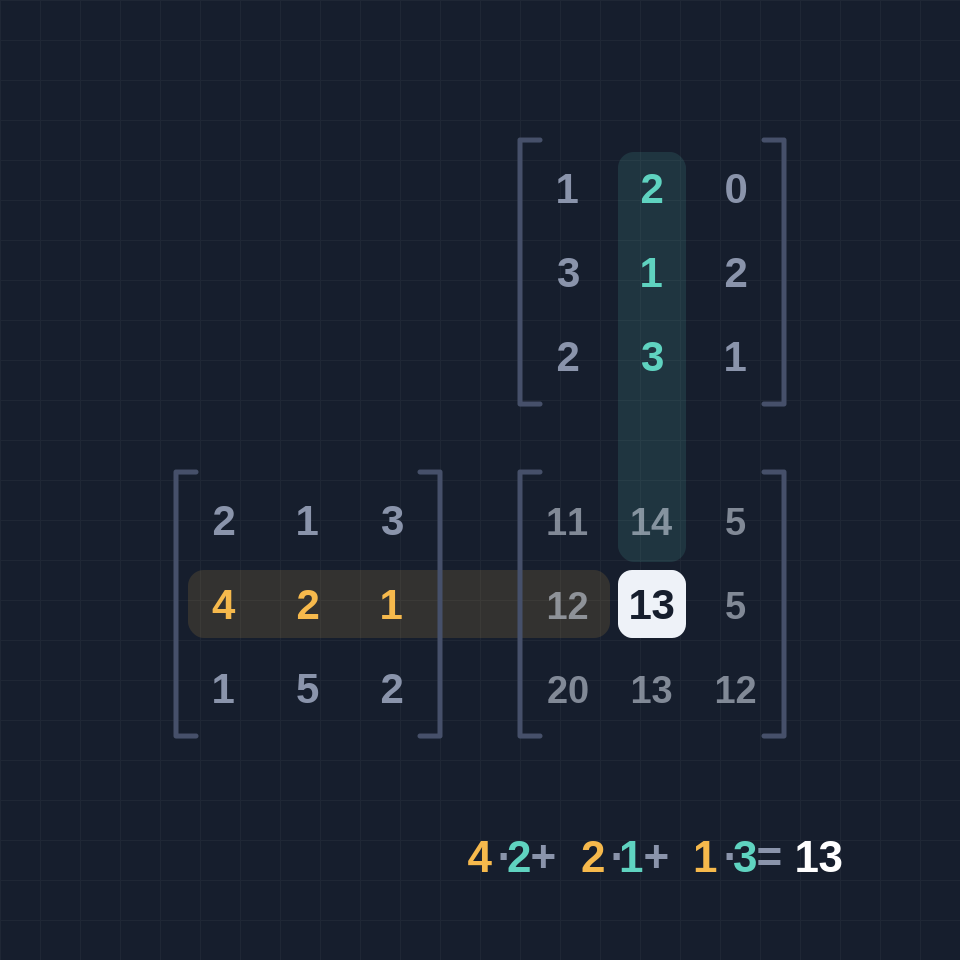
Матричний калькулятор
Безкоштовний онлайн-калькулятор матриць: додавайте, віднімайте, множте, транспонуйте й обертайте матриці розміром до 6x6, обчислюйте визначник, ранг і степені з точними дробами.
Епіцикли Фур'є
Намалюйте будь-яку фігуру й подивіться, як її обводять кола, що обертаються: епіцикли Фур'є онлайн. Виберіть серце, зірку чи метелика, введіть слово, задайте, скільки кіл обертається, і збережіть PNG або SVG.
Готові спробувати?
Відкрийте PictorX у браузері — без встановлення і без кредитної картки.
Перейти до редактора