
Percentages
Amount of substance
View
Molar mass calculator: weigh any formula
One mole of any substance contains 6.02214076 × 10²³ particles, and its mass in grams is the molar mass. Type a formula such as H₂O, Ca₃(PO₄)₂ or CuSO₄·5H₂O and the calculator adds up the atomic weights, shows how the mass divides between the elements, converts between grams, moles, particles and litres of gas, and works backwards from a composition to the formula. Type a chemical formula, or pick an example, and the molar mass appears at once, with the share of each element by mass as blocks, a pie chart and a table. Write counts after the element (H2O; Unicode subscripts work too), groups in brackets with their count after them (Ca(OH)2, K4[Fe(CN)6]), water of crystallisation after a dot or a star (CuSO4·5H2O, CuSO4*5H2O), a number in front for several formula units (2H2O), isotopes with their mass number (¹³C, [13C], D2O) and a charge at the end (SO4^2-, SO₄²⁻, NH4+): it is shown but does not change the mass. A mistake is pointed out with the character where it happens. Under Amount, type a mass, a number of moles, a number of particles (6.022e23 works) or the litres of a gas at STP, and the tiles convert it into the others. Switch Calculate to From mass percentages to find the empirical formula from a composition such as C 40.92, H 4.58, O 54.50; leave the number off one element to give it the rest, and add the molar mass to get the molecular formula. Use this formula then weighs it. Save the picture, or open it in the photo editor with the pencil: each element's block, the chart, the table and the words come as layers of their own.
Як це працює
- Type a formula or pick an example: water, table salt, glucose, caffeine, aspirin, copper(II) sulfate pentahydrate, chlorophyll a and more.
- Read the molar mass in g/mol and see each element's share of the mass in the blocks, the pie chart and the table.
- Enter an amount in grams, moles, particles or litres of gas at STP and the tiles convert it into the others.
- Switch to From mass percentages to find the empirical and molecular formula from a composition, then save the picture or edit it in the photo editor.
What molar mass means
The molar mass M of a substance is the mass of one mole of it, in grams per mole. A mole is a fixed number of particles, the Avogadro constant Nₐ = 6.02214076 × 10²³, chosen so that the molar mass in g/mol is the same number as the mass of one particle in daltons. To find it, add up the atomic weights of all the atoms in the formula: water, H₂O, is 2 × 1.008 + 15.999 = 18.015 g/mol, so 18 grams of water hold about 6.022 × 10²³ molecules.
Reading a formula
A number after an element counts its atoms (H₂O has two hydrogens), and a number after brackets multiplies everything inside: Ca₃(PO₄)₂ has 3 calcium, 2 phosphorus and 8 oxygen atoms. Square brackets mark complex ions, as in K₄[Fe(CN)₆]. A dot joins water of crystallisation: CuSO₄·5H₂O is one copper sulfate with five water molecules, 249.68 g/mol instead of 159.60 for the anhydrous salt. A charge such as SO₄²⁻ is shown but hardly changes the mass: an electron weighs only 0.00055 g/mol.
Mass percent and the empirical formula
The mass percentage of an element is its atoms' share of the molar mass: in glucose, C₆H₁₂O₆, carbon is 6 × 12.011 / 180.156 = 40.00 %. The empirical formula is the simplest whole-number ratio of the atoms, CH₂O for glucose, found by dividing the counts by their greatest common divisor. Going the other way, divide each percentage by the atomic weight to get the moles in 100 g, divide by the smallest and multiply until all are whole numbers; a measured molar mass then tells how many empirical units make one molecule.
Grams, moles, particles and gas volumes
Moles connect the balance to the particles: n = m / M and N = n × Nₐ. 10 g of copper sulfate pentahydrate is 10 / 249.68 = 0.04005 mol, or 2.412 × 10²² formula units. For gases, one mole of an ideal gas takes up 22.711 L at 0 °C and 1 bar, the standard temperature and pressure IUPAC has used since 1982, or 22.414 L at 0 °C and 1 atm, the older definition many textbooks still use.
Поширені запитання
How do you calculate molar mass?
Multiply the atomic weight of each element by the number of its atoms in the formula and add the results. For CO₂: 12.011 + 2 × 15.999 = 44.009 g/mol. Brackets multiply what is inside, and water of crystallisation after a dot is added on: CuSO₄·5H₂O = 63.546 + 32.06 + 9 × 15.999 + 10 × 1.008 = 249.68 g/mol.
What is the difference between molar mass, molecular weight and formula weight?
They are the same number with different names and units. Molar mass is the mass of one mole in g/mol; molecular weight (relative molecular mass) is the mass of one molecule relative to 1/12 of a carbon-12 atom and has no unit; formula weight is used for ionic compounds such as NaCl, which form lattices rather than molecules. For water all three are 18.015.
Which atomic weights does the calculator use?
The IUPAC 2021 standard atomic weights, with as many decimals as IUPAC gives. For the fourteen elements whose isotopic composition varies in nature, such as hydrogen, carbon, oxygen and chlorine, IUPAC's conventional values are used: 1.008, 12.011, 15.999 and 35.45. The molar mass is rounded to the decimals of the least precise atomic weight in the formula, which is why NaCl gives 58.44 and glucose 180.156.
How many particles are in a mole?
Exactly 6.02214076 × 10²³, the Avogadro constant, fixed by the 2019 redefinition of the SI. A mole of water is 18.015 g and contains that many molecules; a mole of table salt is 58.44 g and contains that many NaCl formula units, so twice as many ions.
How do I find an empirical formula from percentages?
Divide each mass percentage by the element's atomic weight to get the moles in 100 g, divide all by the smallest, and multiply by the smallest whole number that makes every ratio whole. Vitamin C, C 40.92 %, H 4.58 %, O 54.50 %, gives 1 : 1.333 : 1, times 3 = C₃H₄O₃; with its molar mass of 176.12 g/mol the molecular formula is twice that, C₆H₈O₆.
Can I use the picture?
Yes. Save gives a PNG at the size you choose, and the pencil opens the picture in the PictorX photo editor with the background, each element's block, the pie chart, the table and the labels on layers of their own, and the formula, its name, the molar mass and the amount as editable text. In the editor itself it is under Apps ▸ Science ▸ Chemistry ▸ Molar Mass Calculator. Everything runs in your browser.
Схожі інструменти
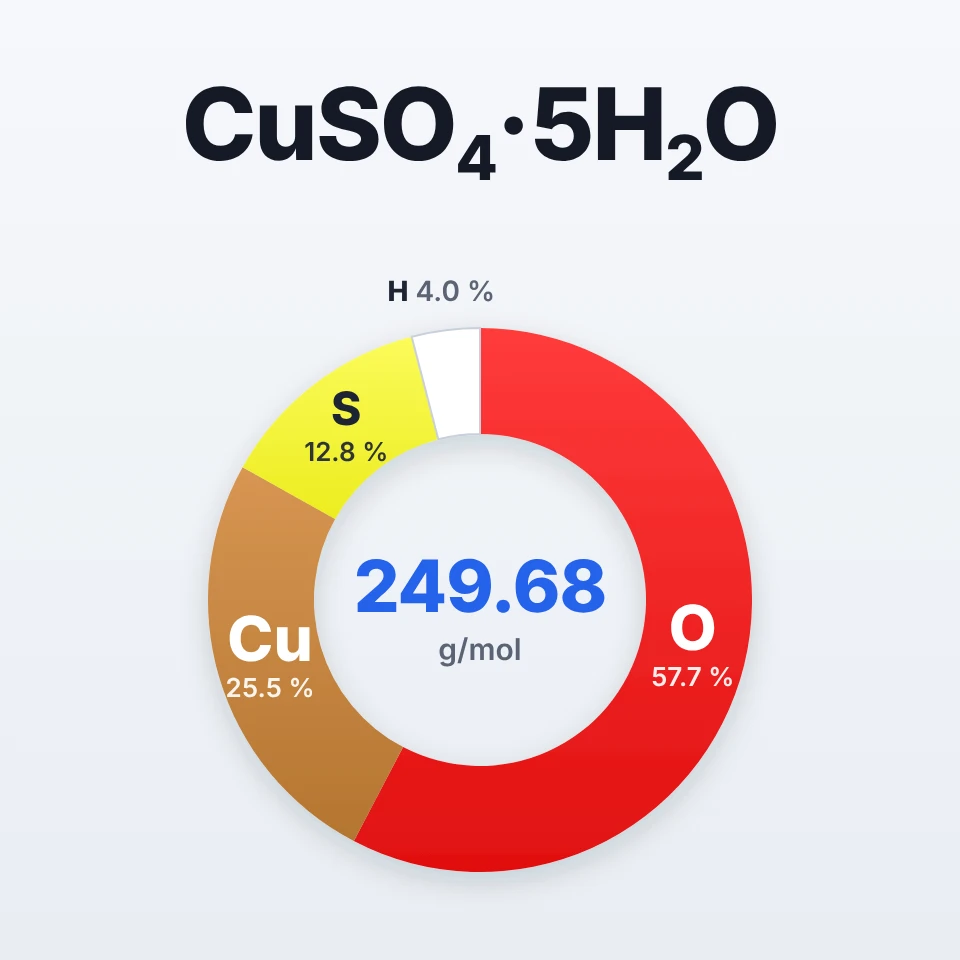
Molar mass explained
What a mole is and why chemists count atoms by weighing them: the Avogadro constant, relative atomic mass and IUPAC standard atomic weights, how to calculate molar mass from a formula with brackets and hydrates, mass percent composition, empirical and molecular formulas, and the molar volume of a gas.
Інтерактивна періодична таблиця
Інтерактивна періодична таблиця всіх 118 елементів: розфарбовуйте її за категорією, блоком, агрегатним станом чи електронегативністю й клацайте елемент, щоб побачити його атомну масу, електронну конфігурацію та оболонки.
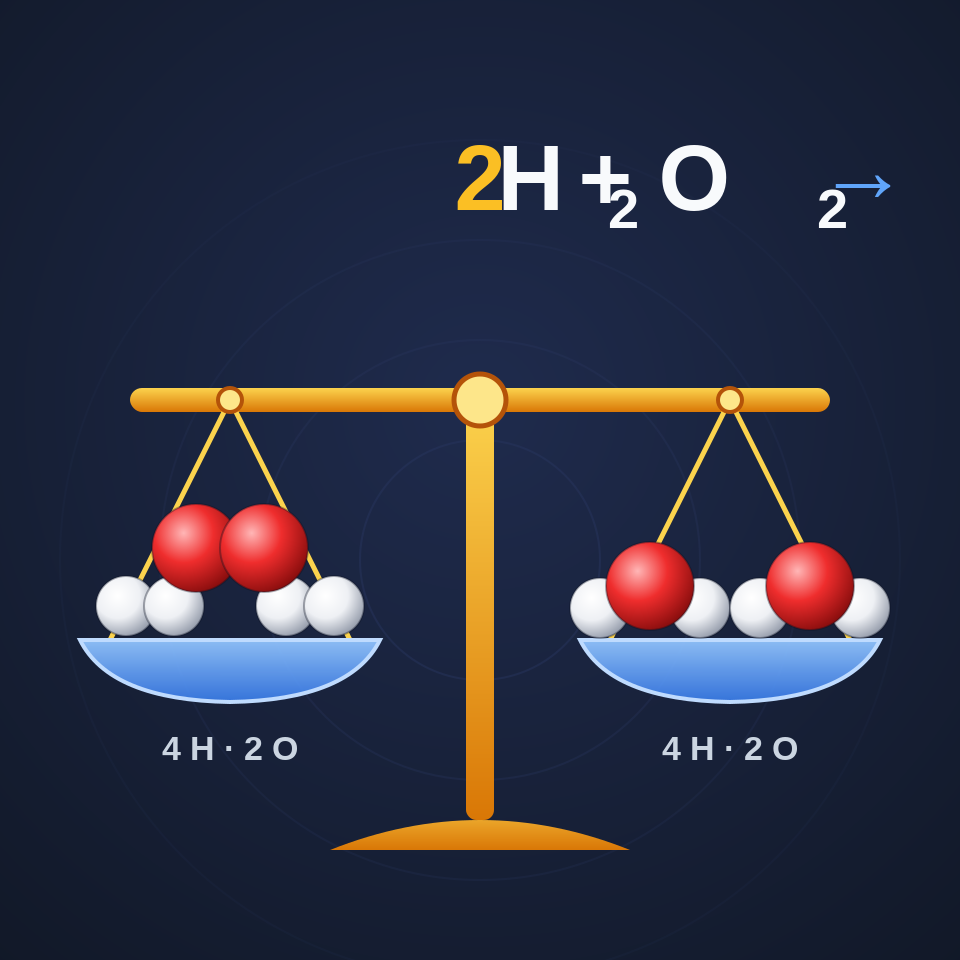
Балансування хімічних рівнянь
Зрівнюйте будь-яке хімічне рівняння миттєво й точно, зокрема з йонами, гідратами та окисно-відновними реакціями. Рахуйте атоми в обох частинах, дивіться, які ступені окиснення змінюються, і обчислюйте молярні маси, лімітуючий реагент і вихід продукту.
Конструктор молекул
Безкоштовний онлайн-конструктор молекул: з'єднуйте атоми одинарними, подвійними й потрійними зв'язками, отримуйте формулу й молярну масу, дивіться справжню форму молекули в 3D і розв'язуйте хімічні завдання.
Готові спробувати?
Відкрийте PictorX у браузері — без встановлення і без кредитної картки.
Перейти до редактора