
Molar mass explained
Chemists cannot count atoms one by one, so they weigh them. The mole turns a mass on a balance into a number of particles, and the molar mass is the exchange rate. This page explains the Avogadro constant, where atomic weights come from and why some are intervals, how to read a formula and add up its mass, percent composition, empirical and molecular formulas, and the volume of a mole of gas.
Counting by weighing
A teaspoon of water holds about 1.7 × 10²³ molecules, far too many to count. Chemistry therefore works with the mole, a fixed number of particles. Since the 2019 redefinition of the SI, one mole contains exactly 6.02214076 × 10²³ specified particles, the Avogadro constant Nₐ. Before 2019 the mole was defined as the number of atoms in 12 g of carbon-12, and the new value was chosen to agree with it. The amount of substance n, measured in moles, is the number of particles divided by Nₐ.
Atomic mass, relative atomic mass and atomic weight
The mass of one atom is tiny: a carbon-12 atom has 1.9926 × 10⁻²³ g. Atomic masses are therefore given in daltons (Da, also called unified atomic mass units, u), 1/12 of the mass of a carbon-12 atom. The relative atomic mass, or atomic weight, of an element is the average mass of its atoms in daltons, weighted by how common each isotope is: chlorine is about 76 % chlorine-35 and 24 % chlorine-37, so its atomic weight is 35.45, not a whole number. Because the dalton and the mole fit together, an element's atomic weight is also the mass of one mole of its atoms in grams, to better than a part in a billion.
Standard atomic weights and why some are intervals
IUPAC's Commission on Isotopic Abundances and Atomic Weights reviews the measurements and publishes the standard atomic weights every two years. For most elements the value comes with an uncertainty in its last digit, which is why sodium is given as 22.98976928 but copper only as 63.546. For fourteen elements, including hydrogen, carbon, nitrogen, oxygen, sulfur and chlorine, the mix of isotopes differs measurably between sources: carbon in limestone is heavier than carbon in plants, and oxygen in rain differs from oxygen in sea water. Since 2009 IUPAC gives their standard atomic weights as intervals, such as [12.0096, 12.0116] for carbon, with a conventional value (12.011) for everyday calculations. Elements without stable isotopes, such as technetium and radon, have no standard atomic weight; the mass number of their longest-lived isotope is quoted in brackets instead.
Molar mass from a formula
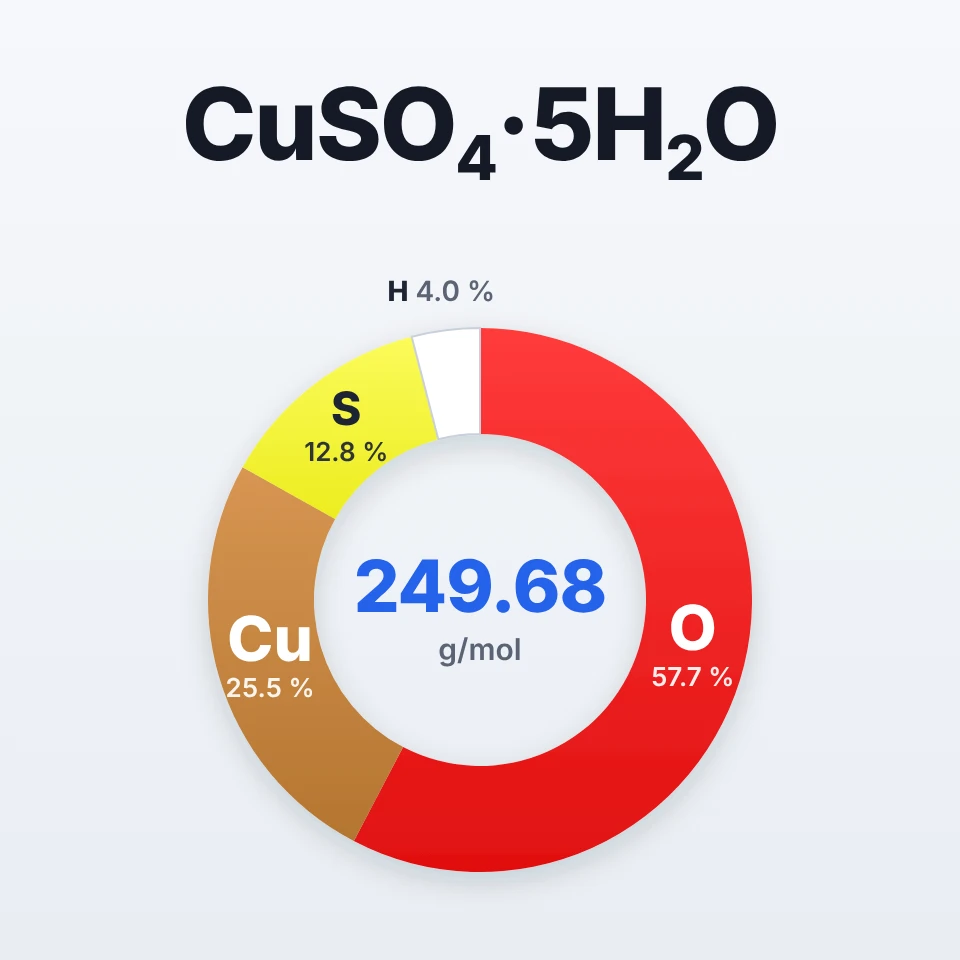
The molar mass of a compound is the sum of the atomic weights of the atoms in its formula, in grams per mole. A subscript counts the atom before it, a subscript after brackets multiplies the whole group, and a centred dot adds a second part with its own number in front: in CuSO₄·5H₂O there are 1 copper, 1 sulfur, 4 + 5 = 9 oxygen and 10 hydrogen atoms, so M = 63.546 + 32.06 + 9 × 15.999 + 10 × 1.008 = 249.68 g/mol. A sum is only as precise as its least precise term: sulfur's 32.06 has two decimals, so the result is rounded to two. An ion's charge comes from electrons gained or lost, and an electron has only 1/1836 of the mass of a hydrogen atom, 0.00055 g/mol, which is usually ignored.
Moles, mass and particles
Three formulas link the quantities: n = m / M turns a mass into moles, m = n × M turns moles into grams, and N = n × Nₐ gives the number of particles. A 500 mg aspirin tablet, C₉H₈O₄ with M = 180.159 g/mol, contains 0.5 / 180.159 = 0.002775 mol of aspirin, or 1.671 × 10²¹ molecules. The particles counted are molecules for molecular substances and formula units for ionic compounds: a mole of NaCl contains a mole of Na⁺ ions and a mole of Cl⁻ ions.
Percent composition
The mass percentage of an element in a compound is the mass of its atoms in one mole divided by the molar mass: w = n × Aᵣ / M × 100 %. Water is 11.19 % hydrogen and 88.81 % oxygen by mass, although two of its three atoms are hydrogen. Percent composition is what elemental analysis measures: a sample is burned and the carbon dioxide, water and nitrogen formed are weighed, which gives the percentages of carbon, hydrogen and nitrogen, with oxygen often taken as the rest.
Empirical and molecular formulas
The empirical formula gives the simplest whole-number ratio of the atoms; the molecular formula gives the actual numbers in a molecule, a whole multiple of it. Glucose, C₆H₁₂O₆, and formaldehyde, CH₂O, share the empirical formula CH₂O. From a composition, divide each percentage by the atomic weight to get the moles in 100 g, divide by the smallest, and multiply by a small whole number until all are whole within the accuracy of the analysis (a ratio of 1.33 means multiplying by 3, 1.5 by 2). If the molar mass is known, from mass spectrometry for example, dividing it by the mass of the empirical formula tells how many empirical units make one molecule. Ionic compounds have only empirical formulas.
The molar volume of a gas
By Avogadro's law, equal volumes of gases at the same temperature and pressure contain the same number of molecules, whatever the gas. For an ideal gas V = nRT / p, so one mole takes up 22.711 L at 0 °C and 100 kPa (1 bar), the standard temperature and pressure IUPAC has recommended since 1982, and 22.414 L at 0 °C and 101.325 kPa (1 atm), the older standard many textbooks still use. At 25 °C and 1 bar it is 24.79 L. Real gases differ from this by a fraction of a per cent at these conditions.
How the calculator works
The app reads the formula character by character: element symbols are matched against the 118 elements with the capital letter first (Co is cobalt, CO is carbon monoxide), counts may be ordinary digits or Unicode subscripts, brackets of any kind nest, a dot or a star starts a hydrate, and a charge or a state such as (aq) at the end is recognised and set aside. When something does not fit, it reports the character where reading failed. Each element is weighed with its IUPAC 2021 standard atomic weight, isotopes with their atomic masses from the 2020 Atomic Mass Evaluation, and the molar mass is shown with the decimals of the least precise weight used. The blocks in the picture are a squarified treemap: each element's area is its share of the mass.
Поширені запитання
Why is the atomic weight of chlorine 35.45 and not a whole number?
Because natural chlorine is a mixture of two isotopes: about 75.8 % chlorine-35 (34.969 Da) and 24.2 % chlorine-37 (36.966 Da). The weighted average is 35.45. Only elements with a single stable isotope, such as fluorine, sodium, aluminium and gold, have atomic weights close to a whole number, and even those are not exactly whole, because the binding energy of the nucleus changes its mass.
Is molar mass the same as molecular weight?
In number, yes. Molar mass has the unit g/mol; molecular weight, properly called relative molecular mass, is a pure number, the mass of a molecule divided by 1/12 of the mass of a carbon-12 atom. Water has a molar mass of 18.015 g/mol and a relative molecular mass of 18.015. Since 2019 the two differ by less than a part in a billion.
What does the dot in CuSO₄·5H₂O mean?
It joins the parts of an adduct, most often water of crystallisation: each formula unit of the blue crystals holds five water molecules in its lattice. Their mass counts in the molar mass, 249.68 g/mol against 159.60 g/mol for the white anhydrous salt, so 36 % of the blue crystals' mass is water. Heating drives the water off and the crystals turn white.
What is STP?
Standard temperature and pressure. Since 1982 IUPAC has defined it as 0 °C (273.15 K) and 100 kPa (1 bar), where a mole of ideal gas fills 22.711 L. Many textbooks still use the older 0 °C and 1 atm (101.325 kPa), with 22.414 L. Other standards, such as 25 °C and 1 bar (24.79 L), are also in use, so it is worth checking which one a problem means.
Схожі інструменти
Molar mass calculator: weigh any formula
Calculate the molar mass of any chemical formula with the IUPAC standard atomic weights, hydrates, brackets, ions and isotopes included. See the mass percent of each element, convert grams to moles, particles and litres of gas, and find the empirical formula from percentages.

Інтерактивна періодична таблиця
Інтерактивна періодична таблиця всіх 118 елементів: розфарбовуйте її за категорією, блоком, агрегатним станом чи електронегативністю й клацайте елемент, щоб побачити його атомну масу, електронну конфігурацію та оболонки.
Як збалансувати хімічні рівняння
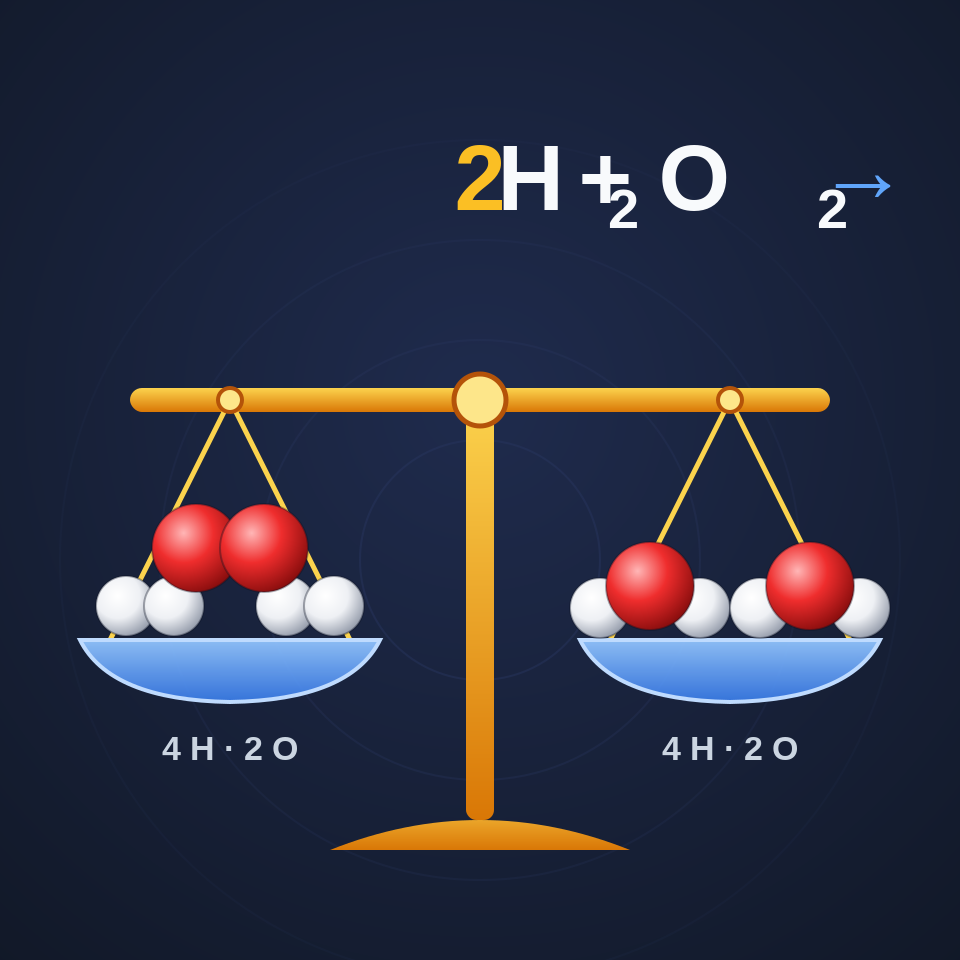
Як крок за кроком зрівнювати хімічні рівняння: збереження атомів, метод підбору та алгебраїчний метод, йонні та окисно-відновні рівняння зі ступенями окиснення і як від коефіцієнтів перейти до молей, грамів і лімітуючого реагенту.
Молекули та хімічні зв'язки: пояснення
Як атоми сполучаються в молекули: валентність і заповнені оболонки, одинарні, подвійні й потрійні зв'язки, неподілені електронні пари, молекулярні формули і молярна маса, форми за теорією VSEPR від лінійної до тетраедричної, а також ізомери.
Готові спробувати?
Відкрийте PictorX у браузері — без встановлення і без кредитної картки.
Open the molar mass calculator