
How Morse code is written and timed
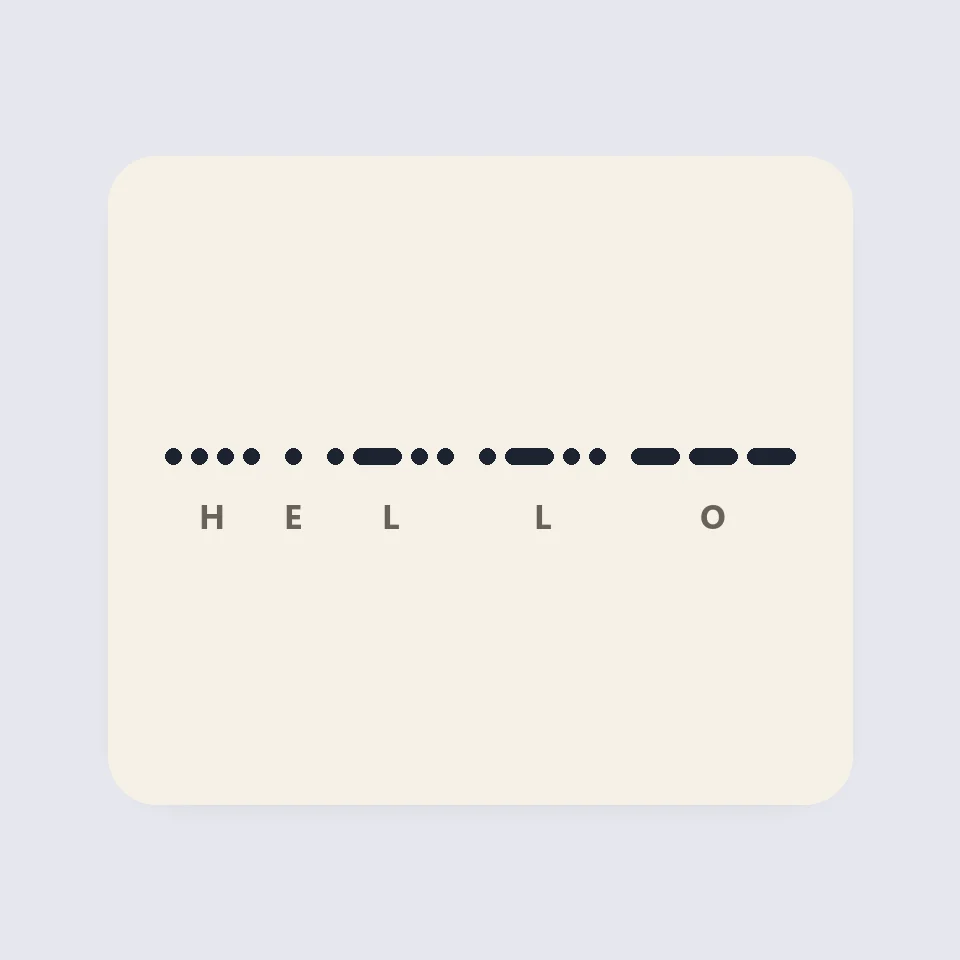
Morse code writes letters as short and long signals. On a page those signals are dots and dashes. On a lamp they are flashes. The silences between them are part of the code.
Two codes, one still in use
Samuel Morse and Alfred Vail demonstrated an electric telegraph in 1844. Their American Morse code used dots, dashes and extra gaps inside some letters, which suited a sounder on a wire. The code used on radio, and in classrooms, is International Morse. It was standardized for cables and wireless, and it is specified in ITU-R M.1677. It uses only dots, dashes and three lengths of silence.
The rhythm
A dot lasts one unit. A dash lasts three. The silence between the parts of one letter lasts one unit, the silence between letters lasts three, and the silence between words lasts seven. Speed is given in words per minute, measured on the word PARIS followed by a space. That word and its space are 50 units, so at one word per minute a unit lasts 1.2 seconds, and at ten words per minute a dot lasts 0.12 seconds.
Learning speed
A letter sent very slowly is harder to recognize than the same letter at a normal rhythm, with a longer wait afterwards. That way of practising is called Farnsworth timing. The dots and dashes stay at a character speed, here 15 words per minute, and the gaps between letters and words grow so the whole message still finishes at the speed you chose. At 15 words per minute or faster there is nothing to stretch, so Learn and Standard match.
Reading a picture, and SOS
Grouped letters put each sign in its own cluster, with the letter underneath, so a page can be read by someone who is still learning the patterns. A strip is one line of signal and silence. The alphabet chart is the reference, with the letters you used marked. SOS is three dots, three dashes and three dots. As a distress signal those nine marks are sent as one run, without the usual gaps between the letters. The app writes them as the letters S, O and S, which is how a chart teaches them and how you read the word.
Câu hỏi thường gặp
Is this American Morse or international Morse?
International Morse, the code used on radio and in classrooms. American Morse is an older telegraph code with different patterns and extra gaps inside letters.
Why do some characters disappear?
The international alphabet has a sign for A to Z, the digits, common punctuation and a number of accented letters. A character with no sign is counted under the design and left out. An accented letter that has no sign of its own is sent as its base letter.
Can I use this to call for help?
It is a learning tool. A picture on a page is not a radio signal, and a real distress call has its own rules. The app is for a lesson, a note, or a design.
Công cụ liên quan
Visual Morse Code
Turn text into a Morse code design of dots and dashes. Play it as a flashing lamp, copy the code, and save a card for a lesson, a note, or a page.
Trình tạo mã QR
Trình tạo mã QR miễn phí cho URL, văn bản, Wi-Fi, liên hệ vCard, email, điện thoại, SMS và vị trí. Màu tùy chỉnh có kiểm tra tương phản, vùng trống, mô-đun bo tròn hoặc chấm, logo, tải PNG và SVG. Không cần đăng ký, không tải lên.
Đếm từ và ký tự
Công cụ đếm từ và ký tự miễn phí: từ, ký tự có và không có khoảng trắng, câu, đoạn, từ duy nhất, thời gian đọc và nói, mật độ từ khóa và giới hạn cho X, SMS, mô tả meta và tiêu đề. Dùng cho mọi ngôn ngữ.
Công cụ chuyển chữ hoa thường
Công cụ đổi chữ hoa thường miễn phí: CHỮ HOA, chữ thường, kiểu tiêu đề theo quy tắc ngôn ngữ, kiểu câu, camelCase, PascalCase, snake_case, kebab-case, CONSTANT_CASE, dot.case và slug URL, cùng công cụ dọn khoảng trắng, ngắt dòng, ký hiệu đầu dòng và emoji.
Mã QR hoạt động thế nào
Mã QR hoạt động thế nào? Phát minh năm 1994 của Denso Wave, mẫu định vị và mô-đun, phiên bản 1–40, mặt nạ, các mức Reed-Solomon L, M, Q, H và mẹo quét.
Sẵn sàng thử chưa?
Mở PictorX trong trình duyệt — không cần cài đặt, không cần thẻ tín dụng để bắt đầu.
Open Visual Morse Code