
Prisms and rainbows: white light split into its colours
White light is a mixture of every colour, and glass and water bend each colour by a slightly different angle. Shine a beam through a prism and the colours fan out into a spectrum; turn the beam and watch the deviation fall to its minimum and rise again; add Newton's second prism and the colours become white once more. Then follow a ray of sunlight into a raindrop, through one or two reflections and out again, and see why every raindrop sends its brightest light back at 42°, which is where the rainbow appears. Pick an example or a scene. On the prism, drag anywhere on the picture to aim the beam and watch the colours fan out: the deviation is smallest when the light crosses the prism symmetrically, and below a certain angle the light is trapped by total internal reflection. Change the glass, the apex angle and the light, catch the spectrum on a screen, or add Newton's second prism to put the colours back together. In the raindrop, drag up and down to choose the height at which a ray of sunlight meets the drop and follow it through one or two reflections; the graph shows the angle every height leaves at, and Many rays shows how they bunch up at the rainbow angle. In the sky, drag the bow up or down to move the Sun behind you. Press Play to sweep the angle of incidence, the ray's height or the Sun's elevation; Back and Step move by half a second.
Як це працює
- Pick an example or a scene: a prism, a raindrop or the rainbow in the sky.
- On the prism, drag on the picture to aim the beam; change the glass, the apex angle and the light, and read the deviation, the spread of the colours and the refractive index in the tiles.
- In the raindrop, drag up and down to choose where the sunlight meets the drop, follow it through one or two reflections, and turn on Many rays to see them bunch up at the rainbow angle.
- Press Play to sweep the angle, the ray's height or the Sun, then save the picture, record a video or edit it in the photo editor.
Why a prism splits white light
Light slows down in glass, and the refractive index n says by how much: about 1.52 for ordinary crown glass. A ray that enters at a slant bends by Snell's law, n₁ sin θ₁ = n₂ sin θ₂. But n is not quite the same for every colour: in crown glass it is 1.513 for red light at 700 nm and 1.531 for violet at 400 nm. That small difference is dispersion. A prism's two faces bend the light the same way twice, so the colours leave at different angles and spread into a spectrum, red bent least and violet most. The app takes n for each wavelength from the Sellmeier equation of the real material.
Minimum deviation
The deviation δ is the angle between the beam that comes in and the beam that goes out: δ = θ₁ + θ₂ − A, where A is the prism's apex angle. As the beam turns, δ falls, reaches a minimum and rises again. The minimum comes when the light crosses the prism symmetrically, parallel to its base, and then n = sin((A + δmin) / 2) / sin(A / 2). That is how refractive indices are measured in the laboratory: a 60° crown glass prism has its minimum deviation of 38.6° at an angle of incidence of 49.3°.
Total internal reflection
When light inside the glass meets the second face at more than the critical angle, sin θc = 1 / n, none of it can leave and the face becomes a perfect mirror. In a 60° crown glass prism that happens when the beam meets the first face at less than about 29°. Some light is reflected at every face even below that angle; the Fresnel equations give the share, about 4 % at glass at normal incidence, and the Reflections box shows those faint rays.
Rainbows: light in a raindrop
A raindrop is a tiny sphere of water. Sunlight that enters it refracts, reflects off the back and refracts out again, leaving at an angle that depends on how far from the centre it entered. For water that angle, measured from the antisolar point opposite the Sun, can never exceed about 42°, and near that maximum many rays leave together: Descartes' ray. Red leaves at up to 42.4° and violet at up to 40.6°, so you see a bow of colours, red outside. Two reflections give the fainter secondary bow at about 51°, with its colours reversed, and between the two the sky is darker: Alexander's dark band.
Поширені запитання
Why does a prism separate white light into colours?
Because the refractive index of glass depends on the wavelength. Violet light, with the shortest wavelength we see, slows down most in glass and is bent most; red is bent least. At each face of the prism the colours change direction by slightly different angles, so a narrow white beam leaves as a fan, a spectrum from red to violet. Newton showed in 1666 that the colours were in the white light all along: a second prism cannot split one colour further, and an inverted prism puts them back together into white.
What is the angle of minimum deviation?
As you turn a prism in a beam, the angle by which the beam is bent first falls and then rises. The smallest value, δmin, comes when the light passes through the prism symmetrically. At that angle n = sin((A + δmin) / 2) / sin(A / 2), where A is the apex angle, so measuring δmin gives the refractive index precisely. For a 60° prism of crown glass δmin is 38.6° in yellow sodium light.
Why is the rainbow always at 42°?
Each raindrop sends sunlight back in many directions, but after one reflection inside, no ray leaves at more than about 42° from the antisolar point, the point opposite the Sun. Near that limit the rays from a wide range of entry points leave almost together, so the light is concentrated there. You therefore see bright light from all the drops that lie 42° from the antisolar point: a circle around the shadow of your head. Red leaves at a slightly larger angle than violet, so red is on the outside.
Why is the secondary rainbow reversed and why is the sky dark between the bows?
The secondary bow comes from light that reflects twice inside the drops. Its rays leave at no less than about 51°, with violet at a larger angle than red, so its colours run the other way, red inside. Single reflections send light only inside 42° and double reflections only outside 51°, so no light from either reaches you from the band in between. That darker band is named after Alexander of Aphrodisias, who described it around 200 AD.
Why can't I see a rainbow at midday?
The rainbow is a circle of 42° around the antisolar point, which is as far below the horizon as the Sun is above it. When the Sun is higher than about 42°, the whole primary bow is below the horizon. That is why rainbows are seen in the morning and the late afternoon, and why the lowest Sun, near sunset, gives the tallest bows, almost semicircles. From an aircraft or a mountain you can sometimes see the whole circle.
Can I use the picture?
Yes. Save gives a PNG at the size you choose, Record films the turning beam, the ray moving across the drop or the setting Sun with its sound, and the pencil opens the picture in the PictorX photo editor with the background, the lamp, the prisms or the raindrop, the screen, the light, the reflections, the graph and the labels on layers of their own and the caption as editable text. In the editor itself it is under Apps ▸ Science ▸ Physics ▸ Prism & Rainbow. Everything runs in your browser.
Prism & Rainbow: як записати відео?
Натисніть червону кнопку «Запис» на панелі відтворення: вона знімає те, що показує сцена. Натисніть її ще раз, щоб зупинити, і відео збережеться на вашому пристрої. Запис безкоштовний, потрібно лише увійти. Без підписки на відео в куті буде невеликий логотип PictorX. Кнопка поруч із «Запис» відкриває параметри відео: формат (як показано, квадрат, сторіз 9:16 або широкий 16:9), тривалість (доки ви не зупините, або 5, 10, 15 чи 30 секунд для соцмереж) і файл: MP4, WebM або анімований GIF. Для звуку виберіть власні звуки застосунку або одну з трьох музичних доріжок: спокійну, яскраву чи ритмічну.
Схожі інструменти
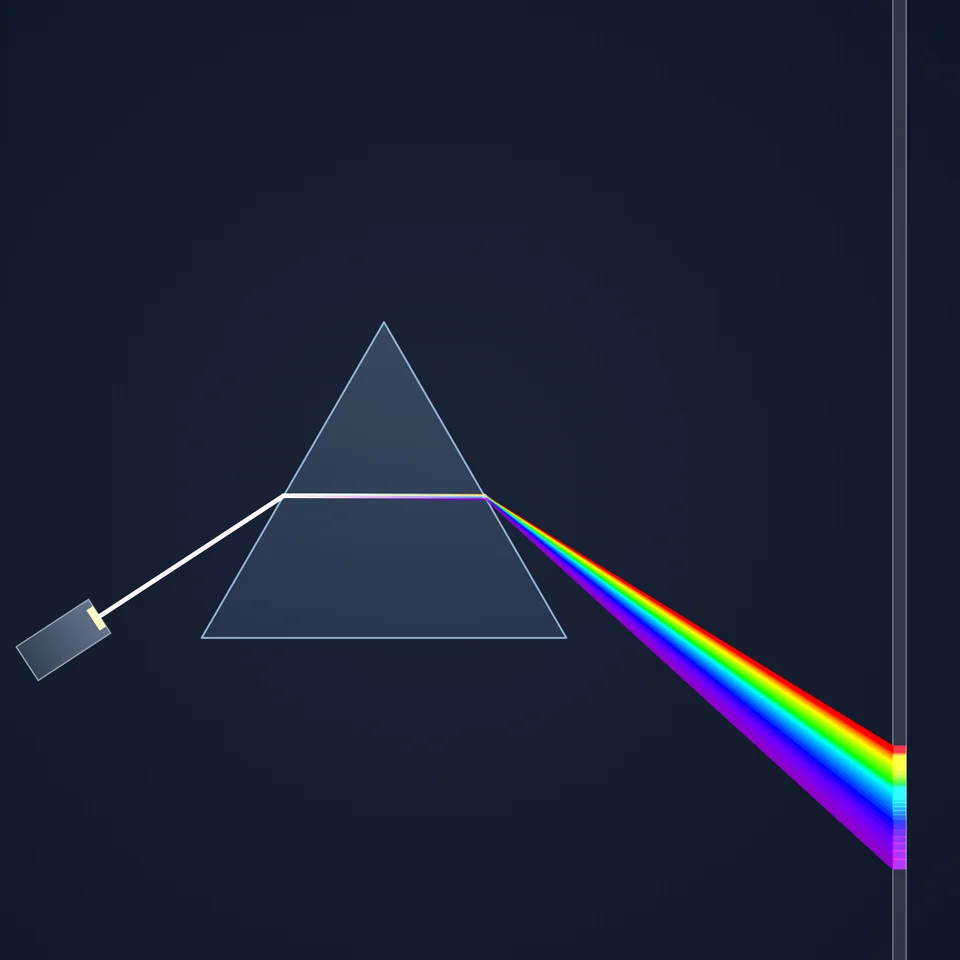
Prisms and rainbows explained
How white light splits into colours: refraction and dispersion, the refractive index and the Sellmeier equation, the prism's deviation and minimum deviation, Newton's experiments, crown and flint glass, spectroscopes, how raindrops make the primary and secondary rainbows at 42° and 51°, Alexander's dark band, supernumerary bows and ice halos.
Закон Снелліуса і заломлення світла
Подивіться, чому світло заломлюється. Влаштуйте рятувальнику забіг піском і морем, посвітіть лазером з повітря у воду, скло чи алмаз і дивіться, як світло крізь тонкі шари креслить брахістохрону.
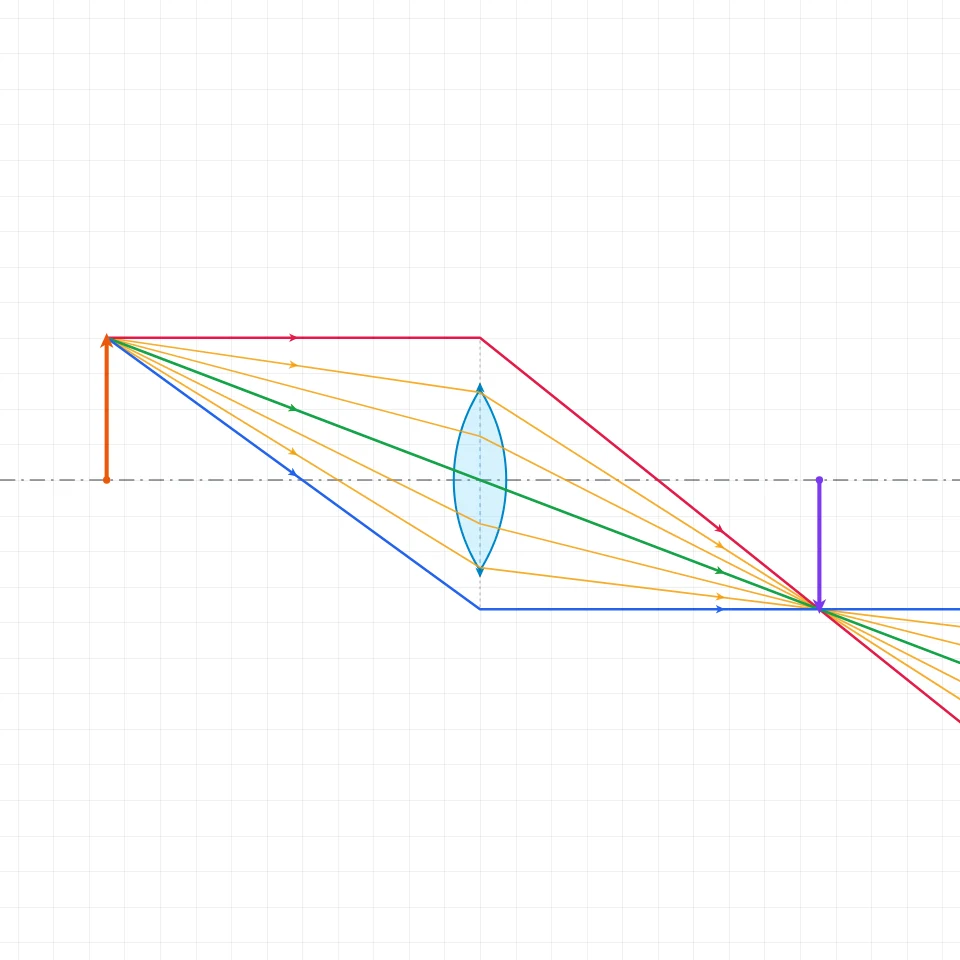
Хід променів у лінзах і дзеркалах
Будуйте променеві діаграми для опуклих і увігнутих лінз і дзеркал онлайн: перетягуйте предмет і дивіться на головні промені та дійсне чи уявне зображення з формулою тонкої лінзи 1/f = 1/dₒ + 1/dᵢ і збільшенням. Зберіть фотоапарат, проєктор, два телескопи й мікроскоп.
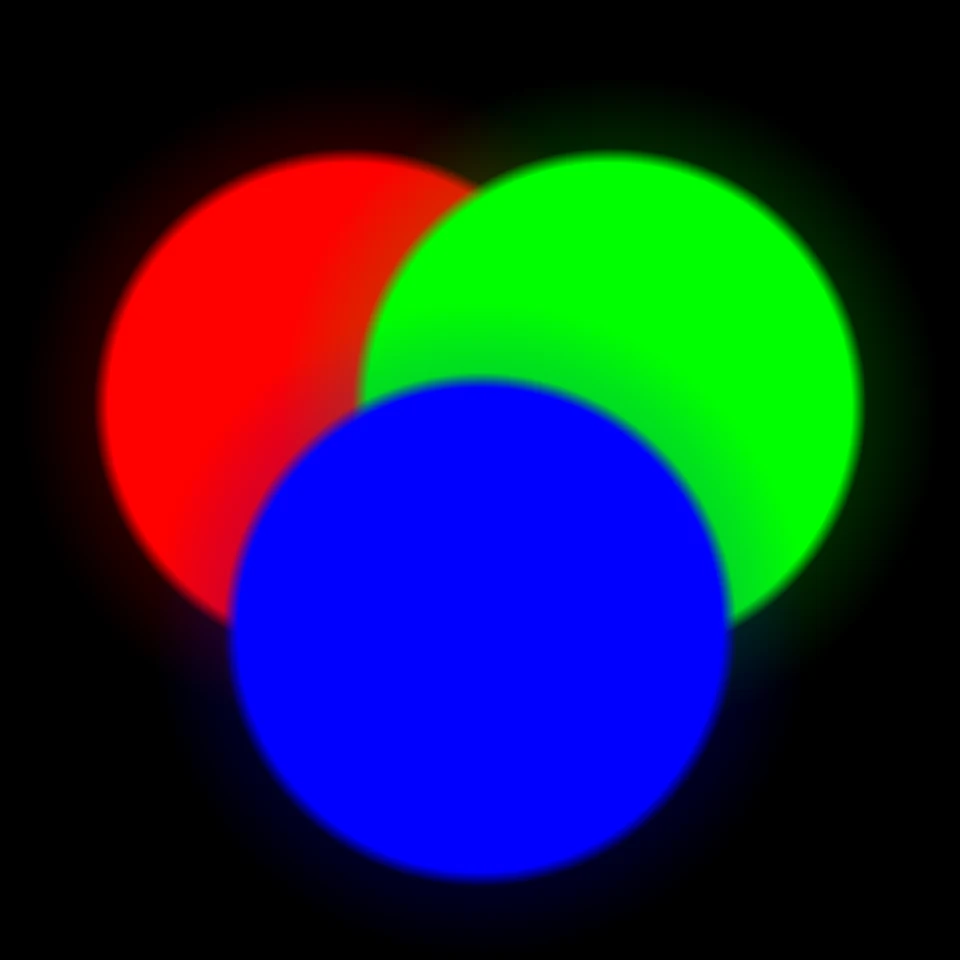
Змішуйте світло й фільтри: адитивне і субтрактивне змішування кольорів
Змішуйте кольорове світло й кольорові фільтри онлайн: червоне, зелене й синє світло в сумі дають біле, а блакитний, пурпуровий і жовтий фільтри, перемножуючись, дають чорне. Перетягуйте кола, зчитуйте hex, RGB, CMYK і HSL, дивіться спектр і реакцію трьох типів колбочок ока та підбирайте цільовий колір.
Інтерференція хвиль у хвильовій ванні
Хвильова ванна у вашому браузері: два джерела утворюють вузлові лінії, плоска хвиля проходить крізь подвійну щілину, одну щілину чи дифракційну ґратку, а картина падає на екран. Брижі на воді, звук і світло з реальними довжинами хвиль і частотами, зонд, який можна почути, і фазована решітка, що керує своїм променем.
Готові спробувати?
Відкрийте PictorX у браузері — без встановлення і без кредитної картки.
Перейти до редактора