
3D electron orbitals: the shapes of the hydrogen atom
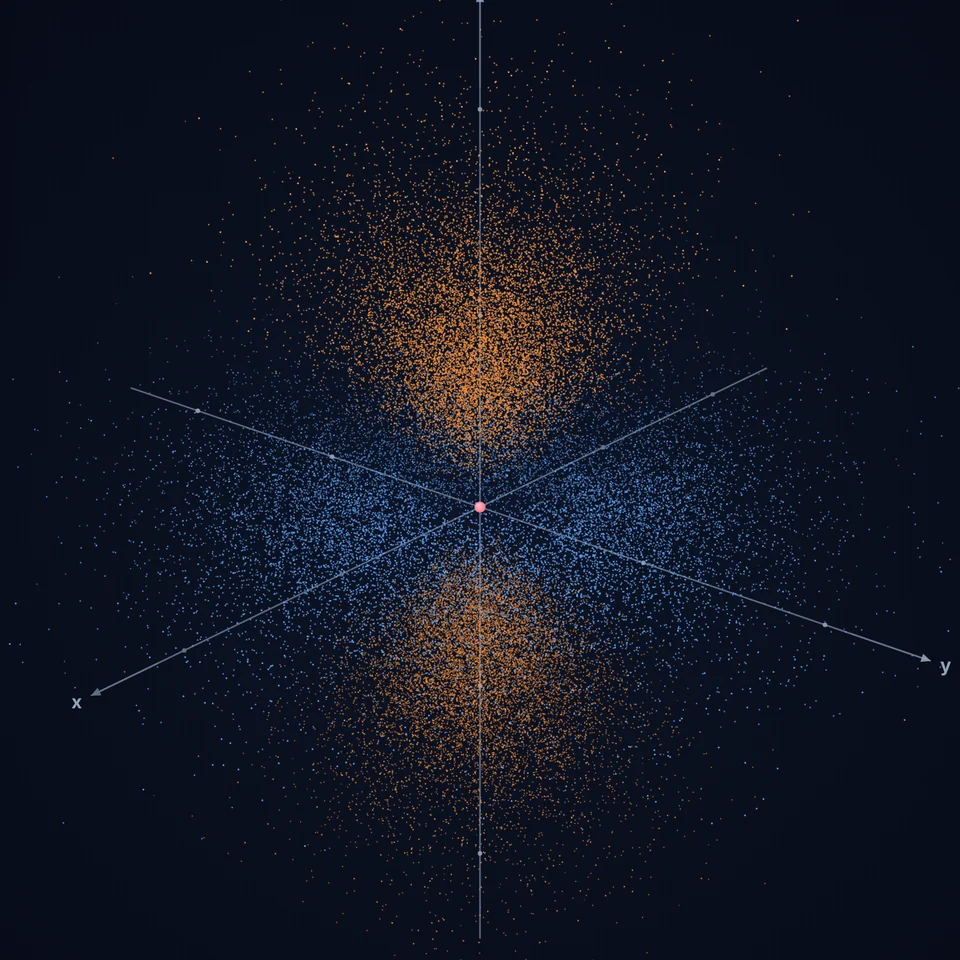
An electron in an atom has no orbit, only an orbital: a wavefunction that says how likely it is to be found at each place. Here the exact orbitals of hydrogen and of ions like He⁺ are drawn in 3D, from the 1s sphere and the 2p dumbbells to the four-leaved d orbitals and the many-lobed f orbitals, as clouds of points, surfaces or slices, with their nodes, energies and radial probability, and you can turn them with your finger. An orbital is where an electron of a hydrogen-like atom is likely to be found: each dot of the cloud is one place where a measurement could find it, drawn at random from |ψ|², so the cloud is dense where the probability is high. Choose the shell n and the orbital (s, p, d, f and beyond), or one of the examples; orange and blue are the two signs (phases) of the wavefunction, which matter when orbitals overlap to form bonds. Drag the picture to turn it and use the mouse wheel or two fingers to zoom. View shows the point cloud, a surface that encloses 90 % of the probability, a slice through the atom with the nodes as dashed lines, or the radial probability P(r) = r²R² with the most probable radius and the average distance ⟨r⟩. Nodal surfaces shows where ψ is zero: n − l − 1 spheres and l planes or cones. Play turns the view (in a slice it sweeps the slice through the atom), Build up adds the points one measurement at a time, and in a superposition of two states Time evolution shows the cloud swinging back and forth at the frequency ΔE/h. Raise the nuclear charge Z to see the orbital shrink by 1/Z and its energy grow by Z². With Sound on you hear a tone for the energy, 41 octaves below its real frequency, and Record films it with the sound.
Як це працює
- Pick an example or choose the shell n and the orbital, s, p, d, f and beyond, and the nuclear charge Z.
- Drag the picture to turn the orbital and use the wheel or two fingers to zoom; orange and blue show the two signs of the wavefunction.
- Switch the view between the point cloud, a surface, a slice with its nodes and the radial probability chart.
- Press Play to turn it, build the cloud up one measurement at a time or watch a superposition of 1s and 2p swing back and forth; switch Sound on and record a video.
Orbitals are probability clouds
Quantum mechanics replaces the electron's orbit with a wavefunction ψ, a solution of Schrödinger's equation. Its square |ψ|² is the probability density: the chance of finding the electron in a small volume around a point. The app draws each orbital as thousands of dots, each one a place where a measurement could find the electron, chosen at random with exactly that probability, so the cloud is dense where the electron is often found and thin where it is rare. An orbital has no sharp edge; the usual pictures show the surface that encloses 90 % of the probability, which the Surface view draws.
Quantum numbers n, l and m
Each orbital of a hydrogen-like atom is labelled by three whole numbers. The principal quantum number n = 1, 2, 3 ... sets the shell, the size and, for one electron, the energy E = −13.6 eV × Z²/n². The angular momentum quantum number l = 0 ... n − 1 sets the shape: s (l = 0) is round, p (l = 1) has two lobes, d (l = 2) mostly four, f (l = 3) six or eight. The magnetic quantum number m = −l ... l picks one of the 2l + 1 orientations, which chemists combine into real orbitals named after their shape, such as px, dxy and dz². Shell n holds n² orbitals.
Nodes and phases
A node is a surface where ψ, and with it the probability, is exactly zero. Every orbital has n − 1 nodes: n − l − 1 radial nodes, spheres where the radial function changes sign, and l angular nodes, planes or cones through the nucleus. A 2p orbital has one nodal plane, a 3s orbital two nodal spheres, a 3dz² orbital two cones. On either side of a node the wavefunction has opposite signs, shown in orange and blue. The sign of one orbital cannot be measured, but when orbitals overlap in a molecule, lobes of the same sign add up to a bond and lobes of opposite sign cancel.
Radial probability and the size of an atom
The radial probability P(r) = r²R(r)² gives the chance of finding the electron at a distance r from the nucleus, whatever the direction. For hydrogen's 1s orbital it peaks at exactly one Bohr radius, 52.9 pm, the radius of Bohr's first orbit, although the average distance ⟨r⟩ is 1.5 a₀. Higher shells reach farther: ⟨r⟩ = (3n² − l(l+1))/2Z. A larger nuclear charge pulls the electron in: He⁺ has the same orbitals at half the size and four times the binding energy, which Hydrogen vs He⁺ shows on the same scale.
Поширені запитання
What is an atomic orbital?
An atomic orbital is a wavefunction of one electron in an atom: a solution of the Schrödinger equation that gives the electron's energy and, through its square, the probability of finding it at each point. It is often drawn as the region where the electron is found 90 % of the time. Each orbital holds at most two electrons, of opposite spin.
Why do p orbitals look like dumbbells?
Because their angular part is proportional to x/r, y/r or z/r: the wavefunction is largest along one axis and zero in the plane at right angles to it, the nodal plane. Squared, that gives two lobes on opposite sides of the nucleus, one where ψ is positive and one where it is negative. The three p orbitals of a shell point along x, y and z.
How many nodes does an orbital have?
n − 1 in all: n − l − 1 radial nodes (spheres) and l angular nodes (planes or cones). 1s has none, 2s one sphere, 2p one plane, 3d two planes or two cones, 4f three angular nodes. The Nodes tile counts them and Nodal surfaces draws them.
What do the colours of the lobes mean?
They give the sign, or phase, of the wavefunction: orange where ψ is positive and blue where it is negative. The density |ψ|² is the same for both, so for a single orbital the sign cannot be seen in any measurement. It matters when orbitals combine: in a bond, lobes of the same sign overlap constructively, and in hybrid orbitals the s and p parts add on one side and cancel on the other.
What is the most probable distance of the electron in hydrogen?
For the ground state, 1s, it is one Bohr radius, a₀ = 52.9 pm, where the radial probability r²R² peaks. The average distance is larger, 1.5 a₀, because the cloud has a long tail. For the 2p orbital the most probable distance is 4 a₀ and the average 5 a₀; in general the most probable radius of the orbital with l = n − 1 is n² a₀, the radius of Bohr's orbit n.
Can I use the picture?
Yes. Save gives a PNG at the size you choose, and the pencil opens the picture in the PictorX photo editor with the background, the axes, the nodal surfaces, the nucleus, the positive and negative lobes, the radial chart and the labels on layers of their own, and the caption as editable text. In the editor itself it is under Apps ▸ Science ▸ Chemistry ▸ 3D Electron Orbitals. Everything runs in your browser.
3D Electron Orbitals: як записати відео?
Натисніть червону кнопку «Запис» на панелі відтворення: вона знімає те, що показує сцена. Натисніть її ще раз, щоб зупинити, і відео збережеться на вашому пристрої. Запис безкоштовний, потрібно лише увійти. Без підписки на відео в куті буде невеликий логотип PictorX. Кнопка поруч із «Запис» відкриває параметри відео: формат (як показано, квадрат, сторіз 9:16 або широкий 16:9), тривалість (доки ви не зупините, або 5, 10, 15 чи 30 секунд для соцмереж) і файл: MP4, WebM або анімований GIF. Для звуку виберіть власні звуки застосунку або одну з трьох музичних доріжок: спокійну, яскраву чи ритмічну.
Схожі інструменти
Atomic orbitals explained
How quantum mechanics describes the electron in an atom: the Schrödinger equation and the wavefunction, the quantum numbers n, l and m, the shapes of the s, p, d and f orbitals, radial and angular nodes, the radial probability and the Bohr radius, energy levels, hydrogen-like ions, hybrid orbitals and superpositions.
Модель атома Бора
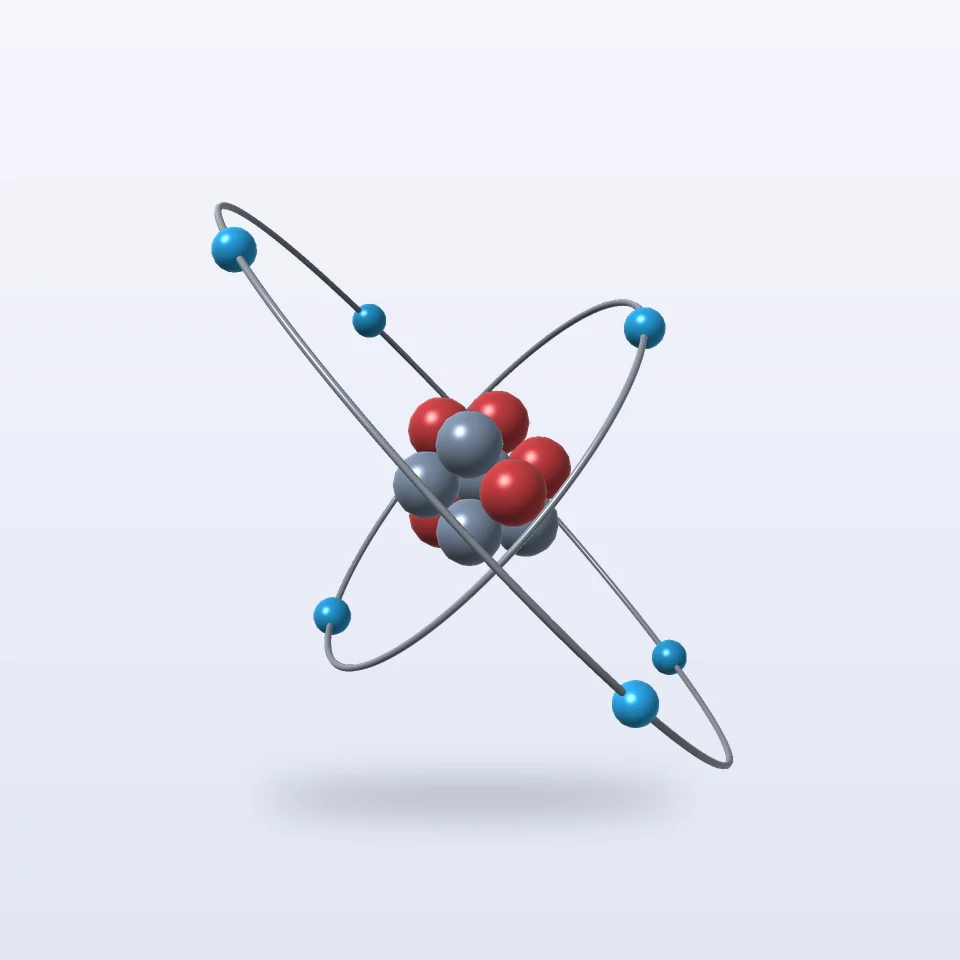
Побудуйте модель Бора будь-якого з 118 елементів у 3D: ядро з протонів і нейтронів з електронами, що обертаються на своїх оболонках. Створюйте йони, порівнюйте рівномірні відстані зі співвідношенням n² за Бором і дізнавайтеся кількість електронів на кожній оболонці та валентних електронів.
Конструктор атомів: діаграми Бора для кожного елемента
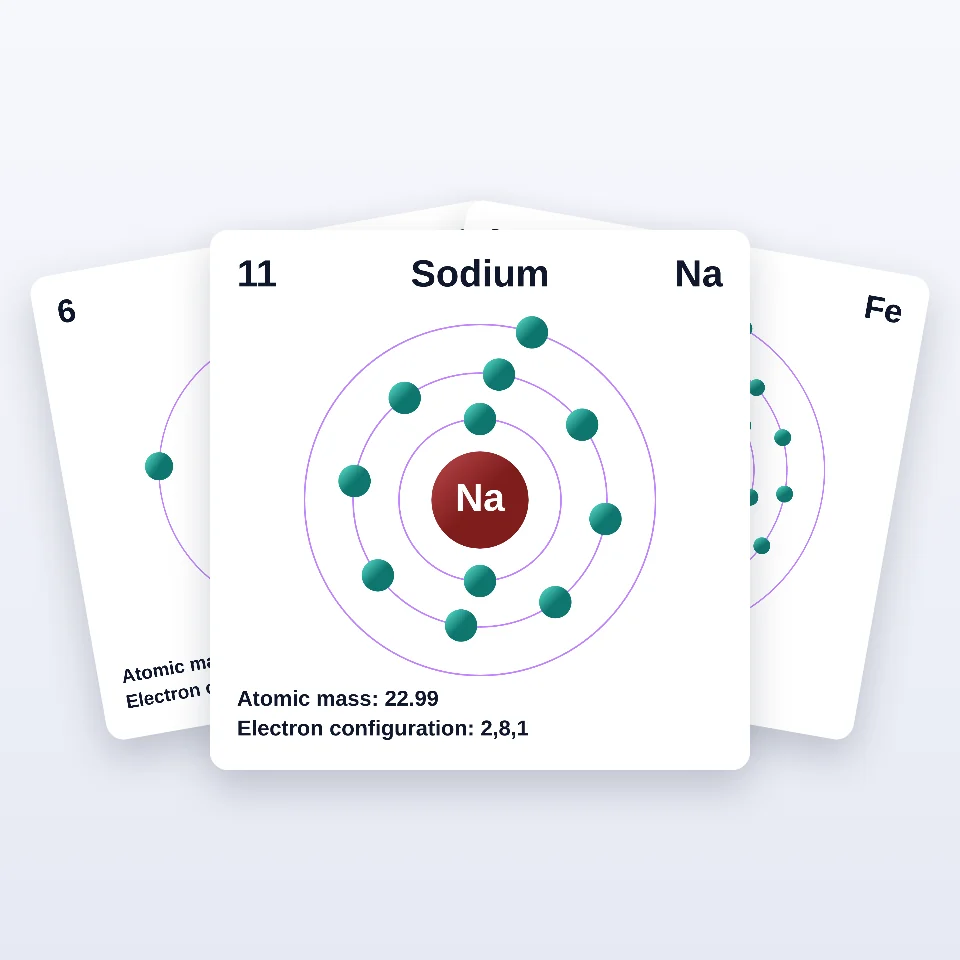
Створіть діаграму Бора для будь-якого зі 118 елементів або його іонів: ядро, кожна оболонка з її електронами, атомний номер, назва й символ, атомна маса та електронна конфігурація на одній картці. Виберіть кольори, збережіть її або редагуйте, маючи кожну частину на окремому шарі.
Конструктор молекул
Безкоштовний онлайн-конструктор молекул: з'єднуйте атоми одинарними, подвійними й потрійними зв'язками, отримуйте формулу й молярну масу, дивіться справжню форму молекули в 3D і розв'язуйте хімічні завдання.
Готові спробувати?
Відкрийте PictorX у браузері — без встановлення і без кредитної картки.
Перейти до редактора