
The unit circle and trigonometry explained
Trigonometry began with triangles and astronomy, but the unit circle turns it into the study of rotation. This page explains how one circle of radius 1 defines all six trigonometric functions for every angle, why radians are the natural unit, where the exact values of the special angles come from, and how the graphs, the identities and the inverse functions follow from the same picture.
From chords to sines
Greek astronomers measured angles with chords: Hipparchus in the 2nd century BC and Ptolemy in his Almagest tabulated the length of the chord that a central angle cuts from a circle. Indian mathematicians found the half-chord more convenient. Aryabhata, around 500 AD, called it jya-ardha; through the Arabic jiba and a mistranslation as the Latin sinus it became our sine. The cosine is the sine of the complementary angle, the co-sine. Madhava of Sangamagrama found infinite series for sine and cosine in the 14th century, long before they reached Europe.
One circle defines every function
On the circle x² + y² = 1, the point reached by turning through θ from (1, 0) is (cos θ, sin θ). Positive angles turn counter-clockwise, negative ones clockwise, and angles past 360° go round again, so sine and cosine are periodic with period 360°. The other four functions follow: tan θ = sin θ / cos θ, cot θ = cos θ / sin θ, sec θ = 1 / cos θ and csc θ = 1 / sin θ. Each is undefined where its denominator is zero.
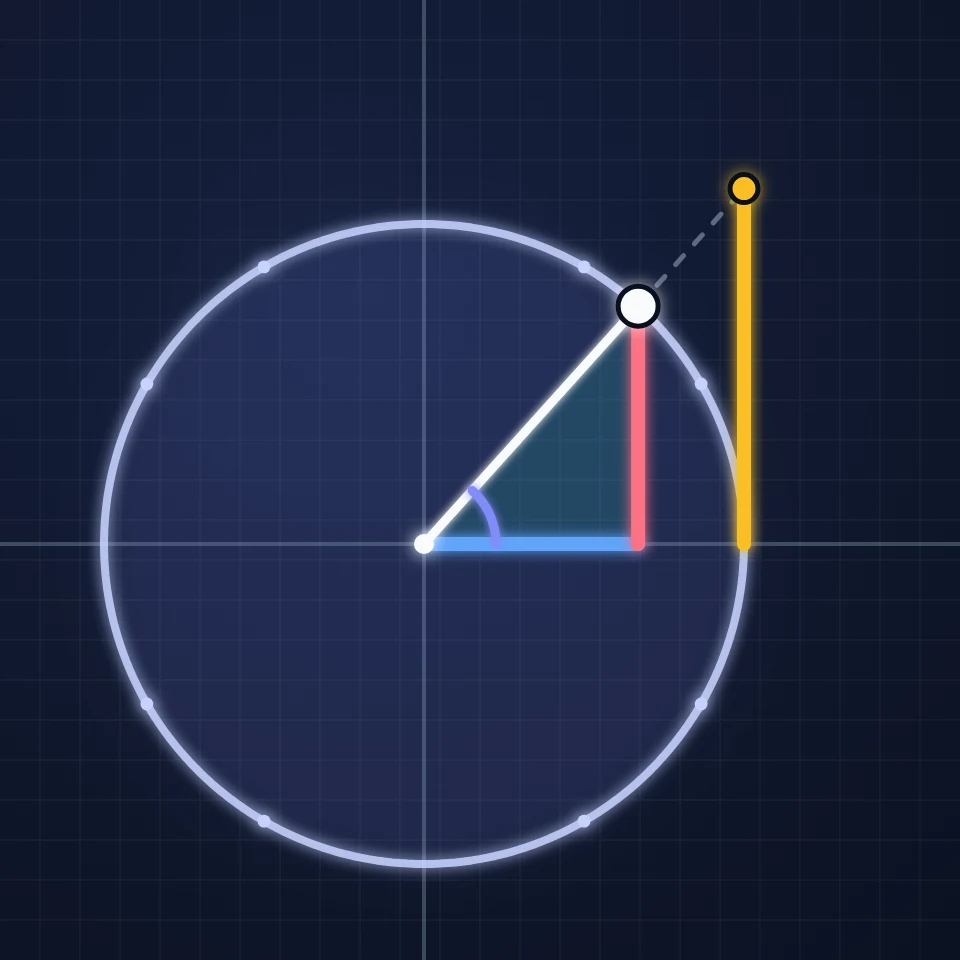
Six segments in one picture
Each function is a length in the classic diagram. The legs of the right triangle under the radius are cos θ and sin θ. The ray, extended to the tangent line x = 1, meets it at the height tan θ, and the distance from the origin to that point is sec θ; on the line y = 1 the same ray gives cot θ and csc θ. Similar triangles prove it: the triangle with legs 1 and tan θ has the same shape as the one with legs cos θ and sin θ. The tangent takes its name from this tangent line, the secant from the Latin for cutting, because its line cuts the circle.
Radians: measuring angles by arc length
An angle of one radian cuts an arc as long as the radius, so on the unit circle the arc length is the angle. A full turn is 2π radians, which gives the conversion 180° = π rad. Radians make calculus simple: for small x, sin x ≈ x, and the derivative of sin x is cos x, statements that need a factor of π/180 in degrees. Common angles are fractions of π: 30° = π/6, 45° = π/4, 60° = π/3 and 90° = π/2.
Special angles and their exact values
Two triangles give the values everyone learns. Halving an equilateral triangle with side 2 gives a 30°-60°-90° triangle with sides 1, √3 and 2: sin 30° = cos 60° = 1/2, sin 60° = cos 30° = √3/2, tan 30° = √3/3 and tan 60° = √3. Halving a unit square along its diagonal gives the 45° triangle: sin 45° = cos 45° = √2/2 and tan 45° = 1. The angle-difference formulas then give 15° and 75°: sin 15° = (√6 − √2)/4 and tan 15° = 2 − √3. In the other quadrants these values repeat with the signs of x and y, so the reference angle and the quadrant are enough.
Graphs and transformations
Plotting sin θ against θ unrolls the circle into the sine wave, which repeats every 2π, stays between −1 and 1 and crosses zero at the multiples of π. The cosine wave is the same curve shifted left by π/2, since cos θ = sin(θ + π/2). The tangent repeats every π and has vertical asymptotes at π/2 + kπ. In y = A sin(Bθ + C) + D, |A| is the amplitude, 2π/|B| the period, −C/B the phase shift and D the midline: the language of every oscillation, from sound waves and alternating current to tides and the seasons.
Identities
Identities are equations that hold for every angle. The Pythagorean identity sin²θ + cos²θ = 1 is the circle's equation; dividing it by cos²θ gives 1 + tan²θ = sec²θ. The angle-addition formulas sin(α + β) = sin α cos β + cos α sin β and cos(α + β) = cos α cos β − sin α sin β follow from rotating a point twice; with α = β they give the double-angle formulas sin 2θ = 2 sin θ cos θ and cos 2θ = cos²θ − sin²θ. Euler's formula e^(iθ) = cos θ + i sin θ packs them all into one: multiplying two points of the unit circle adds their angles.
Inverse functions and how the app works
Sine is not one-to-one, so arcsin returns a principal value: an angle from −90° to 90° (arccos from 0° to 180°, arctan strictly between −90° and 90°). arcsin(sin 150°) is therefore 30°, not 150°. In the app the angle is kept in degrees from −360° to 360°; sine and cosine are computed in double precision, and the multiples of 15° are recognised exactly, so their values are shown in closed form and their radians as a fraction of π. The graphs are drawn afresh for every frame, the playback either sweeps the angle at a steady speed or glides from special angle to special angle, and the tone you hear has a pitch of 440 × 2^(sin θ) hertz.
Поширені запитання
Why is the unit circle's radius 1?
Because then the coordinates are the sine and cosine themselves. On a circle of radius r the point at angle θ is (r cos θ, r sin θ); dividing by r scales every circle to the unit circle, so nothing is lost.
Is sin(−θ) = −sin θ?
Yes. Turning clockwise by θ reflects the point in the x-axis: its y-coordinate changes sign and its x-coordinate stays the same. So sine and tangent are odd functions, sin(−θ) = −sin θ, while cosine is even, cos(−θ) = cos θ.
What are the periods of sine and tangent?
Sine and cosine repeat every 360° (2π), because a full turn brings the point back. Tangent repeats every 180° (π): half a turn sends the point to (−cos θ, −sin θ), and the ratio of the two is unchanged.
Why does arcsin only give angles between −90° and 90°?
Every value of sine between −1 and 1 is reached by two angles in each turn, and by infinitely many in all. To make arcsin a function, one interval is chosen on which sine takes every value exactly once: from −90° to 90°. The other solutions are 180° minus that angle, plus whole turns.
Схожі інструменти
The unit circle: sine, cosine and tangent you can turn
Drag an angle round the unit circle and see sin, cos and tan as segments, with exact values for 30°, 45°, 60° and every special angle, degrees and radians as multiples of π, the quadrant signs (ASTC), the reference angle, the sine and cosine graphs traced live and identities checked with real numbers.
Функції, графіки і системи координат
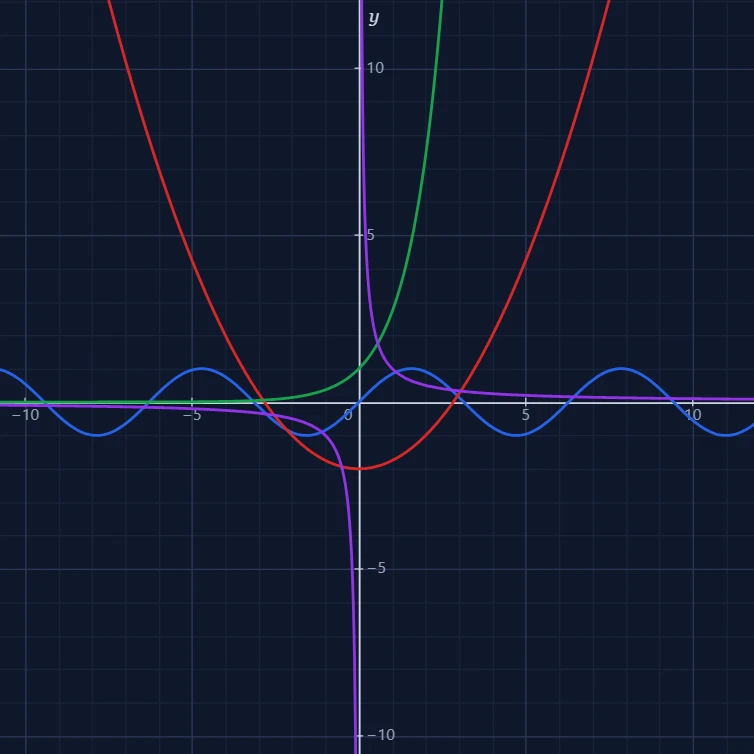
Що таке математична функція? Як система координат перетворює формулу на графік, як Рене Декарт поєднав алгебру й геометрію та які існують інші системи.
Compass and straightedge constructions explained
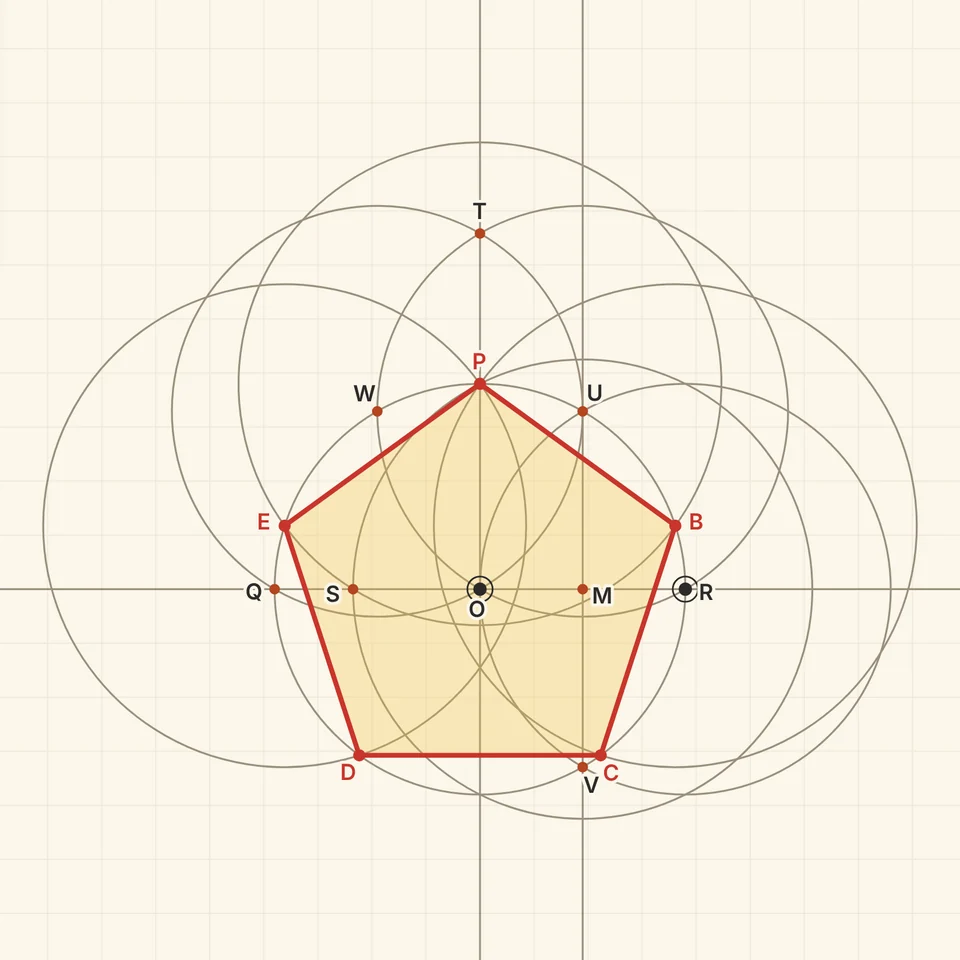
How geometry is done with only a compass and a straightedge: Euclid's postulates and the collapsing compass, the classic constructions of bisectors, perpendiculars, parallels and regular polygons, constructible lengths such as √2 and the golden ratio, Gauss's 17-gon, and why angle trisection, doubling the cube and squaring the circle are impossible.
Епіцикли Фур'є
Намалюйте будь-яку фігуру й подивіться, як її обводять кола, що обертаються: епіцикли Фур'є онлайн. Виберіть серце, зірку чи метелика, введіть слово, задайте, скільки кіл обертається, і збережіть PNG або SVG.
Готові спробувати?
Відкрийте PictorX у браузері — без встановлення і без кредитної картки.
Open the unit circle app